Introduction: A Masterpiece in the Valley of the Kings
Deep within the Rose Valley of central Bulgaria lies a vast network of burial mounds that once belonged to the Odrysian Kingdom—the most powerful tribal union of ancient Thrace. Among these thousands of tumuli, the Thracian Tomb of Kazanlak, discovered accidentally by soldiers digging a trench in 1944, stands as a supreme archaeological jewel. Constructed around the early 3rd century BC, this brickwork beehive tomb is celebrated not for its structural scale, but for the breathtaking preservation of its interior walls.
The Kazanlak frescoes represent the world's finest, most intact examples of Hellenistic mural painting outside of Greece itself. At a time when Thracian elite culture was heavily influenced by Greek artistic trends, an anonymous master painter covered the narrow walls of the tomb with a vivid, emotional narrative of death, status, and the afterlife. Because Thracian society left behind no written literature, these paintings serve as an invaluable visual codex, illuminating the spiritual beliefs, courtly rituals, and military traditions of a civilization that long rivaled the power of Macedonia and Rome.
1. Architectural Anatomy: The Beehive Design
The tomb was engineered using a traditional Thracian architectural form known as a tholos, designed to mimic both a sacred cave and a cosmic womb. It is divided into three distinct structural chambers, each painted to guide the deceased ruler on their journey to the ancestral realm.
The Dromos (Entrance Passage): A narrow, rectangular corridor built of stone and brick. The walls here are painted with friezes depicting a clash of cavalry and infantry, representing the military exploits and earthly battles of the buried chieftain.
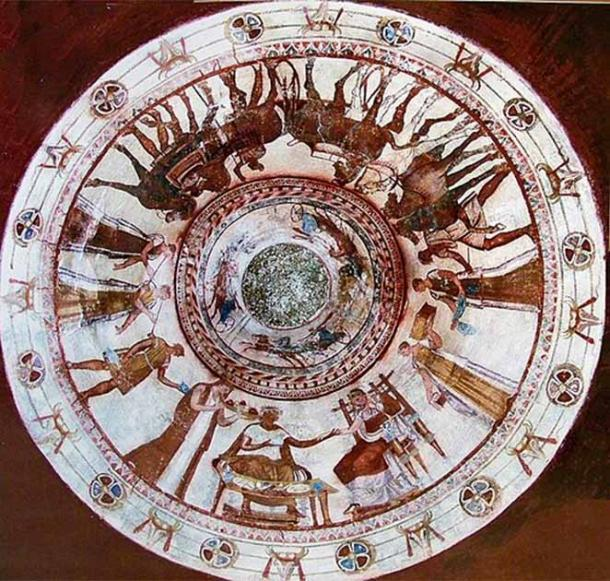
The Tholos (Burial Chamber): The heart of the monument—a circular, beehive-shaped room topped with a corbeled brick dome. The narrowness of the chamber (less than 9 feet in diameter) forces the viewer to look upward, where the grandest frescoes encircle the conical ceiling.
The Construction Material: Unlike many Greek tombs carved directly into bedrock, Kazanlak was built using meticulously shaped, kiln-fired clay bricks bound with mortar, showcasing a highly developed local tradition of brick engineering.
2. The Main Frieze: The Funeral Banquet
The most famous composition in the entire tomb occupies the widest section of the dome in the burial chamber. It depicts a solemn, ritualistic funeral feast (perideipnon) celebrating the deceased ruler’s transition into a deified ancestor.
The Enthroned Chieftain: The central figure is the Thracian ruler, wearing a golden laurel wreath. He sits before a table laden with food, holding a silver phiale (libation bowl). He does not look at the viewer; his gaze is fixed on his wife, projecting an aura of quiet, melancholic majesty.
The Gesture of Farewell: The emotional anchor of the entire tomb is the tender clasping of hands between the chieftain and his seated queen. Their wrists overlap in a delicate, expressive gesture of eternal separation and enduring connection across the threshold of death.
The Courtly Procession: Flanking the royal couple is a grand retinue of servants and musicians. To the left, a tall woman in a long cloak approaches holding a tray of pomegranates—a classic ancient symbol of fertility and the underworld. To the right, two long-trumpeted musicians sound a mournful fanfare to signal the start of the funerary rites.
3. The Chariot Frieze: The Celestial Race
Directly above the funeral banquet, at the very apex of the conical dome where the brickwork narrows to a small capstone, the painter executed a secondary, high-velocity frieze.
The Three Chariots: This upper ring depicts three separate war-chariots, each pulled by a team of four frantic, rearing horses, racing at full speed around the eye of the dome.
The Ritual Games: This scene visualizes the funeral games (agon), a core Thracian custom described by the Greek historian Herodotus. Upon the death of a noble, Thracians staged intense athletic and equestrian competitions near the burial mound to honor the bravery and vitality of the deceased.
The Illusion of Movement: The artist utilized the curved, tapering architecture of the dome to enhance the scene's kinetic energy. As a viewer stands below and turns their head, the horses appear to be in perpetual, circular motion around the top of the tomb.
4. Style, Color Chemistry, and Hellenistic Synthesis
The frescoes of Kazanlak represent a brilliant synthesis of local Thracian subjects executed using advanced, cutting-edge Hellenistic painting techniques.
The Painting Technique: The murals were executed using a sophisticated hybrid of buon fresco (painting on wet plaster) and fresco secco (adding details after the plaster dried). This allowed the artist to map out bold, sweeping compositions while maintaining the precision needed for fine jewelry and horse reins.
The Color Palette: The artist worked with a refined, organic palette dominated by four primary colors: white (lime), black (carbon), red (ochre), and yellow (goethite). The backgrounds are painted an uncharacteristic, striking pompeiian red, which makes the human figures pop forward in dramatic contrast.
The Mastery of Chiaroscuro: Moving away from the flat, two-dimensional silhouettes of the earlier Classical era, the Kazanlak master used skiagraphia (shading techniques). By blending tones on clothing folds, horse musculature, and facial features, the painter created genuine volume, depth, and psychological realism.
5. Legacy and UNESCO Preservation
The Thracian Tomb of Kazanlak is far more than a local burial vault; it is a monumental bridge in the history of art. Because almost all the grand palaces and public murals of the great Hellenistic capitals—like Alexandria, Antioch, and Pella—have been utterly destroyed, this hidden tomb in Bulgaria preserves a rare echo of the high-classical painting traditions that eventually laid the groundwork for Roman and Renaissance art.
Recognizing its unparalleled cultural value, UNESCO declared the tomb a World Heritage Site in 1979. To protect the fragile, 2,300-year-old plaster from the heat, moisture, and carbon dioxide introduced by human breath, the original tomb is sealed inside a climate-controlled vault, accessible only to specialized researchers. However, an exact, brick-for-brick replica was constructed immediately adjacent to the site. This replica allows modern travelers to step inside the exact visual landscape of the Thracian elite, experiencing the same tender hand-clasp and thundering chariot race that a grieving court commissioned at the dawn of the Hellenistic age.