Introduction: The Escape to the North Atlantic
In the late 9th century AD, a massive migration wave rippled out of Scandinavia. While some Norse fleets turned toward the rich shores of Anglo-Saxon England and mainland Europe to raid, a distinct contingent of seafaring pioneers pointed their longships northwest into the uncharted, open waters of the North Atlantic. Their destination was Iceland—a volcanic island of glaciers, geysers, and fertile coastal valleys.
The settlement of Iceland (Landnám) represents a unique chapter in the Viking Age. Unlike the military conquests of Ireland or Normandy, Iceland was an empty landscape with no indigenous population to conquer or assimilate. Instead, it became a blank canvas for Norse society. Fleeing the political centralization and heavy taxes of King Harald Fairhair in Norway, an independent coalition of chieftains engineered a brand-new, stateless society, establishing the oldest surviving parliament in the world on a foundation of law, agriculture, and maritime isolation.
1. Accidental Landfalls: The Pioneers of Exploration
Before intentional colonization could begin, Iceland had to be mapped through a series of accidental, harrowing landfalls recorded in the Landnámabók (The Book of Settlements).
Naddodd the Viking (c. 860 AD): The first Norseman to sight the island was a Norwegian raider who was blown wildly off course while sailing to the Faroe Islands. He landed on the eastern coast, found no sign of human habitation, and named the territory Snæland (Snowland) before leaving.
Garðar Svavarsson (c. 870 AD): A Swedish explorer who intentionally sought out Naddodd's discovery. He successfully circumnavigated the landmass, proving it was a large island, and overwintered on the northern coast at Húsavík.
Flóki Vilgerðarson (c. 870 AD): The first Norseman to intentionally sail to the island with the goal of settlement. Lacking navigational charts, he famously released three ravens to guide his path toward land. After a brutal winter killed his livestock, he noted the fjords choked with drift ice and renamed the country Ísland (Iceland)—a grim name intended to deter future rivals.
2. The Great Migration: The Settlement Phase (874 – 930 AD)
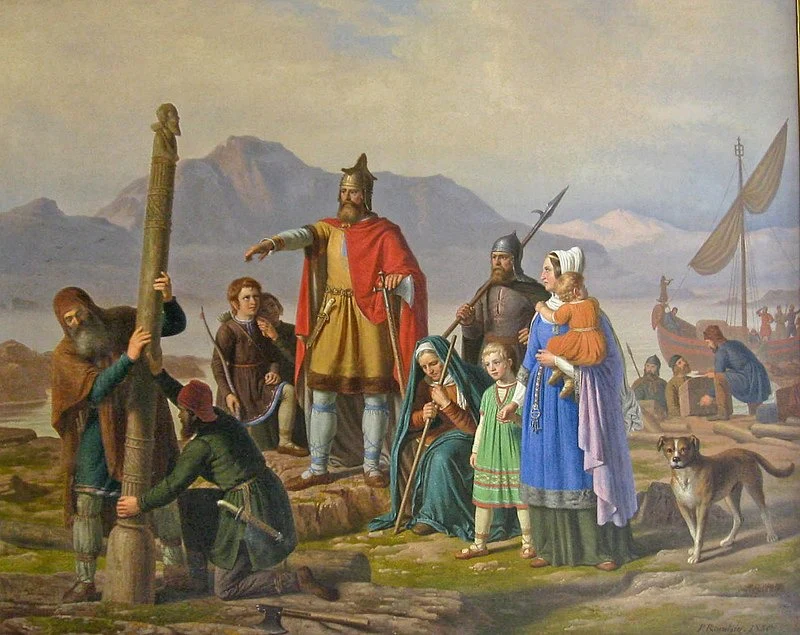
The true colonization of Iceland began in 874 AD with the arrival of Ingólfr Arnarson, a Norwegian chieftain fleeing a blood feud.
The Sacred Pillars: As his longship neared the coast, Ingólfr cast his öndvegissúlur (wooden high-seat pillars carved with images of the Norse gods) into the sea, vowing to settle wherever the waves washed them ashore. His thralls spent three years searching the coastline, finally locating the pillars on a smoky, geothermal bay in the southwest. Ingólfr named the site Reykjavík ("Smoky Bay"), which remains Iceland's capital today.
The Push Factor: Back in Norway, King Harald Fairhair was violently consolidating the fractured petty kingdoms under a single, absolute crown. Fiercely independent chieftains refused to surrender their ancestral lands and submit to royal taxation. They packed their families, wealth, and livestock onto ships and headed to Iceland to preserve their traditional autonomy.
The Celtic Infusion: DNA studies and historical texts confirm that the Viking migration was not entirely Scandinavian. On their way to Iceland, Norse chieftains raided and traded in Scotland and Ireland, bringing thousands of Celtic women and enslaved people with them. This created a distinct Hiberno-Norse cultural blend at the very foundation of Icelandic society.
3. The Knárr: The Heavy Transport of the Atlantic
While the iconic, slender warship (langskip) was used for coastal raiding, the colonization of Iceland was entirely dependent on a different class of vessel: the Knárr (Oceanic Merchant Ship).
The Structural Design: The knárr was shorter, wider, and deeper than a warship. It relied almost entirely on a massive, heavy square sail rather than oarsmen. This deep hull created a sprawling, open cargo hold in the center of the ship.
The Logistical Cargo: To survive in Iceland, a knárr had to act as a floating homestead. A single ship could carry up to 30 people alongside cattle, sheep, pigs, horses, barrels of freshwater, grain, tools, and timber.
The Open-Ocean Transit: Navigating the 600 miles of open, unpredictable Atlantic water between Norway and Iceland without a compass was a staggering feat. Sailors relied on "dead reckoning"—utilizing the flight paths of migrating birds, whale behavior, ocean swells, and solar navigation tools like the sunstone (sólarsteinn) to maintain their latitude.
4. The Althing: Engineering a Stateless Legal Republic
By 930 AD, the prime coastal land was completely claimed, and Iceland’s population had ballooned to roughly 30,000 people. With no king, army, or executive government, the chieftains needed a system to resolve bloody property disputes and prevent total anarchy. Their solution was the Althing.
The General Assembly: Founded in 930 AD at Þingvellir (Thingvellir)—a dramatic rift valley where the North American and Eurasian tectonic plates tear apart—the Althing was an annual open-air assembly. Every summer, citizens from across the island gathered for two weeks to trade, arrange marriages, and settle legal disputes.
The Lawspeaker (Lögsögumaður): In a society without written books, the Lawspeaker was the supreme legal authority. He was required to memorize the entire complex body of Icelandic law and recite one-third of it from memory every year while standing atop the Lögberg (Law Rock).
The Chieftain Power (Goðorð): Local authority was held by 39 chieftains called Goðar. They did not rule over geographic territories, but over people; an ordinary farmer could choose to pledge his loyalty to any chieftain he wished, creating a highly competitive, fluid political ecosystem based on mutual dependence.
5. Environmental Adaptation and Collapse
The pristine landscape the Vikings discovered was highly fragile, forcing a radical shift in their traditional farming practices.
Forestry: Up to 40% of Iceland was originally covered in low birch forests and scrubland. Within a century of arrival, the Vikings clear-cut the forests for fuel, iron-smelting, and pastureland, causing catastrophic, permanent soil erosion.
Livestock: Early settlers brought pigs and heavy cattle, mimicking Norwegian farming models. The cold climate and eroded topsoil couldn't support cattle long-term, forcing the economy to shift entirely to hardy sheep, which provided both mutton and wool (vaðmál).
Architecture: Traditional Scandinavian longhouses required massive timber frames. Depleted of local forests, Icelanders adapted by inventing turf houses, utilizing thick blocks of volcanic soil and grass over minimal driftwood frames as natural insulation against the arctic winters.
6. The Literary Legacy: The Sagas
The unique political isolation and legalistic nature of Icelandic society birthed one of the greatest literary flowerings of the medieval world: the Icelandic Sagas.
Written down in the 12th and 13th centuries, these prose narratives capture the gritty, realistic history of the early settlement era. Unlike the grand, idealized myths of European chivalry, sagas like Njál's Saga or Egil's Saga focus on complex legal feuds, farm boundary disputes, marital breakdowns, and the psychological toll of the blood feud. They serve as an unparalleled sociological window, documenting exactly how a group of fiercely independent pagan sailors transformed an uninhabited volcanic rock into a highly organized, literate, and enduring North Atlantic republic.