Introduction: Woven Codices of the Desert
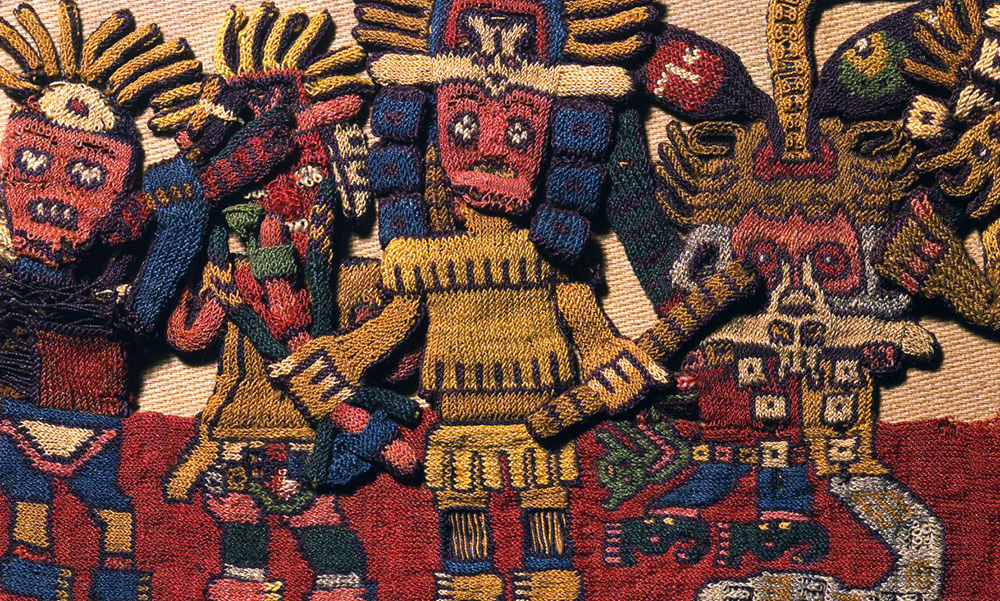
Along the hyper-arid, windswept coastline of the Paracas Peninsula in Peru, a society flourished between 800 BC and 100 BC that achieved what many textile historians consider the pinnacle of pre-Columbian textile art. The Paracas culture did not leave behind a written alphabet; instead, they recorded their cosmology, social hierarchies, and complex spiritual transformations in thousands of exquisite, intricately woven fabrics.
Most of these textiles survived intact for over two millennia because they were buried in deep, subterranean shaft tombs within the Paracas Necropolis. Bundled around the mummified remains of the elite, these textiles served as sacred wrappings for the afterlife. Beyond their vivid colors, the hallmark of Paracas textiles is their sophisticated use of geometric abstraction—a deliberate mathematical language that converted the natural world into a grid of symbolic code.
1. The Geometry of the Canvas: Linear vs. Block Color Styles
Paracas artisans utilized two primary design styles to structure their textiles, each dictating how geometric space was divided on the cloth.
The Linear Style: Dominant in the early phases, this technique relied heavily on straight, rigid lines. Figures were broken down into sharp angles, diamonds, and stepped patterns. The geometric constraints meant that human, avian, and feline figures were highly abstract, often sharing limbs or merging into one another.
The Block Color Style: Developing later, this style allowed for more fluid, curved outlines, but the overall composition remained strictly geometric. Figures were repeated across the fabric in a precise, checkerboard or diagonal grid pattern, with solid blocks of contrasting color filling the shapes.
2. The Mathematics of Iteration and Symmetry
The geometric patterns on Paracas mantles (large shawls) were not random decorations; they followed rigorous structural rules of symmetry, inversion, and rotation.
[ Normal Figure ]     ──►     [ Inverted Figure ]
       ▲                              │
       │                              ▼
[ Rotated 180° ]     ◄──     [ Color-Swapped ]
Translational Symmetry: A single icon—such as a falcon or a shaman—was repeated across the entire surface of the garment in flawless, equidistant rows.
180-Degree Rotation: To create visual rhythm, the weavers frequently inverted alternate figures. An upright figure would be placed directly next to an identical figure flipped completely upside down.
Color Serialization: The weavers used complex mathematical algorithms to shift color schemes. If a mantle used a palette of four colors (e.g., red, green, yellow, blue), the colors of the background, tunic, and eyes of the repeating figure would systematically rotate so that no two adjacent figures looked identical, despite having the exact same geometric shape.
3. The Sacred Menagerie: THe Three Tiers of Reality
The geometric motifs were highly stylized representations of the Paracas worldview, which divided the universe into three interacting realms: the sky, the earth, and the underworld.
The Oculate Being: The most prominent geometric figure in Paracas art is a supernatural entity with massive, concentric-circle eyes. Often depicted with a severed trophy head or a knife, this being represents a powerful deity associated with fertility, sacrifice, and the underworld.
Feline Motifs (The Jaguar/Puma): Earthly power was represented by the apex predators of the Andes and the Amazon. Jaguars were abstracted into stepped lines, with their whiskers, spots, and claws rendered as sharp triangles and repeating diamond patterns.
Avian Motifs (The Falcon/Condor): Representatives of the celestial realm, birds were geometrically distilled into sharp wings and hooked beaks. Often, shaman figures were woven with avian wings, visually symbolizing the spiritual flight undertaken during ritual trances induced by psychotropic plants like the San Pedro cactus.
4. Materials, Dye Chemistry, and Structural Mastery
The execution of such complex geometric patterns required an advanced understanding of material science and organic chemistry.
The Fiber Hybrid: Paracas textiles utilized a deliberate blend of two distinct fibers. The structural warp (the vertical structural threads) was typically made from locally grown coastal cotton, which provided tensile strength. The weft (the horizontal design threads) was spun from camelid wool (alpaca or vicuña) imported via trade routes from the high Andes. Camelid wool was softer and, crucially, held dyes far better than cotton.
The Dye Palette: Paracas artisans successfully isolated over 190 distinct hues from natural sources. They used madder root (Relbunium) for brilliant reds, cochineal insects for deep purples, indigo plants for blues, and various mineral mordants (like volcanic ash) to permanently fix the colors to the fiber.
The Stem-Stitch Technique: To create their crisp, geometric borders, artists used an advanced embroidery technique called the stem-stitch. By packing thousands of microscopic stitches into every square inch, they created a raised, carpet-like texture that made the geometric figures pop out in sharp relief against the flat background cloth.
5. Architectural Alignment: Textiles as Ritual Grids
AttributeParacas Architectural SpaceParacas Textile SpaceOrganizational PrincipleStepped platforms and plazas oriented to solar solsticesGrid-based layouts using warp and weft coordinatesFunctionGathering spaces for ritual dance and sacrificeWearable maps worn during civic-religious performancesSymmetryDualism (Upper/Lower plazas)Dualism (Color-swapping, inverted motifs)
6. Legacy and Archaeological Significance
The geometric patterns of the Paracas textiles represent a profound intellectual achievement. Rather than trying to capture the world as it looked visually, the Paracas people used abstraction to capture the underlying, invisible laws of balance and duality that they believed governed the cosmos.
When the Paracas culture transitioned into the Nazca culture around 100 BC, this geometric design language left the looms and expanded onto the landscape. The exact same mathematical principles of symmetry, iteration, and animal abstraction found on the Paracas burial mantles were enlarged a thousandfold to create the world-famous Nazca Lines in the desert floor, proving that for ancient Peruvians, geometry was the ultimate bridge between humanity and the divine.