Located in the northern geographic core of modern Mexico City, the archaeological site of Tlatelolco stands as one of the most poignant, historically dense, and tragic locations in all of Mexico. Founded in 1337 CE by a dissident faction of the Mexica people just years after the establishment of Tenochtitlan, Tlatelolco developed as a sovereign twin city on an adjacent island within the vast waters of Lake Texcoco. While Tenochtitlan focused its energies on military dominance and imperial administration, Tlatelolco transformed into the undisputed commercial and economic engine of the Mesoamerican world, hosting a legendary marketplace that astounded the arriving Spanish conquistadors with its scale, order, and sheer volume of goods.
The heart of Tlatelolco was its massive public market (tianguis), which operated daily and drew over sixty thousand buyers and sellers from across the Aztec Empire. The market was managed with flawless bureaucratic precision by a dedicated guild of elite long-distance merchants known as the pochteca. The pochteca acted as both international traders and imperial spies for the Aztec triple alliance, traveling deep into the tropical lowlands to bring back exotic luxury goods such as green jade, brilliant quetzal feathers, liquid cacao beans—which doubled as currency—and precious jaguar pelts. The market was organized into strict, orderly rows, with judges permanently stationed in a nearby pavilion to resolve commercial disputes instantly and punish fraudulent merchants who altered weights or sold counterfeit goods.
When Bernal Díaz del Castillo, a soldier in Hernán Cortés’s army, first beheld the market of Tlatelolco in 1519, he wrote with absolute bewilderment that the sheer murmur and hum of the buying and selling could be heard miles away. He noted that the marketplace was twice the size of the grandest squares in Salamanca or Constantinople, offering everything from gold, copper, and obsidian blades to medicinal herbs, domestic turkeys, and massive piles of woven cotton clothing. Tlatelolco was a true monument to the economic integration of Mesoamerica, proving that commerce could unite highly disparate cultures across thousands of kilometers of rugged terrain.
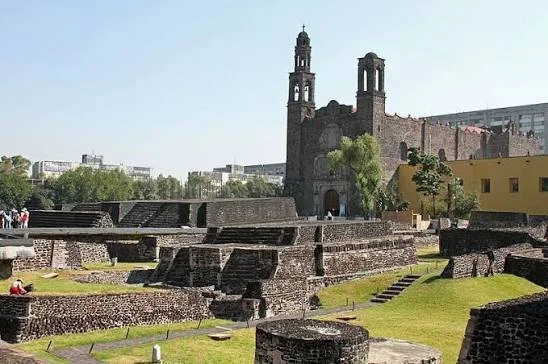
Architecturally, the ceremonial center of Tlatelolco mirrors that of its twin sister Tenochtitlan. It is dominated by a grand, stepped Dual Pyramid Temple, built in successive layers over two centuries. Like the Templo Mayor, this massive volcanic stone structure supported two shrines at its peak: one dedicated to Tlaloc, the god of rain, and the other to Huitzilopochtli, the god of war. Surrounding this central pyramid are several fascinating secondary structures, including the Coatepantli (Wall of Serpents), an elegant stone barrier that demarcated the sacred ceremonial space from the secular market, and the Momztli, a ritual platform adorned with relief carvings of human skulls, highlighting the intense sacrificial culture that underpinned the Aztec state.
Tlatelolco is also etched into history as the site of ultimate indigenous resistance and catastrophic tragedy. On August 13, 1521, after a brutal, eighty-day siege led by Hernán Cortés and his thousands of indigenous Tlaxcalan allies, Tlatelolco became the final stand for the Aztec forces under the command of the young Emperor Cuauhtémoc. The city was systematically dismantled stone by stone, and over forty thousand Mexica citizens were slaughtered in the final hours of combat. A moving stone plague at the site today commemorates this horrific event with the words: "It was neither victory nor defeat. It was the painful birth of the mestizo nation that is the Mexico of today."
Today, Tlatelolco forms the core of the world-famous Plaza de las Tres Culturas (Plaza of the Three Cultures), an architectural space where three distinct eras of Mexican history physically collide. Here, the pre-Columbian volcanic stone foundations of the Aztec market and temples stand side-by-side with the heavy, colonial stone Church of Santiago Tlatelolco—constructed using the very blocks of the destroyed dual pyramid—all of which are framed by the mid-twentieth-century modernist concrete skyscrapers designed by architect Mario Pani. Tlatelolco remains a powerful monument to survival, economic genius, and cultural synthesis, chronicling the complicated story of Mexico from its ancient imperial height to the modern day.