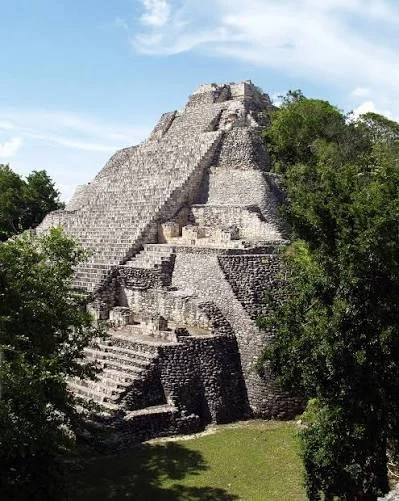
Located in the heart of the rugged Calakmul biosphere region in southern Campeche, Becán occupies a uniquely dramatic chapter in Mesoamerican history. Founded in the Late Preclassic period around 550 BCE and continuously occupied for well over a millennium, Becán stands as one of the definitive examples of defensive militarism within the Maya civilization. The site’s name, which translates in Yucatec Maya to "Ditch or Ravine Formed by Water," refers directly to its most famous and defining architectural feature: a massive, continuous defensive moat and earthen rampart system that completely encircles the city’s ceremonial and administrative core, transforming the site into a formidable prehistoric citadel.
For many decades, early twentieth-century Mayanists championed the romantic theory that Classic Maya cities were peaceful vacant ceremonial centers populated only by quiet priests. The discovery and intensive excavation of Becán profoundly dismantled this perspective, providing irrefutable physical evidence that warfare, territorial defense, and geopolitical conflict were endemic components of Classic Maya life. The defensive moat at Becán is a staggering feat of ancient labor. Measuring approximately two kilometers in circumference, the moat averages sixteen meters in width and cuts up to four meters deep into the natural limestone bedrock. The stone excavated from this massive trench was piled onto the inner side to create an elevated earthen rampart, topped by a defensive wooden palisade wall that effectively created a vertical barrier over eleven meters high.
To access the heavily fortified urban interior, visitors and defenders had to cross one of seven strategic stone causeways that bridged the moat. These land bridges were engineered to be easily defensible; they were narrow, forcing potential invaders into bottleneck formations where they could be easily targeted by defenders positioned high atop the rampart walls with spears, atlatl darts, and sling stones. Within this secure perimeter, the elite of Becán constructed an extremely dense, labyrinthine urban environment characterized by the Río Bec architectural style, which is defined by massive solid towers, false temple facades, and highly complex, multi-story palace complexes with internal staircases and vaulted chambers.
The architectural heart of Becán is Structure VIII, a towering building that dominates the Central Plaza. This building features twin solid stone towers that mimic the steep, unclimbable pyramids of Tikal, a stylistic choice intended to project cosmic power and architectural prestige. On the western side of the site lies Structure IX, the tallest pyramid at Becán, which rises over thirty-two meters into the jungle canopy. This structure served as the primary religious stage for the city’s rulers, offering an unobstructed view of the surrounding landscape and allowing sentries to spot approaching enemy armies kilometers away across the dense forest.
The interior of Becán's buildings reveals a highly sophisticated and protective urban planning strategy. Structure IV, for example, is a massive residential palace complex featuring a maze of interconnected rooms arranged around a private inner courtyard. The rooms are dark and cool, insulated by thick limestone walls that provided relief from the intense tropical heat. Many of these elite chambers contain stone benches that served as both beds and throne platforms, where rulers met with generals and ambassadors to negotiate alliances or plan military campaigns during the turbulent centuries of the Classic Maya collapse.
The intensive fortification of Becán suggests that the city was a critical geopolitical prize, likely serving as a strategic regional capital that controlled vital trade routes cutting across the base of the Yucatán Peninsula. The presence of Teotihuacán-style artifacts, including green obsidian projectile points and cylindrical tripod pottery vessels, indicates that Becán maintained deep, sometimes volatile connections with the militaristic empires of Central Mexico. As an enduring archaeological monument, Becán remains a stark reminder of the fragile balance between artistic brilliance and raw military survival, its deep moat standing as a silent testament to an era when the Maya built not just to honor the gods, but to survive the wrath of their neighbors.