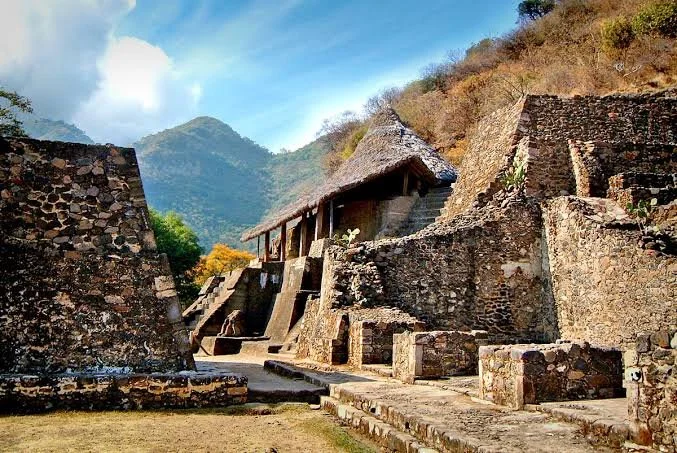
Perched dramatically on the steep, pine-forested slopes of the Mexican highlands in the State of Mexico, the archaeological site of Malinalco stands as an unparalleled triumph of Mesoamerican rock-cut architecture. Founded by the Matlatzinca people and later conquered and heavily fortified by the Mexica (Aztec) Empire under Emperor Ahuitzotl around 1501 CE, Malinalco—meaning "Place of Malinalxochitl" (the Aztec goddess of sorcery and grass)—served a highly specialized, elite state function. It was not a typical residential city, but rather a restricted, deeply sacred cliffside sanctuary and monastery designed specifically for the initiation of the empire’s elite military orders: the Eagle and Jaguar Warriors.
The crowning architectural jewel of Malinalco is Structure I, known locally as the Cuauhcalli, or the House of the Eagles. This building is a profound anomaly in Mesoamerican archaeology: it is a monolithic temple carved directly out of the living mountain cliff face, a technique reminiscent of Petra in Jordan or the Ellora Caves in India. Instead of assembling individual stone blocks, Aztec master sculptors meticulously chiseled away thousands of tons of solid volcanic basalt bedrock to hollow out a circular temple chamber, complete with its own integrated stairs, exterior sloping walls (talud-tablero), and highly detailed interior sculptures, all seamlessly emerging from a single piece of stone.
To enter the sacred precinct of the Cuauhcalli, an initiate had to pass through a doorway shaped like the gaping maw of a colossal earth serpent. The entrance features a beautifully carved, extended stone tongue that serves as a literal welcome mat, symbolizing that the warrior was stepping directly out of the physical world and into the womb of the earth goddess, Coatlicue. The circular design of the interior chamber was engineered to replicate a sacred cave, the traditional Mesoamerican locus of spiritual transformation, emergence, and communion with the supernatural forces of the underworld.
Inside the dark, rock-cut chamber, the artistic detail carved into the living rock is breathtaking. Arranged along a curved stone bench that lines the circular wall are three life-sized, high-relief sculptures: two majestic eagles and a fierce jaguar. The feathers of the eagles and the spots of the jaguar are meticulously etched into the stone. On the floor in the absolute center of the room is a third eagle sculpture, its back hollowed out slightly to serve as a cuauhxicalli, a sacred stone vessel used to receive the hearts and blood of sacrificed prisoners, which were offered to nourish the sun god Huitzilopochtli.
It was within this solemn, subterranean space that the most rigorous Aztec military transformations occurred. To attain the rank of an Eagle or Jaguar Warrior, candidates—typically the sons of nobility or exceptionally brave commoners—had to undergo days of intense fasting, sleep deprivation, sensory isolation, and ritual bloodletting inside the dark mountain. At the climax of the ceremony, the emperor himself would pierce the nasal septum of the warrior with an eagle claw or jaguar bone, inserting a precious jade or turquoise nose plug that legally marked them as elite military commanders, entitled to wear the feared animal skins and feathered suits into battle.
Surrounding the monolithic Cuauhcalli are several other fascinating structures built onto terraced platforms along the cliff face. Structure III features a unique interior mural painting that depicts the spirits of dead warriors floating amidst celestial clouds, while Structure IV holds a large circular platform where ritual gladiatorial combats were staged. Malinalco stands today as a stunning monument to the synthesis of nature and architecture, where the Aztec state literally carved its imperial ideology, martial devotion, and cosmic mythology directly into the permanent volcanic backbone of Mexico, ensuring that the strength of their elite warriors would remain forever fused to the earth itself.