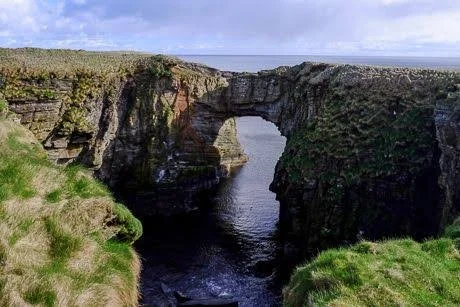
The broch at Torness on Stronsay belongs to one of the most distinctive architectural traditions of Iron Age northern Scotland. Brochs are massive, circular stone towers found primarily in northern Scotland and the Northern Isles, particularly Orkney and Shetland. Their impressive walls, complex internal architecture, and considerable labor requirements have made them some of the most recognizable archaeological monuments of Scotland's prehistoric landscape.
Torness is therefore significant not merely because it preserves the remains of an Iron Age building, but because it forms part of a much larger architectural and social tradition that transformed the northern Scottish landscape during the later prehistoric period.
What Was a Broch?
A broch is generally characterized by a circular plan and a thick double-skinned stone wall. The space between the inner and outer faces of the wall could contain galleries, chambers, stairways, and other architectural features.
Many brochs were originally extremely substantial structures. Their walls could reach several meters in thickness, while surviving examples demonstrate that some towers may originally have stood considerably higher than their present ruins.
The exact function of brochs remains debated.
Older interpretations often described them primarily as defensive towers. Modern archaeology generally takes a more cautious approach. Brochs could certainly provide protection, but their monumental architecture may also have expressed wealth, identity, status, authority, and community organization.
Construction of the Torness Broch
Constructing a broch required enormous quantities of stone.
Builders first had to select an appropriate location and gather suitable building material. Stone then needed to be transported, positioned, and carefully fitted into walls.
The double-wall construction characteristic of brochs provided both structural stability and internal space. Galleries and chambers within the wall could serve practical purposes while also reducing the amount of solid masonry required.
No mortar was necessary in many traditional dry-stone constructions. Stability depended upon careful stone placement, wall geometry, weight distribution, and skilled masonry.
The construction process would have required coordinated labor. This suggests that broch-building societies possessed mechanisms for organizing substantial communal projects.
Interior Organization
Broch interiors often contained a central open area surrounded by architectural features.
A hearth was typically an important component of Iron Age domestic architecture. Cooking, warmth, craft production, and social interaction could all take place around the central fire.
Stone-built cells within the walls provided additional space. Some may have been used for storage, while others may have served specialized functions.
Stairways built into the thickness of the wall are among the most remarkable features associated with brochs. In some examples, these staircases may have connected multiple levels.
Defense or Display?
The question of whether brochs were primarily defensive remains controversial.
Their thick walls certainly provided protection. However, a tower with monumental architecture could also function as a visible statement of social power.
Imagine approaching an island settlement and seeing a massive circular stone structure rising above the surrounding landscape. The monument would immediately communicate that its inhabitants possessed considerable resources and organizational capacity.
Architecture can therefore operate as a form of social communication.
The Torness broch should be understood within this broader framework rather than reduced to the label “fort.”
Brochs and Social Hierarchy
The construction of a broch may indicate that communities were capable of mobilizing labor and resources on a large scale.
This raises questions about leadership.
Who organized construction? Who controlled access to the building? Did particular families or social groups possess greater authority?
Archaeologists continue to debate these issues because the archaeological record rarely provides straightforward answers.
However, the sheer scale of broch architecture indicates that Iron Age communities were socially sophisticated.
Agriculture and Maritime Life
The Torness community would have existed within an island economy.
Agriculture probably supplied cereals and livestock, while the sea offered fish, shellfish, seabirds, and opportunities for transportation.
The combination of land and sea resources made Orkney particularly well suited to diversified economies.
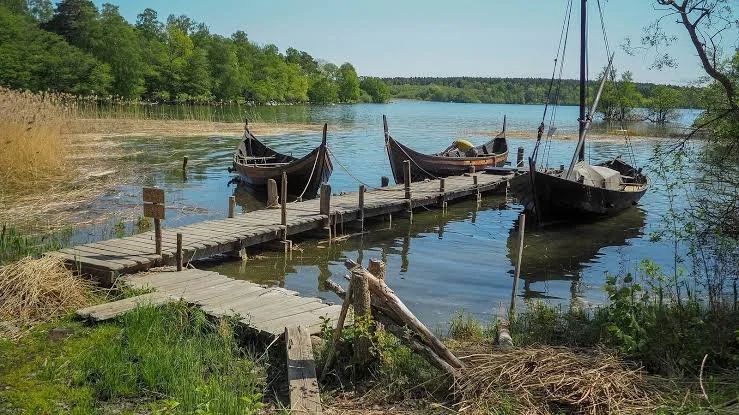
Boats also allowed communication with neighboring islands. The people of Torness therefore belonged to a maritime society in which the sea was not simply a barrier but a route.
Technology and Craft
Broch communities were not simply farmers.
Craft activities could include textile production, pottery manufacture, woodworking, bone working, and metalworking.
Iron tools improved the ability to process wood and agricultural products. Wool production required spinning and weaving, while animal bones could be turned into tools or ornaments.
Archaeological deposits associated with brochs can therefore reveal a surprisingly diverse range of activities.
The Broch in the Orkney Landscape
Torness should also be considered alongside other Iron Age monuments on Stronsay and the surrounding islands.
Orkney contains numerous brochs and other forms of substantial stone architecture. Their distribution demonstrates that monumental construction was widespread rather than restricted to one political center.
This raises the possibility that brochs served as focal points for local communities.
They may have functioned as residences, meeting places, storage centers, ceremonial spaces, defensive refuges, or combinations of these roles.
Later History
Like many prehistoric monuments, the broch did not necessarily become irrelevant after the Iron Age.
Ancient structures could remain visible and sometimes continue to influence settlement patterns. Later inhabitants might reuse stone, occupy nearby areas, or attach stories and traditions to earlier ruins.
The physical survival of a broch therefore extends its significance beyond the period in which it was constructed.
Archaeological Interpretation
Modern archaeological investigation combines excavation with landscape analysis, environmental science, radiocarbon dating, artifact studies, and architectural recording.
Rather than asking only “What was this building used for?”, archaeologists can ask broader questions:
How did its inhabitants obtain food?
What was their relationship with neighboring communities?
How did they organize labor?
What resources were available locally?
How did the settlement change over time?
These questions transform the broch from an isolated ruin into evidence for a complex society.
Conclusion
Torness Broch is an important representation of Orkney's Iron Age architectural heritage. Its massive stone construction demonstrates advanced dry-stone engineering, while its location reflects the agricultural and maritime economy of Stronsay.
Whether its primary role was defensive, domestic, social, ceremonial, or a combination of these functions, the broch clearly represented something more substantial than an ordinary house.
Its monumental character reflects a society capable of organizing labor, managing resources, and constructing buildings intended to endure.
Today, the surviving ruins provide a direct connection to an Iron Age world in which architecture, agriculture, maritime activity, community identity, and social authority were closely interconnected.