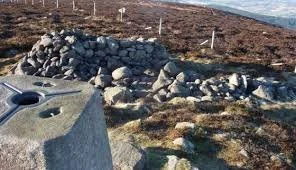
The cairn at Green Hill on Stronsay belongs to the long tradition of prehistoric monument construction that characterizes the Orkney Islands. Cairns are among the most enduring forms of prehistoric architecture in Britain. Constructed primarily from stone and earth, they were frequently associated with burial, remembrance, ceremonial activity, and the creation of enduring places within the landscape.
Although the appearance of a cairn may seem simple compared with a monumental stone circle or broch, these structures often represent complex social practices. Their construction required the deliberate collection and movement of stone, while their use could involve ceremonies involving multiple generations.
Cairns and the Prehistoric Landscape
Orkney possesses an exceptionally rich archaeological landscape. Neolithic chambered tombs, Bronze Age cairns, standing stones, stone circles, settlements, and later monuments exist across the islands.
A cairn was not simply a pile of stones.
Its shape, location, materials, and relationship with surrounding features could carry cultural meaning. The act of constructing a monument transformed an ordinary area into a socially significant place.
Green Hill should therefore be understood as part of a landscape in which communities repeatedly interacted with the physical environment.
Burial and Commemoration
Many prehistoric cairns were connected with the treatment of the dead.
Burial monuments provided places where communities could commemorate ancestors. The dead could become part of the landscape itself, allowing later generations to encounter physical reminders of their predecessors.
This practice had important social consequences.
Ancestors could provide communities with a sense of continuity. A monument established a connection between people living in the present and generations who had occupied the same landscape in the past.
Monument Construction
Building a cairn required organized labor.
Even when individual stones were relatively small, a substantial monument required many loads of material. Workers had to collect stones, transport them, and arrange them deliberately.
Construction may have occurred during communal events.
Such gatherings would have created opportunities for people from different households to cooperate, exchange information, share food, conduct ceremonies, and reinforce social relationships.
Monument building was therefore simultaneously an architectural and social activity.
Choosing the Location
The position of a prehistoric monument was rarely meaningless.
Builders may have selected prominent hills or ridges because they provided visibility. A monument placed on elevated ground could be seen from considerable distances.
Green Hill's location is therefore relevant to understanding how the monument interacted with the surrounding landscape.
Visibility could have helped create territorial associations, commemorate ancestors, or establish a recognizable landmark.
Materials and Meaning
Stone itself could possess cultural significance.
Different rocks have different colors, textures, shapes, and physical properties. Prehistoric communities may have recognized these characteristics even if their symbolic meanings are impossible to reconstruct today.
The act of selecting and arranging stones transformed natural material into architecture.
Later Alteration and Reuse
Prehistoric monuments frequently underwent modification.
A cairn could be enlarged, disturbed, reopened, or incorporated into later agricultural landscapes. Later communities sometimes removed stones for construction or field clearance.
These processes complicate archaeological interpretation because the monument visible today may represent multiple phases of activity.
Archaeological Evidence
Archaeologists study cairns using several types of evidence.
Excavation can reveal construction layers, burial deposits, hearths, artifacts, and episodes of rebuilding. Radiocarbon dating may establish chronological sequences when suitable organic material survives.
Landscape archaeology can determine how the monument relates to settlements, fields, standing stones, and other archaeological sites.
Modern non-invasive methods such as geophysical survey can sometimes reveal buried structures without extensive excavation.
The Social Meaning of Cairns
Cairns provide evidence for communities that possessed concepts of memory, place, and ancestry.
The construction of a permanent monument suggests that people cared about how locations would be experienced by future generations.
This is particularly significant in island societies. A prominent monument could become a fixed point within a changing landscape.
Stronsay's Archaeological Importance
Stronsay contains evidence from several prehistoric and historic periods. The presence of monuments such as cairns and later settlements demonstrates that the island's landscape was repeatedly occupied and reinterpreted.
Green Hill therefore contributes to a much longer story.
The same general landscape could contain memories of Neolithic communities, Bronze Age groups, Iron Age farmers, Norse settlers, and later inhabitants.
Conclusion
Green Hill's cairn represents more than an archaeological mound. It is evidence of prehistoric communities deliberately transforming their environment to commemorate people, establish places of significance, and create monuments capable of surviving beyond individual lifetimes.
Its archaeological value lies in its ability to connect architecture with social memory.
Through cairns such as Green Hill, archaeologists can investigate not only how prehistoric people built structures but also how they understood ancestry, landscape, community, and the passage of generations.