Brackish estuaries are environments where freshwater from rivers mixes with seawater, creating conditions that can vary considerably according to tides, rainfall, river discharge, and seasonal changes. These transitional landscapes have long attracted human settlement because they provide access to fish, transport routes, fertile wetlands, and sheltered anchorages. Archaeological remains in estuaries may include wooden boats, landing structures, fish traps, piles, tools, and other objects associated with everyday life. When wood survives underwater, it can provide valuable information about construction techniques, resource management, and the relationship between past communities and their aquatic environments.
Wood is an organic material that normally decomposes through the activity of fungi, bacteria, insects, and other organisms. Underwater conditions can slow some forms of decay, particularly when oxygen is limited and the surrounding sediment protects wood from physical disturbance. However, submersion does not guarantee preservation. The rate of deterioration depends on water temperature, oxygen availability, salinity, sediment composition, microbial activity, and the type of wood. Brackish environments are especially complex because these conditions may change over relatively short distances and fluctuate throughout the year.
The archaeological importance of preserved wood lies partly in the information it retains about how objects were made. Wooden structures can preserve tool marks, joints, fastening holes, shaping techniques, and evidence of repairs. Dendrochronology, which examines annual growth rings in suitable timber, may help determine when a tree was felled and sometimes identify the region in which it grew. When a timber retains enough growth rings and can be compared with an appropriate reference chronology, researchers may establish a precise felling date. Such evidence can help reconstruct the construction and maintenance of docks, bridges, boats, and other wooden installations.
The preservation of wooden structures in estuaries is closely connected to sedimentation. Fine mud and silt can gradually cover timbers, reducing exposure to oxygen and limiting physical damage. If sediment accumulates rapidly enough, it may protect a structure from later erosion. Conversely, changes in tidal currents or river channels can expose buried wood, allowing deterioration to accelerate. Archaeologists therefore examine the relationship between wooden remains and the surrounding sediment layers. Sediment cores, grain-size analysis, and environmental reconstruction can help establish whether a structure was originally built on a stable shoreline, in a shallow channel, or within a changing wetland.
Brackish water also creates chemical and biological challenges. Salinity influences the organisms that can colonize submerged wood, while variations in oxygen levels affect the processes responsible for decay. Some bacteria can degrade the structural components of wood even when conditions are unfavorable for many fungi. Marine wood-boring organisms may be active where salinity permits, although their distribution varies according to species and environmental conditions. As a result, two wooden objects recovered from the same estuary may show very different levels of preservation. Researchers must evaluate each specimen rather than assuming that all underwater wood has undergone the same process.
The archaeological study of estuarine wood can be organized around several types of evidence. A preserved boat fragment may reveal construction methods and patterns of repair, while wooden posts arranged along a shoreline could indicate a landing stage, fish trap, barrier, or building foundation. In some cases, the function of a structure remains uncertain because similar arrangements can serve different purposes. The spacing of posts, their orientation, associated artifacts, and the local hydrology all help narrow the possibilities. Comparisons with other securely identified structures are useful, but they must account for differences in environment and cultural practice.
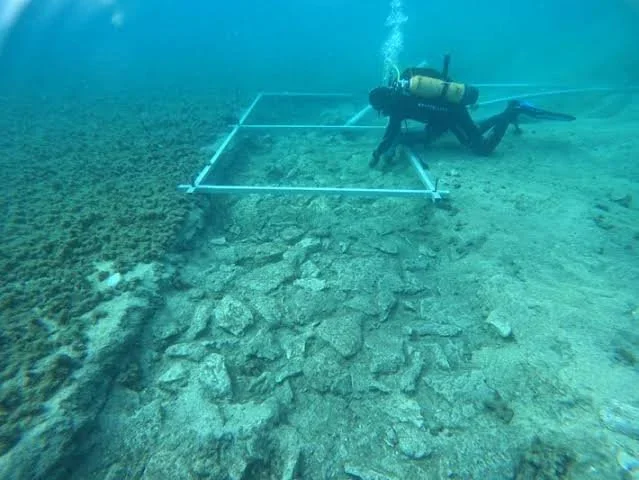
Excavating underwater wood requires specialized methods because recovery can alter the conditions that enabled its survival. Waterlogged timber may contain substantial moisture and have weakened internal structures. If it dries too quickly after excavation, the wood can shrink, crack, warp, or collapse. Archaeological teams therefore document the structure in place, record its dimensions and orientation, and develop conservation plans before removal whenever possible. Some objects can be studied underwater without excavation, while others require controlled recovery to protect them from damage caused by currents, construction, or environmental change.
Conservation continues after the wood has been recovered. Waterlogged timber often requires gradual treatment to replace or stabilize the water within its structure before it can be safely dried. The appropriate method depends on the object's size, condition, composition, and intended display or storage environment. Long-term preservation also requires stable humidity, temperature, and handling conditions. Conservation records are essential because treatment can affect the physical and chemical properties of the specimen, influencing future analysis. Samples intended for dating or chemical investigation should be selected and documented carefully so that conservation procedures do not compromise the research.
Estuarine archaeological sites can also preserve evidence of environmental change. Wood from boats and structures may be associated with pollen, seeds, shells, microfossils, and sedimentary deposits that help reconstruct past vegetation and water conditions. These records can reveal whether a shoreline was once more exposed, sheltered, freshwater-dominated, or influenced by tidal movement. Such information is valuable for understanding how communities adapted to changing coastlines, floods, and shifts in aquatic resources. Nevertheless, environmental interpretations require multiple lines of evidence because no single sediment or biological indicator provides a complete reconstruction.
The study of underwater wood in brackish estuaries demonstrates the close relationship between archaeological preservation and environmental conditions. Waterlogged timbers can preserve evidence of craft skills, transport, fishing, construction, and changing settlement patterns that would otherwise disappear. By combining underwater survey, wood identification, dendrochronology, sediment analysis, and conservation science, researchers can reconstruct both the human activities that produced these remains and the environmental processes that preserved them. These investigations are particularly important because estuarine landscapes continue to change, placing many submerged archaeological sites at risk from erosion, dredging, development, and rising sea levels.