Introduction
Located in northeastern Louisiana, Watson Brake is the oldest known large-scale mound complex in North America. Constructed around 3500 BCE, approximately 5,400 years ago, it predates both Poverty Point and many of the world's earliest monumental sites. Built by Archaic-period hunter-gatherers, Watson Brake overturned long-held archaeological beliefs that only settled agricultural societies could organize the construction of monumental earthworks. The discovery of this ancient site demonstrated that Indigenous communities in North America possessed sophisticated engineering skills and social organization thousands of years before farming became widespread.
Site Layout and Construction
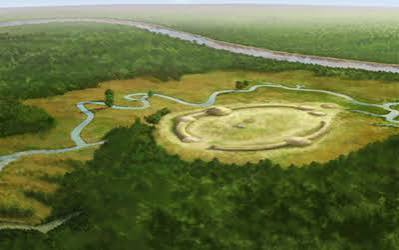
Watson Brake consists of eleven earthen mounds connected by a network of low ridges that form an irregular oval approximately 280 meters (920 feet) across. Rather than being isolated mounds, the connected layout created a unified ceremonial complex overlooking an ancient river channel.
The mounds were constructed gradually over several centuries using basket loads of locally gathered soil, clay, and sediment. Archaeological excavations reveal multiple construction phases, indicating that the site remained an important gathering place for generations. The builders periodically enlarged and reshaped the mounds, reflecting continuous community involvement in maintaining the sacred landscape.
Community Life
Unlike later mound-building cultures that relied heavily on agriculture, the inhabitants of Watson Brake survived through hunting, fishing, and gathering wild plants. The nearby wetlands provided abundant fish, shellfish, turtles, birds, and mammals, supporting seasonal occupations throughout the year.
The construction of the mound complex suggests that dispersed groups periodically assembled for ceremonies, trade, social gatherings, and communal labor. These events strengthened social relationships while reinforcing shared cultural traditions among neighboring communities.
Archaeological Importance
Watson Brake fundamentally changed archaeological understanding of North American prehistory. It proved that monumental construction did not depend upon farming or centralized political systems. Instead, hunter-gatherer societies demonstrated remarkable cooperation, engineering ability, and long-term planning. The site's age places it among the earliest known examples of monumental earthwork construction anywhere in the world.
Conclusion
Watson Brake represents the earliest known tradition of mound building in North America. Its interconnected earthworks reveal that prehistoric hunter-gatherers possessed the organizational skills, engineering knowledge, and social cooperation needed to construct monumental ceremonial landscapes more than 5,400 years ago, laying the foundation for later mound-building cultures throughout the Mississippi Valley.