Ancient Chinese Technology and Inventions That Changed The World

Ancient China is often lauded for its contributions to the advancement of arts, culture, and philosophy. However, its remarkable innovations in technology have left an indelible mark on the world, shaping the landscape of modern civilization in more ways than one. These groundbreaking inventions, developed hundreds, if not thousands, of years ago, continue to influence our lives to this day. Let's explore some of the most significant ancient Chinese technologies and inventions that changed the world.

1. Paper and Papermaking

Invented around the 2nd century BC during the Han Dynasty, paper has arguably been one of the most transformative Chinese inventions. The traditional method involved macerating plant fibers such as mulberry bark or hemp in water, followed by beating it into a slurry and then spreading this mixture on a flat piece of cloth to dry. Once dried, the resulting sheet could be used for writing, painting, and later printing.

This remarkable innovation not only revolutionized communication and record-keeping in ancient China but also paved the way for the proliferation of literature, arts, and science worldwide after it spread along the Silk Road to the Middle East, Africa, and Europe.

2. Gunpowder

Gunpowder, composed of sulfur, charcoal, and potassium nitrate, was a Chinese invention of the Tang Dynasty around the 9th century. Originally conceived for medicinal and mystical purposes, it wasn't long before its explosive properties were harnessed for military use.

The invention of gunpowder marked the advent of a new era in warfare, leading to the development of explosives, firearms, and eventually artillery. Its use greatly influenced the strategies and outcomes of battles, significantly altering the trajectory of human history.

3. Printing

The Chinese invention of woodblock printing during the Tang Dynasty (around the 7th century) and movable type printing during the Song Dynasty (around the 11th century) revolutionized the dissemination of knowledge.

These printing techniques made it possible to produce books, newspapers, and other printed materials in large quantities, promoting literacy and enabling the wide spread of ideas, philosophies, and information. Printing played a crucial role in cultural, scientific, and political revolutions throughout the world.

4. The Compass

Another significant Chinese invention was the compass, invented during the Han Dynasty (around the 2nd century BC). Initially, it was used for divination, fortune-telling, and geomancy. By the Song Dynasty (960-1279), it was being employed for navigation at sea.

The compass dramatically enhanced maritime exploration and trade, making long voyages across the oceans more precise and safer. This navigational tool was instrumental in the Age of Exploration, opening up the world to global trade and interaction.

5. Silk

While silk is a natural material produced by silkworms, the technology of sericulture – the cultivation of silkworms for the production of silk – was a closely guarded secret in ancient China. Dating back to around 3,000 BC, the Silk Road eventually spread this luxurious fabric and the knowledge of its production across Asia and into Europe.

The influence of silk extended beyond fashion. Its trade had profound effects on economies and diplomacy, fostering cross-cultural exchanges between East and West.

6. Porcelain

Known in the West as 'China,' porcelain was another significant Chinese invention. Made by heating certain types of clay to high temperatures, porcelain was valued for its durability, thinness, and beauty.

Originating in the Eastern Han Dynasty (25-220 AD), Chinese porcelain was highly prized around the world, contributing to international trade and cultural exchange. It has also significantly influenced global dining and tea-drinking customs.

In conclusion, these inventions from ancient China have not only transformed the technological landscape but also shaped the course of human history. Their impact extends beyond the realms of science and technology, influencing economics, culture, and society on a global scale. The legacy of these remarkable ancient Chinese inventions is a testament to the ingenuity and creativity of this civilization, which continues to inspire us today.

The Greatest Knight That Ever Lived: William Marshal

When William Marshal died in 1219, he was the Earl of Pembroke, and the regent for the young Henry III, after defeated a great rebellion of English lords and thrown back a devastating invasion by the French. Archbishop Stephen Langton called him “the greatest knight in the world.” His talent as a knight, on the battlefield and as a tournament champion, won him renown and riches through hundreds of victories. For 51 years he loyally served King Henry II, his wife Eleanor of Aquitaine, their sons Henry the Young King, Richard the Lionheart, King John, and their grandson Henry III.

But was he really the greatest knight who ever lived? This is the incredible life story of William Marshal.

Do the ancient stone walls of Saksaywaman in Peru contain hidden communication?

Lying on the northern outskirts of the city of Cusco in Peru, lies the remarkable walled complex of Saksaywaman (Sacsayhuaman), believed to have been built by the Inca. The site is famous for its remarkable large dry stone walls with boulders carefully cut to fit together tightly without mortar, displaying a precision of fitting that is unmatched in the Americas. This, combined with the variety of interlocking shapes, and the way the walls lean inward has puzzled scientists for decades. But there is another puzzle hidden in the stones of Saksaywaman – the angles of the stones, according to researcher Dr Derek Cunningham, correspond to astronomical alignments.

Dr Cunningham, author of ‘ The Long Journey: 400,000 Years of Stone Age Science’ , has put forward a theory that ancient civilizations developed writing from a very archaic geometrical form that is based on the study of the motion of the moon and the sun. According to his hypothesis, astronomical values considered central to the prediction of eclipses, are converted into angular values. In total, there are approximately 9 standard values which Dr Cunningham has identified in a large number of ancient drawings, with a small number of secondary values that are occasionally seen in regional art. Some examples, include the Stonehenge lozenge , the Kharga Oasis Spider , and religious statues from Cyprus.

Now he has discovered the same values are present in the construction of the Saksaywaman stone wall.

The most important of these astronomical values is the sidereal month, which is drawn in early astronomical texts as an angular value at either 13.66 or 27.32 degrees to represent the half and full month values. After the sidereal month value is known it is then a simple matter for astronomers to calculate that the earth is moving approximately 1 degree per day around the sun, and through more careful observations to deduce there is an eclipse season every 6.511 draconic months, this being a time period a time period equivalent to 6 synodic months. Other parameters important for predicting eclipses are the 5.1 degree angle of inclination of the moon’s orbit, and the 9.3/18.6 year lunar nutation cycle. Finally a value of 11 degrees is found on many early Stone Age artefacts, which corresponds to the 11 day difference between the lunar and solar year.

The astronomical values are also represented in the layout of the walls when viewed from above.

Despite the theory being developed only recently, to date many sites now show a striking ability to align to the exact same angular values. This includes the causeways located in front of the Great Pyramids of Giza, as well as the lines making up the body of the Atacama Giant. As Dr Cunningham notes, it is impossible to yet verify that the theory is correct, because many images of important artefacts are distorted during uploading to the internet, and satellite images cannot replace direct ground studies, but so far the results are incredibly consistent, and can even be seen in artifacts dating back tens of thousands of years.

“The potential of the idea to explain some things about so many sites from the pyramids of Egypt to the Atacama Giant in Chile is obviously very controversial, and it should be,” said Dr Cunningham in an article on Popular Archaeology . “But if correct, it could rewrite some aspects of our understanding of not only the Stone Age but also world history. If, on the other hand, scholars prove this specific astronomical theory wrong, then we can move on, knowing that it has been sufficiently tested. What is most intriguing is that a complete new window may have been opened into the past."

Source: https://www.ancient-origins.net/news-histo...

A 2,000 year-old fast-food joint discovered by archaeologists in Pompeii

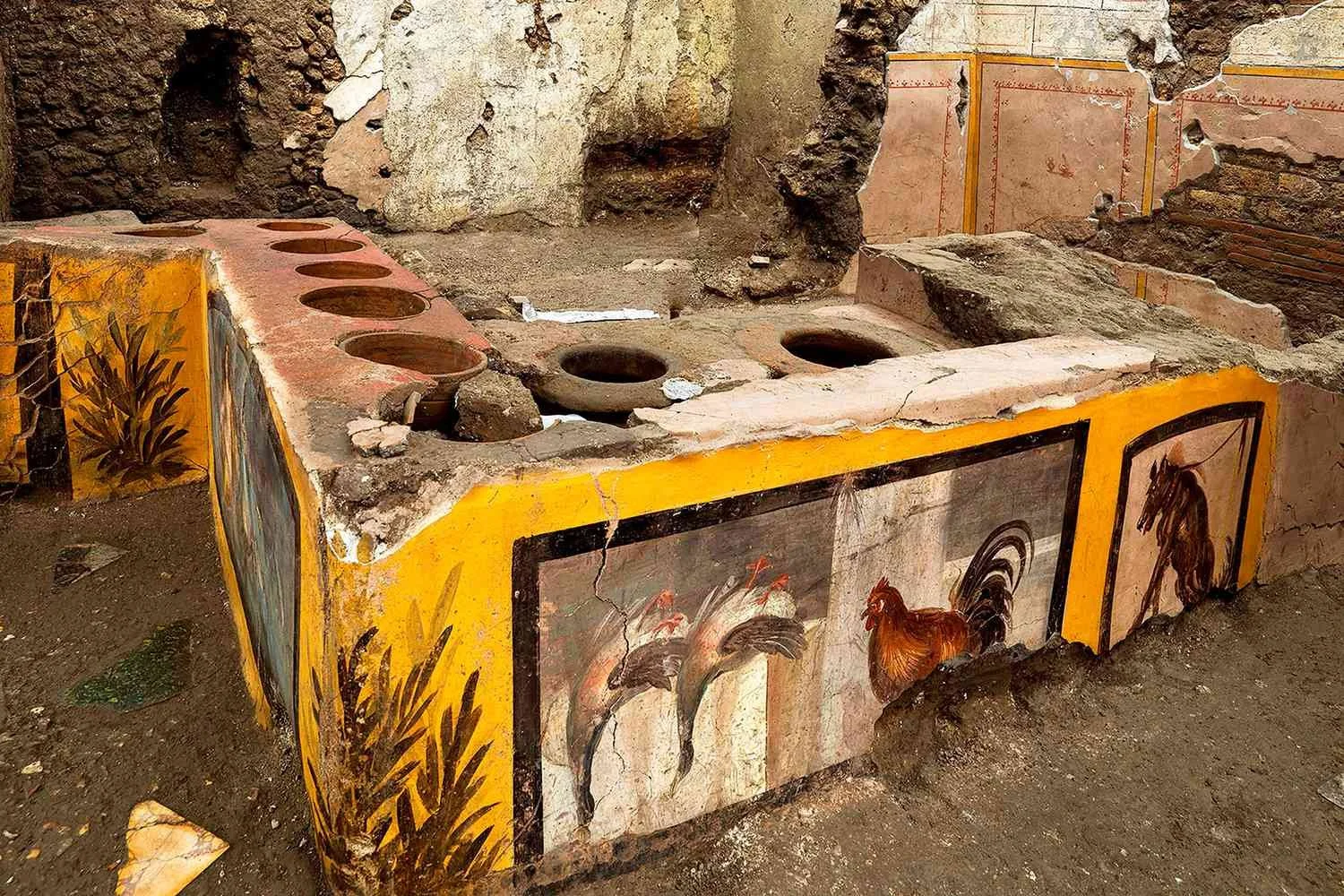
A 2,000-year-old fast-food and drink counter, which was excavated in 2020 in the streets of the ancient Roman city Pompeii, opened to the public on summer 2021.

The Telegraph reported that the opening date was set for August 12 2021 for the "thermopolium," which is Latin for "hot-drink counter."

The counter and surrounding area was discovered in the archaeological park's Regio V site. It had once offered its Roman customers culinary treats including pork, fish, snails, and beef, traces of which were found at the site, Insider's previously Sophia Ankel reported.

Duck bone fragments were also found, as well as crushed fava beans, which were used to modify the taste of wine.

The counter, which is decorated with brightly colored frescos with deep circular jar holders, is the first one out of 80 to be found in what is considered to be a good condition, given its age.

"As well as bearing witness to daily life in Pompeii, the possibilities to analyze afforded by this thermopolium are exceptional because for the first time we have excavated a site in its entirety," said Massimo Osanna, director general at the Archaeological Park of Pompeii, according to The Guardian.

Pompeii was entombed in ash and pumice when the nearby Mount Vesuvius erupted in AD79, killing between 2,000 and 15,000 people. Since its ruins were unearthed in the 16th century, archaeologists have dug up around two-thirds of the site.

Source: https://www.businessinsider.com/pompeii-fa...

Greater Adria, a lost continent hiding in plain sight

Move over, Atlantis. Not all lost continents are myths; here’s one whose existence has just been verified by science. Greater Adria broke off from North Africa 240 million years ago. About 120 million years later, it started sinking beneath Southern Europe. But bits of it remain, scattered across local mountain ranges.

It’s the geological similarities in those mountains that had led scientists to hypothesize the presence of an ancient continent in the Mediterranean. But the region’s geology is so complex that only recent advances in computing—and a 10-year survey by an international team of scientists—were able to produce a geo-historical outline of that former land mass. This is the very first map of the world’s latest lost continent.

The 100-million-year history of Greater Adria starts nearly a quarter of a billion years ago. The world was a very different place back then. It was just recovering from the Permian-Triassic extinction, which came pretty close to wiping out all life on Earth. The planet was repopulated by the first mammals and dinosaurs.

SUPERCONTINENTAL BREAK-UP

Oblivious that biological imperative, Earth’s geology was on a course of its own: fragmentation. At that time, the planet’s land masses had coagulated into a single supercontinent, Pangaea.

Around 240 million years ago, a Greenland-sized piece of continental plate broke off from what would become North Africa and started drifting north. Between 120 and 100 million years ago, the continent smashed into Southern Europe. Even though the speed of that collision was no more than 3 to 4 cm per year, it ended up shattering the 100-km thick crust.

Most of the continental plate was pushed under Southern Europe and swallowed up by Earth’s mantle, a process known as subduction. Seismic waves can still detect the plate, now stuck at a depth of up to 1500 km.

But some of the sedimentary rocks on top were too light to sink, so they were scraped off and got crumpled up—the origin of various mountain chains across the Mediterranean region: the Apennines in Italy, parts of the Alps, and ranges in the Balkans, Greece and Turkey.

DEATH AND BIRTH

Flowing from present to deep past, this time-lapse reconstruction of the geological history of the Mediterranean shows the death and birth (in that order) of Greater Adria in unprecedented amounts of detail.

Some bits of Greater Adria survived both the shave-off into mountainhood and death by subduction. “The only remaining part of this continent is a strip that runs from Turin via the Adriatic Sea to the heel of Italy’s boot,” says Douwe van Hinsbergen, Professor of Global Tectonics and Paleogeography at Utrecht University, and the study’s principal researcher. That’s an area geologists call ‘Adria’, so the team, consisting of scientists from Utrecht, Oslo and Zürich, called the lost continent ‘Greater Adria’.

What was the continent like? A shallow continental shelf in a tropical sea, where sediments were slowly turned into rock, Greater Adria possibly resembled Zealandia, a largely submerged continent with bits sticking out (i.e. New Zealand and New Caledonia), or perhaps the Florida Keys, an archipelago of non-volcanic islands. Either way, dotted with islands and archipelagos above the water, and lots of coral below, it was “probably good for scuba diving,” Van Hinsbergen says.

It took scientists this long to produce the first map of Greater Adria not just because the Mediterranean is, in the words of Van Hinsbergen, “a geological mess (…) Everything is curved, broken and stacked. Compared to this, the Himalayas represent a rather simpler system.” Greater Adria perished by subduction and scraping-off. The Himalayas emerged by the collision of two continents.

ORE DEPOSITS

The region also has a complex geopolitical makeup, obliging the researchers to piece together evidence from 30 different countries, from Spain to Iran, “each with its own geological survey, own maps, own ideas about evolutionary history. Research often stops at national borders.”

So what has geology learned from the discovery of Greater Adria?

  • First off, that its hypothesis was right: Geological similarities across the Mediterranean really did point to a lost continent, now found.

  • Secondly, the reconstruction of Greater Adria has also taught geologists that subduction is the basic way in which mountain belts are formed.

  • They’ve also learned a great deal about volcanism and earthquakes, and “(we) can even predict, to a certain extent, what a given area will look like in the far future,” van Hinsbergen says.

  • Finally, and practically, these insights will help scientists and surveyors to identify and locate ore deposits and other useful materials in mountain belts.

Source: https://bigthink.com/strange-maps/greater-...

DNA from child burials reveals ‘profoundly different' human landscape in ancient Africa

Central Africa is too hot and humid for ancient DNA to survive—or so researchers thought. But now the bones of four children buried thousands of years ago in a rock shelter in the grasslands of Cameroon have yielded enough DNA for scientists to analyze. It's the first ancient DNA from humans in the region, and as the team reports today in Nature, it holds multiple surprises. For one, the area today is the homeland of Bantu speakers, the majority group in western and Central Africa. But the children turned out to be most closely related to hunter-gatherers such as the Baka and Aka—groups traditionally known as "pygmies"—who today live at least 500 kilometers away in the rainforests of western Central Africa.

"In the supposed cradle of Bantu languages and, therefore, Bantu people, these people are basically ‘pygmy' hunter-gatherers," says Lluís Quintana-Murci, a population geneticist at the Pasteur Institute and CNRS, the French national research agency, who was not part of the new study. He and others have long suspected that these groups had a larger range before the Bantu population exploded 3000 years ago. The second big surprise came when the team compared the children's DNA to other genetic data from Africa and found hints that the Baka, Aka, and other Central African hunter-gatherers belong to one of the most ancient lineages of modern humans, with roots going back 250,000 years.

In the new study, geneticists and archaeologists took samples from the DNA-rich inner ear bones of the four children, who were buried 3000 and 8000 years ago at the famous archaeological site of Shum Laka. The researchers were able to sequence high-quality full genomes from two of the children and partial genomes from the other two. Comparing the sequences to those of living Africans, they found that the four children were distant cousins, and that all had inherited about one-third of their DNA from ancestors most closely related to the hunter-gatherers of western Central Africa. Another two-thirds of children's DNA came from an ancient "basal" source in West Africa, including some from a "long lost ghost population of modern humans that we didn't know about before," says population geneticist David Reich of Harvard University, leader of the study.

The discovery underscores the diversity of African groups that inhabited the continent before the Bantus began to herd livestock in the grassy highlands of western Central Africa. The Bantus made pottery and forged iron, and their burgeoning populations rapidly displaced hunter-gatherers across Africa. Analyzing DNA from a time before this expansion offers "a glimpse of a human landscape that is profoundly different than today," Reich says.

The team compared the children's DNA to ancient DNA extracted earlier from a 4500-year-old individual from Mota Cave in Ethiopia and sequences from other ancient and living Africans, using various statistical methods to sort out how they all were related, which groups came first, and when they split from one another. The team's bold new model pushes back Central African hunter-gatherer origins to 200,000 to 250,000 years ago—not long after our species evolved. The model suggests their lineage split from three other modern human lineages: one leading to the Khoisan hunter-gatherers in southern Africa, one to east Africans, and one to a now-extinct "ghost" population.

An early diversification of modern humans fits the great variation seen in fossils of early Homo sapiens, says paleoanthropologist Katerina Harvati of the University of Tübingen, who is not part of this study. The lineages would have parted company and moved off into different parts of Africa 200,000 to 250,000 years ago, preserving their distinctness by only occasionally interbreeding at the boundaries.

But others say that although the new study offers compelling new evidence, the data aren't yet solid enough to build a reliable model. "It needs to be further tested with additional whole genome data from both modern and, if possible, ancient DNA from more Africans," says evolutionary geneticist Sarah Tishkoff of the University of Pennsylvania.

That may be possible. A third key lesson from the study is that ancient DNA can be extracted from bones in Central Africa after all. "The future is not as bleak for ancient DNA in these regions," says population geneticist Joshua Akey of Princeton University.

Source: https://www.science.org/content/article/dn...

Did a Deadly Plague Destroy Neolithic Europe?

What caused the Neolithic Decline in Europe? Was it the first great plague in history? And if so, did it cause a Neolithic apocalypse?

In the 4th Millennium BC, Neolithic Europe experienced a sustained decline. By about 3000 BC Western Steppe Herders like the Yamnaya and related groups migrated west into Europe, changing the genetics and culture forever, and bringing about the Bronze Age.

The male lineages of Neolithic Europe came to an end as the steppe herders had offspring with the Neolithic farmer women. Did this only happen because the settled farmers had already been brought to their knees by waves of plague?

In this video we look at the first recorded samples of the plague - Yersinia Pestis - the same bacterium that caused the Black Death and the Plague of Justinian and Bronze Age plagues.

Did the disease first become dangerous in the vast proto-cities of the Cucuteni-Trypillia culture in Eastern Europe?

Family finds $1m worth of 18th-century gold treasure off Florida coast

A family which has spent years hunting for treasure has found $1million worth of gold artefacts in the wreckage of a fleet of 18th-century Spanish ships off the coast of Florida.

Rick and Lisa Schmitt, their two children and daughter-in-law have used their salvage vessel Aarrr Booty to scour the ocean for treasure for the past two summers.

In June, Eric, the couple’s 27-year-old son, found and recovered gold coins and chains from the wreckage of the convoy, which has laid some 15 feet (4.5m) under the water off Fort Pierce, around 130 miles (210km) north of Miami since 1715.

The well-preserved hoard includes 51 gold coins of various denominations and 40 feet (12m) of ornate gold chains featuring olive blossoms.

The most historically striking piece of the find is a highly rare gold coin known as a ‘Tricentennial Royal’. Made for Spain's King Phillip V and dated 1715, only around six of the pieces are known to exist.

Schmitt believes the coin alone is worth around $500,000 (£321,000)

“These things were known as presentation pieces not meant to be circulated as currency,” he told the Orlando Sentinel.

Brent Brisben, whose firm, the 1715 Fleet – Queens Jewels LLC, owns the rights to the wreckage, said he decided to make their finding public to coincide with Friday's 300th anniversary of the sinking of 11 galleons brought down by a hurricane off the coast of Florida as the convoy was sailing from Havana to Spain.

The Schmitts appear to have discovered a small slice of the ship’s cargo, as the convoy’s manifests suggests it carried goods work around $400 million (£256 million) of which $175 million (£112million) has been recovered, Brisben said.

Brisben’s firm bought the rights to the site in 2010 from the heirs of the legendary treasure Mel Fisher.

The company allows treasure-hunters to search the convoy under subcontract agreements.

Under federal and state law, Florida will take possession of up to 20 percent of the find for display in a state museum. Brisben's company and the Schmitt family will split the reminder, Brisben said.

Source: https://www.independent.co.uk/news/world/a...

The Real Story of the 300 - Battle of Thermopylae

This is Sparta! Want to find out what really happened to the 300 Spartan warriors that were completely outnumbered but stood up to the Persian army! Check out today's epic video that reveals the real battle of Thermopylae!

Archaeologist Uncovered An Ancient Egyptian Tomb — Then Noticed The Strange Markings On Its Entrance

In a vast cemetery close to Egypt's Great Pyramids, Professor Oleg and his team of archaeologists are hard at work. The researchers are motivated by the hope that they are about to discover something truly amazing, despite the heat and dust. And sure enough, they find the entrance to an elaborate tomb with baffling symbols on the openings. But what do these strange symbols mean? Experts found an ancient Egyptian tomb and noticed the strange markings on the entrance. It was back in October 2021 When the Egyptian Ministry of Tourism and antiquities announced this outstanding discovery of an ancient tomb, the one on Earth blog Aziz team, the Krypton, a site called secara, a vast necropolis that lies not far south of the modern Egyptian capital Cairo, l magazine. Has been researching this area and making many remarkable discoveries there since 2005. Of course, there was still much work to do in interpreting the symbols and wall paintings of the tomb entrance. The researchers had already reached some conclusions, though. In the October 2021 statement, Mustapha Waziri, Secretary General of the Supreme Council of antiquities revealed what researchers already knew about this crypt.

Experts discovered an ancient bracelet in a cave - and it changed our view of history

As the team of experts ventured deep into the mysterious cave, little did they know that they were about to uncover a stunning artefact that would rewrite history as we know it? With every step they took, the excitement grew. When they finally discovered the ancient bracelet hidden within the cave's depths, they knew they had stumbled upon something truly extraordinary. This remarkable discovery has challenged our long-held beliefs and shed new light on the mysteries of the past.

Today we will discover an ancient bracelet in a cave and the mystery behind it.

Do You Know What Is Hiding Under The Trees Of The Amazon Rainforest?

The Amazon rainforest has always been shrouded in mystery and intrigue, with stories of lost civilisations and treasure troves hidden deep within its dense foliage. For centuries, adventurers and explorers have ventured into the jungle in search of El Dorado, the legendary city of gold. However, the harsh terrain and thick canopy of the rainforest have made it difficult to uncover its secrets. That is, until now.

In this video, we delve into the fascinating world of lost civilisations in the Amazon and the latest technology that is helping to uncover their secrets. Lidar, a remote sensing technology that uses lasers to create detailed 3D maps of the terrain, has revolutionized the way we explore the rainforest. By using Lidar, researchers have been able to uncover vast networks of ancient settlements, roads, and structures that were previously hidden from view.

We also explore the history of adventurers like Percy Fawcett, who famously disappeared while searching for El Dorado in 1925. Fawcett believed that the city of gold was located somewhere in the unexplored depths of the Amazon, and his story has captured the imagination of generations of explorers and treasure hunters.

Through interviews with archaeologists, explorers, and historians, we learn about the latest discoveries in the Amazon and the ongoing search for lost civilisations.

Why Japanese Calligraphy Ink Is So Expensive

Traditional Japanese calligraphy ink, referred to as sumi ink, comes in a solid form. It takes at least four years of production before these ink sticks can be sold, and even longer for the most expensive ones. A 200-gram high-grade ink stick from a producer like Kobaien costs over $1,000. And at some other retailers, prices can reach almost $2,000. Meanwhile, almost double the amount of commercial India ink can go for as little as $9.