The ocean is without doubt the most fascinating place on this planet. This quote pretty much sums it up.... "Earth Should be Named Planet Ocean, Not Planet Earth". That couldn't be more true. We are surrounded by ocean, yet for the most part, we have no idea what creatures are sharing the planet with us. In this video you will see five truly awesome underwater creatures that prove the ocean has far more to offer than what we think. So, from an enormous deep sea shark, to a mysterious alien like creature that was washed up on a beach. Sit back & enjoy this video!
The Missing Pyramid of Giza & The Mysterious Sealed Wooden Box
The Giza Plateau is arguably the most famous historic site in the world, with the astonishing pyramid complexes of Khufu, Khafre and Menkaure, and of course the magnificent Great Sphinx.
Of course, today, Giza is nothing compared to how it would have looked in the 4th dynasty, in the golden era of Egyptian history when these monuments were first constructed, but it’s amazing that these monuments have stood the test of time.
Although the pyramid casing stones have all but disappeared, although many of the limestone has been sandblasted by the desert winds, although these ancient structures have been explored, sometimes dynamited, looted and excavated, it’s incredible that so much has survived on the Giza Plateau, preserved so tourists can get up close and personal with these seemingly impossible achievements of our ancestors.
But although many of the 4th dynasty monuments remain, one of them is certainly missing: pyramid G2-A.
Pyramid G2-A, or GII-A, was completely robbed of its stone. It had two descending passageways, one of which wasn’t found until 1960. Three plug blocks were still in place and on their removal, inside was found a large, sealed wooden box. What was inside? Watch this video to find out!
The Rise of Spartacus: The Gladiator Who Defied an Empire
In this video, we delve into the incredible life and legacy of Spartacus, the legendary gladiator who defied the Roman Empire and led one of the greatest slave revolts in history. From his humble beginnings as a slave in the Roman Empire, to his rise as a legendary gladiator and revolutionary leader, Spartacus' life was full of triumphs, tragedies, and unforgettable moments.
We'll also explore the political and social context of ancient Rome, and how it shaped Spartacus' life and legacy. From the power struggles within the Roman Senate, to the brutal realities of life as a slave, we'll paint a vivid picture of the world in which Spartacus lived and fought.
From how he defeated some of Romes up and coming generals, to his showdown with Crassus.
Discover the shocking truths behind his struggle against the Roman army, the secrets behind his guerrilla tactics, and the betrayal that ultimately led to his downfall.
Throughout the video, we'll use a mix of historical accounts, analysis, and cinematic recreations to bring Spartacus' story to life.
We should all have a deep appreciation for the life and times of Spartacus, and why his story is still relevant today. Join us on this journey to discover the fascinating story of one of history's greatest heroes.
The Geography of Pets
Just like our livestock, the animals we choose to bring into our homes and families all have stories of their own, reaching back thousands of years and spanning almost every continent. Join us as we explore the origins of all of our best friends!
Search for the lost hammer leads to the largest Roman treasure ever found in Britain
When Eric Lawes set off for a field in Hoxne village, Suffolk on November 16, 1992, it wasn’t on a treasure hunt. The metal detector he’d received as a retirement gift was meant to find a hammer lost on the farmland. But the detector picked up a strong signal in the earth, leading Lawes to start digging, and it quickly became apparent that he had indeed found treasure.

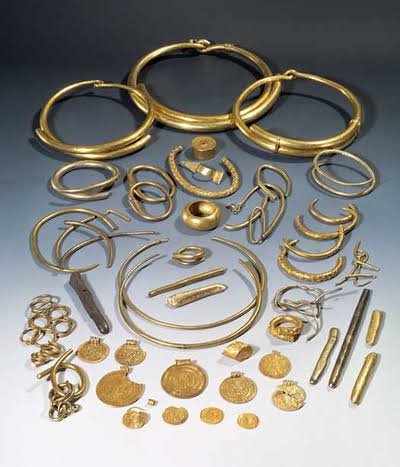
After bringing up only a few shovelfuls of silver spoons and gold coins, Lawes quickly retreated and called the police and the local archaeological society. The very next day, as covertly as possible, the archaeologists excavated a chunk of earth with the treasure still contained within. This way, they could remove the objects under laboratory conditions, which would help determine the age and storage method of the cache. By the time everything had been removed from the dirt, the archaeologists had nearly 60 pounds of gold and silver objects, including 15,234 Roman coins, dozens of silver spoons and 200 gold objects.
Lawes received £1.75 million from the British government for finding the gold and leaving it intact, which he split with the farmer on whose land the hoard was uncovered (he also eventually found the hammer, which later went on exhibit). As for archaeologists, they had their own reward: of the 40 treasure hoards discovered in Britain, the Hoxne Hoard was “the largest and latest ever found in Britain,” says Rachel Wilkinson. The project curator for Romano-British collections at the British Museum, where the artifacts reside, Wilkinson says the unique way this hoard was excavated, compared to how most are retrieved by farmers plowing their field, makes it invaluable.
In the 25 years since the unearthing of the Hoxne hoard, researchers have used the objects to learn more about one of Britain’s most turbulent periods: the island’s separation from the Roman Empire in 410 A.D.

The end of the fourth century A.D. was an unsettled time for the Roman Empire. The territory stretched across the entirety of the Mediterranean world, including all of the land that would come to be Italy, Spain, Greece and France and large chunks of North Africa, Turkey and Britain. Under Emperor Theodosius, Christianity became the sole religion of the empire, while all other belief systems became illegal, a dramatic change after centuries of polytheism. And while parts of the Empire continued to thrive, the Western Roman Empire was deteriorating. Gothic warriors won battles and killed leaders like Emperor Valens, and in 410 the Visigoths (nomadic Germanic peoples) sacked Rome. Meanwhile, Roman subjects in Britain were left to fend for themselves against raiders from Scotland and Ireland, having lost the support of Roman soldiers even before the separation from the Empire.
“The years from the later fourth century to 450, the period including the British hoarding peak, witnessed numerous invasions into the [mainland Europe] Empire by Germanic and Hunnic groups often followed by largescale devastation and disruption,” writes Roman archaeologist Peter Guest, the author of The Late Roman Gold and Silver coins from the Hoxne Treasure.
This level of societal upheaval has led to the “hoards equal hordes” hypothesis. Basically, Romano-British citizens who no longer had the protection of the Roman Empire were so terrified of the raiding Saxons, Angles, Picts and others that they buried their most valuable belongings. According to an entry from 418 in the 9th-century text Anglo-Saxon Chronicle, “In this year the Romans collected all the treasures which were in Britain and hid some in the earth so that no one afterwards could find them, and some they took with them into Gaul.”
For all their fears of “barbarians,” the Romano-British weren’t only the only people in the Roman Empire to experience upheaval—yet nowhere else have hoards been discovered in as dense of numbers as in Britain. Could there be an alternate explanation for why some wealthy family buried so much gold in the ground?

Because no organic materials survived in the Hoxne hoard, radiocarbon can’t be used as a dating technique. Instead, archaeologists use the age of coins, which they arrive it by looking at inscriptions on the coin as well as the ruler depicted on its face.
“The date after which Hoxne must’ve been buried is 408 or 409 [based on the age of the coins] and the traditional model would suggest it was buried around about that point in time,” Guest said in an interview with Smithsonian.com. “My perspective is that actually we’ve been misdating these hoards. If you look at them a little more carefully, then they should be dated to the period after the separation of Britain from the Roman Empire.”
Guest argues that the coins may have been in circulation around Britain for decades after the Roman Empire removed its influence from the island. One bit of evidence he offers for this hypothesis is a practice called clipping. Of the more than 15,000 coins in the Hoxne cache, 98 percent are clipped—bits of their edges have been removed, reducing their size by as much as a third. Based on chemical analyses, Guest and others have found that the metal removed from those coins was used to make imitation Roman coins that remained in circulation for longer.
“The Roman Emperor wasn’t supplying Britain with new gold and silver coins, and in light of that, the population tried to get over this sudden cutoff in the supply of precious metals by making the existing supplies go further,” Guest said.

But part of the value of the Hoxne hoard is that it contains more than just a massive quantity of coins. In The Hoxne Late Roman Treasure: Gold Jewelry and Silver Plate, archaeologist Catherine Johns speculates that the Roman family to whom the treasure belonged kept them as sentimental objects.
This suggestion is possible thanks to an analysis of not just what was in the hoard, but also how it was hoarded. Surrounding the coins and gold objects were nails, hinges, locks, scraps of wood, bone and ivory. Some of the objects were packed with straw, while others were placed in smaller, leather-lined wood boxes. Some of the items revealed significant wear, such as the silver handle in the shape of a tiger that had been detached from its vase, and the damaged pepper pots. All these details imply the stash might have been buried with care rather than being hurriedly hidden. And they also offer archaeologists plenty of fodder for theories about life for a wealthy family at the turn of the fifth century.
Take the dozens of silver spoons, for example. Some of them are worn down and show evidence of being repaired. Others are marked with words, including names (Aurelius Ursicinus and Silvicola) and a Latin phrase (vivas in deo). And while most of the spoons are inscribed to be read from a right-handed position, one spoon looks as if it was made for a leftie.
Or look at the pepper pot, selected by the BBC as one of 100 objects to tell the story of the history of the world. The silver pot is molded in the shape of a noble woman, with holes in the base of the object for pepper to be shaken out. Not only does the pot tell us the owners engaged in international trade—pepper had to be shipped and purchased from India—but it also reveals details about women’s fashion. As Johns writes for the BBC, “The most striking aspect of the lady’s appearance is her intricate hairstyle. It would have required very long, thick hair and the attentions of a skilled hairdresser to create,” and included decorative pins arranged to look like a tiara.

Even the jewelry reveals tiny glimpses of what life may have looked like for women. There’s a gold body chain for an adolescent girl, several rings missing their gemstones, and multiple bracelets, including one with the inscription utere felix domina Iuliane—“use this and be happy, Lady Juliane.”
“Were Aurelius and Juliane the owners of the treasure, or perhaps their ancestors? We do not know,” writes Kenneth Lapatin in the Times Literary Supplement. “These people remain ciphers to us and, unlike their possessions, are largely irrecoverable.”
Archaeology is a field that often requires making inferences. The Hoxne hoard offers tantalizing slivers of the past without enough detail to allow for definitive answers. Even something as simple as when the treasure was buried currently remains unknowable. “You can’t prove or disprove either of these two positions,” Guest said of the hypothesis that the treasure was buried at the end of the Roman Empire in Britain or in the years after the end. “The dating of material culture to produce our chronologies and the difficulty of that goes back a long way in archaeology.”
But even surrounded by unanswered questions, the Hoxne treasure is an irresistible collection that tells a dramatic story: the end of one empire, the earliest days of what would eventually become another empire. And whatever else it might provide archaeologists, it also provides the public with a happy ending—sometimes you find buried treasure when you least expect it.
The Birth of Civilisation - The First Farmers (20000 BC to 8800 BC)
In the following video we will we cover the earliest origins of agriculture in settlements throughout the Near East, and the great monuments their peoples erected. Enjoy!
12 Most Incredible Archaeological Finds
We'll never run out of amazing archaeological finds to show you on this channel because the world's archaeologists will never stop coming up with incredible discoveries! This collection takes us all over the world and to every great period of history. Telling you the stories of these finds is what we do best here, so let's get straight into it!
Dinosaurs of the beginning of the Jurassic period
The Jurassic period, or the Jura, is probably the most interesting era. After watching the famous movie “The Jurrasic Park”, an average person might think that the Earth was populated only by dinosaurs, like T-rex. In fact, it wasn't quite like that even though the Jurassic period is also known as the Age of Reptiles.
Let's start with the statement that the Jurassic period, the second in the Mesozoic era, is long and complex. It began 201 million years ago and lasted about 56 million years. It got its name because the fossils were first discovered and explored in the Jura mountains in Switzerland and France. Hence the name of the period.
This era is divided into three stages. The first, which lasted from 201.3 to 174.1 million years ago, is called the Lower Jurassic. At that time, life was recovering from the Triassic-Jurassic extinction that caused about half of all animal species on the planet to disappear. However, the hot and humid climate of the Jura helped life to quickly bounce back. Warm oceans and seas abounded with Ammonoidea, Belemnitida, fish and reptiles. On land, reptiles including dinosaurs quickly filled the ecological niches freed by the previous extinction. In the process of evolution, some reptiles got wings and flew into the sky.
The beginning of the Jurassic period launched the high time for reptiles. Hundreds of dinosaur species appeared on the planet. They settled on all continents, including Antarctica. Some reached incredible sizes and proportions. Some, of course, developed formidable shapes, sometimes bizarre and scary. What are the mysteries of the prehistoric reptiles that lived on Earth 200 million years ago?
19th Century Portraits Brought To Life
We've gathered a collection of 19th-century portraits that appear to come to life as they glide across your screen. The portraits were given a quick restoration, colorization and some facial motion, using some of the latest tools in AI technology. We hope you find this presentation enjoyable, since it was a labour of love to create. Check the video to see fashion, clothing and hairstyle of 19th century men and women in a mixture of daguerreotypes, ambrotypes and tintypes. Enjoy!
California Couple Finds $10M in Gold Coins Buried in Yard
A Northern California couple out walking their dog on their Gold Country property stumbled across a modern-day bonanza: $10 million in rare, mint-condition gold coins buried in the shadow of an old tree.

Nearly all of the 1,427 coins, dating from 1847 to 1894, are in uncirculated, mint condition, said David Hall, co-founder of Professional Coin Grading Service of Santa Ana, which recently authenticated them.
Although the face value of the gold pieces only adds up to about $27,000, some of them are so rare that coin experts say they could fetch nearly $1 million apiece.

"I don't like to say once-in-a-lifetime for anything, but you don't get an opportunity to handle this kind of material, a treasure like this, ever," said veteran numismatist Don Kagin, who is representing the finders. "It's like they found the pot of gold at the end of the rainbow."
Kagin, whose family has been in the rare-coin business for 81 years, would say little about the couple other than that they are husband and wife, are middle-aged and have lived for several years on the rural property where the coins were found.

They have no idea who put them there, he said.
The pair are choosing to remain anonymous, Kagin said, in part to avoid a renewed gold rush to their property by modern-day prospectors armed with metal detectors.
The Invention of Trousers: A History of the Garment That Transformed Humanity
Trousers, pants, slacks—nno matter the name, they are an integral part of our everyday wardrobe. What began as a practical solution to a practical problem has become a staple of fashion across cultures. But have you ever stopped to ponder the origins of this garment? When did our ancestors decide to ditch the tunic, robe, or loincloth in favor of trousers? In this article, we will delve into the intriguing history of the invention of trousers.
Prehistoric Beginnings
The exact origins of trousers remain somewhat unclear, largely due to the absence of ancient textiles that have survived through the millennia. However, archaeological evidence has provided some intriguing clues. In 2014, a study published in the journal Quaternary International discovered the earliest known examples of trousers in western China, dating back to around 3,000 to 3,300 BC.
These ancient trousers were made of wool and designed with straight legs and a wide crotch. This wide crotch, often referred to as a steppe crotch, had a slit that might have been used to tie the trousers around the waist. Archaeologists speculate that these trousers were invented for riding, as they provide protection while allowing the rider flexibility and freedom of movement.
Development and Spread
The use of trousers began to spread with the advent of horseback riding and the strategic advantage it provided for warfare. This new mode of transportation necessitated a new type of clothing that allowed for greater flexibility and protection. As the popularity of horseback riding grew, so did the prevalence of trousers.
Trousers found their way to the Mediterranean world through cultural contact with Persians and other cultures of the East. Greek historians such as Herodotus described the Persian use of trousers in the 5th century BC, and it wasn't long before the Greeks and Romans adopted this practical garment, although not without some cultural resistance, as it was initially seen as 'barbarian' dress.
It is worth noting that while trousers were predominantly a male garment in many cultures, women also wore trousers in certain societies, particularly those where horse riding was common for both genders.
Evolution through the Ages
Over the centuries, the basic design of trousers evolved in various directions according to cultural needs and aesthetic trends. Breeches, a type of trouser that ends just below the knee, became common in Europe from the 16th to the early 19th centuries. These were often worn with stockings and were a standard part of men's dress.
As Europe transitioned into the Industrial Revolution, the design of trousers changed again. The need for practical and durable clothing for factory and manual work led to the invention of denim jeans in the United States in the late 19th century, a style that has persisted to this day.
Meanwhile, women's fashion began to incorporate trousers more frequently in the late 19th and early 20th centuries, particularly in the context of the women's rights movement. The advent of World Wars I and II accelerated this trend as many women entered the workforce and required practical clothing.
Trousers Today
In today's global society, trousers have transcended cultural boundaries and become a universally accepted form of clothing. They come in an endless variety of styles, from casual jeans to formal tuxedo pants, serving a plethora of purposes. The evolution of trousers continues in response to changes in societal norms, technology, and fashion trends.
Whether you're donning denim jeans for a casual outing or dressing up in a formal suit, remember that the trousers you wear are the result of a millennia-long journey, adapting to meet the needs of humans throughout history. The story of trousers is one of practicality and ingenuity, a testament to humanity's endless creativity and the remarkable evolution of culture.
Today, everybody wears trousers—men and women, young and old—at almost all occasions. But who invented the trousers? When? Where? Why? This documentary tells the story of an international research team’s pursuit to find answers to these questions. The camera accompanies the scientists to dry inner Asian archaeological excavation sites in China and the working tables of conservators; to laboratories of ancient climate and animal DNA research; to sheep shearer’s barns and fashion designer’s studios. Viewers can watch the team make discoveries and face insurmountable obstacles in the process of reverse engineering when they try to reproduce the oldest known trousers in the world. The documentary comprises unpublished film material, animation sequences, and music specially composed for this story. The film is the result of cooperation between archaeologists and students of Film University Babelsberg (Konrad Wolf).
Pythagoras Cup (Greedy Cup) filled with Mercury
In the following video we will be talking about Pythagoras’ greedy cup and filling it up with Mercury. Watch the video to find out more!
‘Dark DNA’ Is the Latest Mystery in the World of Genetics… But What Is It?
Scientists are beginning to understand mysterious parts of our DNA. Here’s what they’ve found so far. Enjoy!
Craziest Things Ancient Romans Did
Here is a top list of 20 history facts you probably didn't know about the ancient Roman Empire. From bloody gladiator fights at the colosseum to insane emperors drinking poison. From women sporting a unibrow to gluttony to the point of vomiting. Find out what Julius Caesar and the Senate were really up to.
Real Mermaid Sightings Around The World
Check out these real mermaid sightings around the world! This top 10 list of amazing discoveries of real life mermaid bodies is absolutely intrigueing. Enjoy!
Discoveries Made In The Middle Of Nowhere
In the following video we will be exploring discoveries made in the middle of nowhere. Watch the video below and enjoy!
The Nasty Lives Of Concubines In Imperial China
The word “concubine” has several definitions and many connotations. The easiest way to define the Chinese type of concubinage, at least among the very rich and the Imperial family was that they were mistresses.
Concubinage in China differed in many ways from that of other nations, though it did have similarities as well. At the very top, in the Imperial Household, there was sisterhood, rivalry, palace intrigue, and much more. This likely took place at the home of rich men too. In the Imperial China which lasted until the Communist Revolution of 1949, a man could have only one wife, but as many concubines as he could afford to house, clothe and feed. Frequently, in Chinese history (and that of other nations), a man's wealth and power were partly judged by the number of concubines he kept and how they lived.
Likely the most famous system of concubinage existed within the Chinese imperial family, likely going back at least two thousand years to the Han Dynasty, which lasted from 25AD- to 220AD. The law then, and going forward to 1949 was that the higher the rank of the man, the more concubines he was able to have. Since Han times and likely before, a concubine could be bought, at a slave market in the earliest times, or from a family with an attractive daughter who needed money to survive – these are just two examples. In many cases, a wife would have to approve of this “transaction”. History is full of tales of Chinese wives mistreating their husband's concubine or concubines, sometimes addressed as “little sister”, with a number attached in case of multiple women. That was a common occurrence, but likely as common was a good relationship – especially in a bad marriage: a concubine/mistress could take the attention and pressure off a wife and allow her her own time – even more so in a household with multiple concubines.
The Diabolical Things That Napoleon Bonaparte Did During His Reign
Napoleon Bonaparte, born in then Italian Corsica in 1769, was the dominant personality of his time. He died in exile on the lonely British South Atlantic island of St. Helena in 1821. But though he was a shell of his former self living in isolation in the middle of nowhere, his life cast a long shadow, and his influence continued for decades after his death. His military philosophy and tactics are still taught throughout the world, for though the weapons of today are much different than those used by his armies, the tactics he used on the battlefield are timeless: speed, audacity, and surprise being foremost among them.
Napoleon Bonaparte is one of the most fascinating men in history. If this introduction to the darker side of Napoleon interests you, please “like” and subscribe to our channel! Vive' l'France!
Napoleon became Emperor of France in 1804, though he had been the country's de facto ruler since 1799. For anyone to become emperor after the French Revolution of 1789 and the years immediately after had been unthinkable. The Revolution took place to rid France of a king and a system of privilege and oppression. That revolution cost a lot of blood and treasure and caused years of struggle and chaos in France. When Napoleon was ready to take power, the French were tired of political violence and upheaval, high prices, food shortages, and corrupt government. Napoleon, like Caesar more than 1800 years before him, promised law, order, and economic stability.For the first years of his reign, Napoleon managed to do just that, bring a sense of stability. He also brought France military glory. He rose to fame in the 1790s through his prowess on the battlefield. He helped to bring the ideals of the French Revolution to many parts of Europe. Unfortunately for France and Napoleon, his "eyes were bigger than his stomach," and he "bit off more than he could chew," making enemies of Great Britain and Russia.
The Unspeakable Things Emperor Commodus Did During His Reign
Commodus had ruled Rome from 177. For the first three years of his reign, he was actually "co-Emperor" with his illustrious father, Marcus Aurelius. Marcus Aurelius is well-known today for the collection of his writings entitled "The Reflections of Marcus Aurelius," a virtual handbook for those who wish to live a calm, stoic life of moderation. Marcus Aurelius was a revered figure in his time, and in the time since, he has been dubbed one of the "Five Good Emperors" for his accomplishments: expanding the borders of the empire and increasing the prosperity of Rome.
Commodus, whose birth name was "Lucius Aelius Aurelius Commodus," may have suffered from an inferiority complex, knowing or believing that he could not and would not achieve his father's fame. He may also have been one of the countless spoiled princes throughout history, never being forbidden anything, especially since his stoic father was often absent governing the empire. He might also have been seriously ill mentally – he may have been all three. We will never know for sure. We know that Commodus committed many crimes – not crimes to him perhaps, but to us? Without doubt.
Commodus is sometimes compared to the earlier Roman emperor Nero (37AD- 68 AD). Nero is still remembered as one of the cruellest emperors, and his life ended when he ordered his slave to kill him – he had just been pronounced a "public enemy" by the Senate for his harsh rile. Commodus was also cruel, and he was finally strangled by a champion wrestler, the killing arranged by his advisers.
Both emperors fancied themselves artists. Nero was famed for dressing as a woman and putting on public concerts – he was reputedly terrible, but no one dared not applaud the performances. Commodus also loved singing and dancing and fancied himself a comedian, though his crudity made his aristocratic peers uncomfortable. He also believed himself to be a great gladiator and fought with trained slaves or gladiators, but never in public. Pity the slave or gladiator that didn't let the emperor win, though it is said that Commodus was quite skilled.
Seven Million Years of Human Evolution
Scientists use fossils to reconstruct the evolutionary history of hominins—the group that includes modern humans, our immediate ancestors, and other extinct relatives. Today, our closest living relatives are chimpanzees, but extinct hominins are even closer. Where and when did they live? What can we learn about their lives? Why did they go extinct? Scientists look to fossils for clues.