Introduction
Nonnebakken was one of the Viking Age ring fortresses associated with Denmark's late tenth-century royal building program.
Located in modern Odense on the island of Funen, the fortress represents an important stage in the development of Danish royal authority.
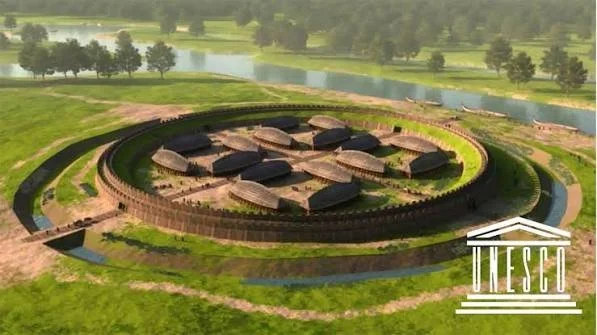
Although much of the original structure has disappeared beneath later urban development, archaeological investigations have revealed evidence of its enormous circular design.
Location
Nonnebakken occupied an important position near Odense.
Its location gave it access to regional transportation routes and surrounding agricultural resources.
The fortress could therefore serve as a strategic center for controlling movement through Funen.
Architectural Design
Like other Danish ring fortresses, Nonnebakken was characterized by a circular defensive enclosure.
Its layout appears to have followed a carefully planned geometric design.
The similarities with other fortresses suggest that they were constructed as part of a coordinated royal program.
Harald Bluetooth
The fortress is generally associated with the reign of Harald Bluetooth.
During this period Denmark experienced increasing political centralization.
The king needed mechanisms for controlling territory and mobilizing military forces.
Nonnebakken was likely part of that system.
Military Function
A fortress could accommodate warriors and protect supplies.
It could also serve as a staging point for military operations.
Its location on Funen made it strategically valuable because the island occupied a central position between parts of Denmark.
Archaeological Evidence
Excavations and geophysical investigations have helped reconstruct the fortress despite later development.
Evidence of ramparts, ditches, and internal organization demonstrates the site's scale.
Archaeological methods are especially important at Nonnebakken because much of the monument is no longer visible above ground.
Urban Transformation
Modern Odense developed around and over parts of the ancient site.
This illustrates an important challenge in archaeology.
Historic settlements often remain beneath modern cities.
Archaeologists must therefore combine excavation with:
aerial photography;
geophysical surveys;
historical maps;
soil analysis;
digital reconstruction.
Political Significance
Nonnebakken demonstrates that royal power extended beyond Jutland.
The construction of major fortifications on Funen indicates that political integration involved strategic infrastructure across the Danish kingdom.
Conclusion
Nonnebakken is a reminder that Viking Age monuments do not always survive as spectacular ruins.
Much of the fortress is now hidden beneath later development, yet archaeological investigation continues to reveal its original form.
As one of the Danish ring fortresses, Nonnebakken provides evidence for Harald Bluetooth's efforts to organize territory, strengthen military authority, and consolidate the Danish kingdom.
Its buried remains represent an important chapter in the emergence of a more centralized Scandinavian state.