The Bible, as you may well know, ranks as the highest-selling book in history and the bedrock of the Christian faith. It’s based on the words of Jesus of Nazareth, better known to many as Jesus Christ. According to the New Testament, the man himself lived some 2,000 years ago – which is something many scholars are intent on proving. And, it seems, archaeology is playing a major part in proving the truth behind the Gospels.
The 9 Types of Biblical Angels Explained
In the following video we will be explaining the 9 types of Biblical Angels. Watch the video to find out more!
The Beautiful Women of Bronze Age Europe
Bronze Age Europe saw the increasing expression of individual and group identity through clothing, hairstyles, and objects of personal ornamentation. But it’s in the artistic tradition of the civilisations of the Aegean that we most clearly see the emergence of ideals of beauty that we well recognise even today.
So how was female beauty represented? What jewellery and clothing did they wear? How did women enhance and emphasise their beauty? How were women represented in Minoan and Mycenaean art? And what did beauty mean to the people of Bronze Age Europe?
Gigantopithecus: The Largest Ape that Ever Existed
Peace is often fleeting in the natural world, however, and shortly after the deer begin their morning drink, they find themselves bolting back into the undergrowth to safety. A flock of birds has disturbed them from their gathering, sent soaring into the warm morning air by something huge moving through the undergrowth. Like something from a hollywood film, the bushes across the stream rattle and rustle, progressively faster, until a tall black shadow can be seen emerging from the tangle of bamboo and leaves. It's a primate - a colossal, reddish coloured, muscular, powerful primate. As its face steadily unsheaths itself from the greenery, it looks almost human - a kind, slow expression spreads across its huge cheeks as it too, pauses to check for tigers.
With none in sight, the primate - Gigantopithecus, a huge, extinct ape - can descend to the stream to drink. As a lone, adult male, this is his territory, and he will spend the morning coursing it for food and water. Although the terrified hoofed mammals are long gone, they needn't have worried - Gigantopithecus is a strict vegetarian, and would have at best just ushered them along so he could have drank in peace. Instead, this giant ape stands tall and proud in his forest home - he is one of the most remarkable animals living in these forests, and there is little that can do him harm.
Pushing through a lofty bamboo thicket, he soon finds himself in a densely surrounded forest clearing, surrounded by others of his kind - his family. Several females, a few yound males and some youngsters, born just last year, are at his command. As the leader of his troop, he will defend them from rival males and predators fiercely, siring as many of his family's children as he can within the constraints of his reign. He, and his kind, are the largest primates ever to live.
15 Most Dangerous Places to be on Earth
Let’s be clear. There are plenty of places on the planet that are perfectly safe to be. The places on today’s list are not. Whether it’s for inhospitable climates, toxic gasses, fires ablazing, death-defying drops, or lakes of lava, these are places you’ll definitely want to avoid. Here are the Top 15 Most Dangerous Place to Be. Enjoy!
US Expedition to an Inner Earth Kingdom
Shambhala is the name of an Inner Earth civilization supposedly hidden in the Himalayan mountains. Legends of Shambhala recorded in ancient Buddhist and Hindu scriptures led the US-funded Nicholas and Helena Roerich on an impossible quest to find the entrance… Were they successful, and what did they encounter on their journey?
Discoveries That Could Change History
From Celtic Britons to a Roman fort at Slack, in the following video we will be exploring discoveries that could change History. Watch the video to find out more!
How Egypts Pyramids were Really Built
The Great Pyramids of Giza are among the most amazing man-made monuments in history. They were built when Egypt was one of the world's wealthiest and most influential civilizations. The king, or Pharaoh, occupied a unique role in ancient Egyptian civilization, as reflected by their enormous scale. Although the construction of pyramids peaked in the late third dynasty and lasted until about the sixth century B.C., they were actually constructed from the beginning of the Old Kingdom until the end of the Ptolemaic period in the fourth century B.C. (c. 2325 B.C.). The Egyptian pyramids, which still transmit much of their grandeur after more than 4,000 years, offer a window into the nation's illustrious past. Watch the video to find out more about the construction of the Pyramids!
What was the master not allowed to do with slaves in ancient Rome?
In the following video we will be explaining what the master was not allowed to do with slaves in ancient Rome. Watch the video to find out!
Hidden Second Egyptian Sphinx Was Finally Revealed
Buried for most of its life in the desert sand, an air of mystery has always surrounded the Great Sphinx. Many questions about the sphinx remained unanswered, like, "Who built the sphinx? When was it built? And mostly, is the Great Sphinx the only sphinx? Or are there more?
Recently, archeologists have discovered another sphinx in Egypt. It backs up the idea of the Great Sphinx having a twin. Let's look at the theory of the second sphinx.
Archaeologists Have Unearthed A 9,000 Year Old City In Israel That Rewrites Human History
When an Israeli company wanted to build a new road from Matza to Jerusalem, their managers probably thought the process would be straightforward. It was thought that there were no significant historical sites in the area where the road was planned. The discovery, which was made just three miles outside of Jerusalem and was completely unanticipated, has the potential to fundamentally alter our understanding of ancient Israel. Watch the video for more!
Buddha Statue Discovered in Ancient Egyptian Port City
The recent discovery illuminates the extensive trading ties between Rome and India.
A Buddha figure measuring two feet tall was found in Berenike, an ancient Egyptian harbor city.
The relic, according to William Dalrymple of the New York Review of Books, is the first Buddha ever discovered west of Afghanistan. It offers fresh evidence of trade between ancient Rome and India and is made of Mediterranean marble.

Researchers uncovered the two-foot-tall Buddha statue in Berenike. Egyptian Ministry of Tourism and Antiquities
Researchers believe it was created in Alexandria somewhere in the second century C.E. based on stylistic features. According to Google Translate, the sun's rays form a halo around the statue's head, "which indicates his radiant mind," according to a statement from the Egyptian Ministry of Tourism and Antiquities.
According to the antiquities ministry, Berenike, which was established in the third century B.C.E., eventually grew to be one of the major ports in Roman-controlled Egypt. For many years, the city was a hub for the trade of semi-precious metals, textiles, and ivory before it was finally abandoned around the sixth century C.E.
Other objects found during recent Berenike excavations also seem to indicate a similar blending of cultures. One of these is a Sanskrit inscription from the time of Phillip the Arab, an emperor who succeeded Marcus Julius Philippus. He was emperor of the Roman Empire from 244 to 249 CE. He was born in what is now Syria.
These discoveries are a part of a growing body of information demonstrating the close ties between the Roman Empire and its prehistoric Indian counterpart. They also assist illuminate the special function Egypt performed, which was "centrally located on the trade route that connected the Roman Empire to many parts of the ancient world," according to the ministry of antiquities.
Researcher collaboration between American and Polish teams has resulted in the Berenike excavations. The American team is led by historian Steven Sidebotham of the University of Delaware, while Mariusz Gwiazda, an archaeologist at the University of Warsaw, is in charge of the Polish team.
Sidebotham, who had a strong commitment to the project, began working there as soon as excavations got under way in 1994. Since then, he and his colleagues have carried on their research into the past of the now-deserted port on the Red Sea despite the shifting forces of political turmoil and budget shortages.
For instance, Ann Manser of the University of Delaware Research journal reported in 2011 that archaeologists discovered a jar containing 17 pounds of black peppercorns imbedded in the courtyard floor of a Berenike temple in 1999. They originated in the first century and were exclusively grown in southwestern India at the period.
"You hear a lot about globalization today," Sidebotham said to the journal, "but there was a 'global economy' linking Europe, Africa, and Asia during the first century of the Christian era, and the city of Berenike is a perfect example of that."

Discovered in a shipwreck in 1900, the Antikythera mechanism is actually closer to 2,000 years old
It initially looked to be nothing more than a rusted lump of some type when it was found in a shipwreck off the coast of Greece, not far from Antikythera, in 1900. Yet in 1902, archaeologist Valerios Stais hypothesized that what is now known as the "Antikythera mechanism" was a type of astronomy-based clock after looking at the gear embedded in it. He was outnumbered because the majority believed that something so sophisticated had to have entered the wreck after its other, 2,000-year-old artifacts. It was believed that until 1,500 years later, nothing comparable had ever existed.
In 1951, British historian Derek J. de Solla Price began investigating the object, and by 1974, he had shown that it was in fact a device from 150–100 BC Greece. He realized it moved hands on the device's face with bronze gears meshing, in accordance with the Metonic cycle, a 235-month pattern that ancient astronomers used to predict eclipses.
Modern imaging technology had identified all 30 of the Antikythera mechanism's gears by the time a digital reproduction of it was published in 2009.
By putting the pieces together, it became apparent that the Antikythera mechanism could forecast not only the locations of the planets Mercury, Venus, Mars, Jupiter, and Saturn—planets that the Greeks were familiar with—but also the positions of the sun, moon, and eclipses. There is even a rotating black and white stone that shows the moon's phases. Apple developer Andrew Carol built a working Lego model of the gadget to demonstrate how it works.
Before advanced imaging technology made it easier to see, the ancient Greek letters on the device's components were too small to read—some of its characters are only 1/20th of an inch wide. A global group of experts shared fresh information gleaned from these papers in June 2016. About 3,500 characters have been read so far in the description of the device.
The text validates the capabilities of the Antikythera mechanism with a few unusual twists. The inscription refers to upcoming eclipses by color, which shows that earlier generations thought they held some type of significance. Second, it appears that several people worked together to create the device on the Greek island of Rhodes, and it was probably not the only one of its kind. It turns out that the Greeks' understanding of mechanics and astronomy was even greater than we previously believed.
On old parchment, a hidden, never-before-seen version of the Gospel of Matthew is revealed by UV light
Unseen until now, a hidden, old Bible fragment was discovered by a historian in the Vatican.
A hidden passage from the Gospel of Matthew, written in Old Syriac and different from what is currently seen in the Bible, has been found by a historian examining a text in the Vatican.
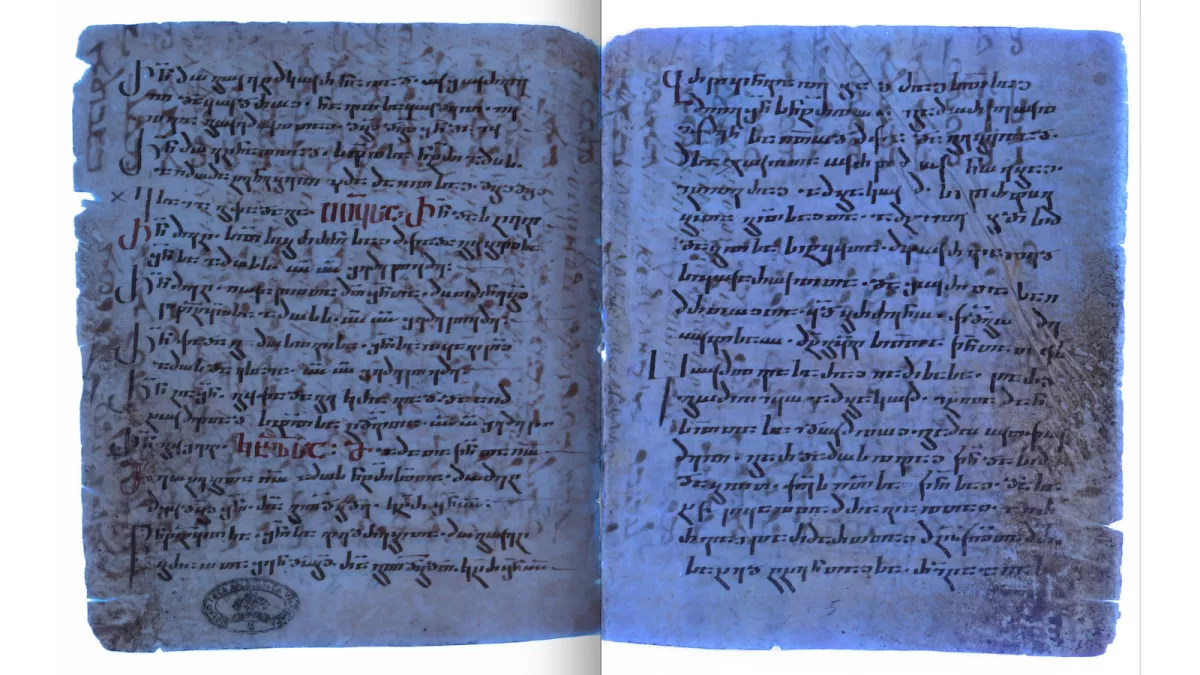
Ultraviolet photography revealed a hidden text containing part of the Gospel of Matthew written in Old Syriac. (Image credit: Image courtesy of Grigory Kessel)
Ultraviolet (UV) photography was used to uncover the alternative gospel. Scribes frequently reused parchments, writing over older manuscripts, because parchment was rare in the Middle Ages, according to a statement from the researchers.
The parchment's most recent writing is in Georgian, while a Greek earlier writing may be found beneath it. But when Grigory Kessel, a researcher at the Austrian Academy of Sciences who specializes in Syriac, looked at UV images from the Vatican library, he discovered yet another layer buried beneath the Greek text.
Matthew 12:1 is partially found in the Old Syriac text. Kessel hypothesized that someone in the sixth century transcribed the phrase onto the parchment. Kessel speculates that the original could have been written in the third century based on the language.
This gospel was probably written sometime in the second half of the first century and is typically credited to the apostle Matthew. Therefore, the recently discovered text is likely 200 years younger than the majority of the gospel.
The verse now reads, "at that time Jesus went through the grainfields on the Sabbath; and his disciples became hungry and began to pick the heads of grain and eat," according to the statement. The recently found Old Syriac text, however, states that the disciples "began to pick the heads of grain, rub them in their hands, and eat them."
According to Kessel, who spoke with Live Science, there is just one other Old Latin-written Gospel manuscript that makes the assertion that the disciples rubbed grain in their hands. If rubbing the grain had any religious significance is unclear.
In an email to Live Science, Sebastian Brock, a retired professor of Syriac at the University of Oxford, said, "This is indeed an exciting discovery, and a brilliant piece of decipherment." Brock observed that the gospels' copies in Old Syriac and Old Latin frequently diverge from other versions. The Middle Ages saw an increasing standardization of the gospels.
These kinds of findings are important for understanding the early development of the New Testament text before it took on the recognized form found in contemporary editions and translations, according to Brock.
9 Rivers That Are Drying Up and The Reason Will Shock You
The world's rivers, the life-giving arteries of our planet, are rapidly dwindling due to extreme climate changes. In this riveting video, we will try to understand the reasons behind this looming crisis. Stay tuned to the end of the video, because it is gonna unfold some secrets. Enjoy!
The Mysterious Sword that No One Is Allowed to Touch
Swords date back to the Bronze Age, which is when we started to see differences between knives and daggers. Since then, we’ve seen some incredible examples of swords used in battles and for decorative purposes. Some are so incredible that people aren’t sure if they’re even real. From Napoleon’s sword at the Battle of Austerlitz to an important enthronement ceremonial sword, here are 20 most legendary swords that actually exist.
A Look Inside the Roman Brothels of Ancient Pompeii
The story of Pompeii’s destruction is renowned across the world. In 79 AD, this prosperous Roman town was destroyed by a massive, volcanic eruption. Pompeii became frozen in time, only to be rediscovered c.1500 years later.
Vesuvius’ eruption has preserved Pompeii in its final moments. The wealth of archaeology that has been unearthed over the past few centuries here is extraordinary. From gladiator graffiti to political adverts. And amidst all of this archaeology, we even have the names of actual Pompeiians surviving. The stories of everyday people - men and women - who lived and worked all around the town some 2,000 years ago. Not emperors, empresses and generals. But bakers, barmen and prostitutes whose stories are usually lost to history.
Tristan Hughes explores the stories of some of these men and women who called Pompeii home. Wealthy villa owners such as the entrepreneurial businesswoman Julia Felix, who owned a luxurious estate near the amphitheatre and converted part of her property into a restaurant. The plucky bar owner Sextus Amarantus, who imported wines from as far away as Gaza to sell at his establishment. Or the famous freeborn gladiator Marcus Attilius, who defeated a great champion in his very first arena fight.
In this video, Tristan steps inside one of Pompeii's infamous brothels, "Lupanar", known for the erotic paintings on its walls and its close association with Venus, a deity of sex and a mythological figure closely tied to prostitution.
Later, Tristan enters one of the oldest surviving Roman amphitheatres in Pompeii that was buried by the eruption of Vesuvius in 79 AD and explores the lives of those gladiators who risked their lives every time they stepped into the arena.
100 Most Amazing Ancient Ruins of the World
The world is littered with ancient ruins of man-made cities and settlements dating back thousands of years. We have compiled for you the ruins that represent the extraordinary achievements of humanity in various cultures and civilizations from South America to Mesopotamia and from Africa to Asia.
Medieval words you should start using today
In this video we will present to you the medieval words that we think we should bring back. Enjoy!
Complete History Of Earth In 7 Minutes
Have you ever thought about how our planet Earth came into existence? What was the first life form that existed on Earth billions of years before the humans came into existence? What caused the extinction of dinosaurs? For how recent have the humans appeared on Earth as compared to the age of planet Earth? These are some of the mind boggling questions that raise curiosity. Let's find out the complete history of earth, from the time Earth came into existence billions of years ago to the present time.