The Mysterious Giant Figures of the Sahara: Who Painted Ti-n-Torha's Round Heads?
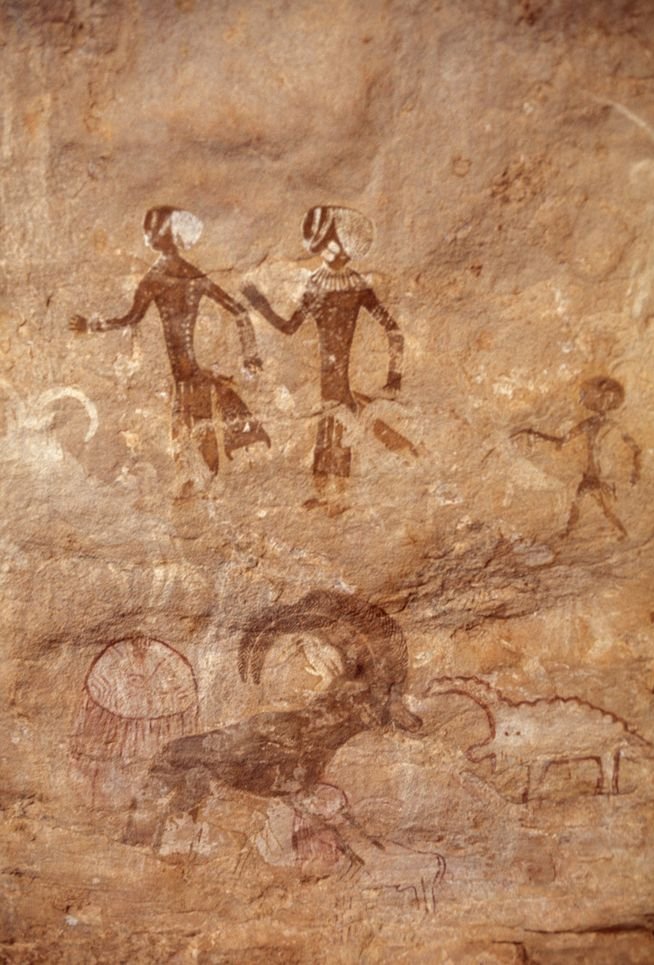
Among the most mysterious prehistoric images of the Sahara are the so-called Round Head paintings.
These unusual figures are characterized by large circular or featureless heads and elongated human bodies.
Some appear isolated.
Others appear in groups.
Their unusual appearance has inspired fascination, speculation, and sometimes outright pseudoscientific theories.
In rock shelters associated with the broader Ti-n-Torha/Tin Torha landscape of southwestern Libya and the central Saharan cultural world, prehistoric art forms part of a long sequence of human activity.
However, identifying every individual panel and assigning it to a precise cultural group remains difficult. “Round Head” is primarily an archaeological and art-historical descriptive category rather than the known name of the people who created the images.
The mystery remains profound.
But the archaeological evidence points toward prehistoric human culture—not visitors from another planet.
What Are Round Head Paintings?
The term describes a recognizable artistic style found in several parts of the central Sahara.
Typical characteristics may include:
Large rounded heads.
Simplified facial features.
Elongated bodies.
Dynamic body positions.
Group scenes.
Large-scale human figures.
Some of the figures appear almost supernatural to modern observers.
But prehistoric symbolism often uses exaggeration.
A figure may be deliberately enlarged because of ritual importance.
Why Are the Heads So Large?
No one can say with certainty.
Possible explanations include:
Masks.
Ceremonial head coverings.
Ritual transformation.
Symbolic exaggeration.
Supernatural beings.
Artistic convention.
The problem is that prehistoric artists did not leave written explanations.
Modern archaeologists must study patterns.
If similar figures appear repeatedly, this suggests shared artistic traditions.
The “Alien” Myth
Because some Round Head figures appear strange, they have been used in claims about ancient astronauts.
These theories are not supported by archaeological evidence.
The figures can be understood within the broader development of prehistoric Saharan art.
Ancient societies created symbolic images.
Modern people should not assume that unusual art requires a supernatural explanation.
The fact that we do not understand an image does not mean its creators were not human.
Ti-n-Torha and the Archaeological Landscape
The Ti-n-Torha area is important as part of the wider prehistoric landscape of southwestern Libya.
Rock shelters, caves, archaeological deposits, and artistic remains reveal repeated human use of these environments.
A site should never be separated entirely from its surroundings.
The artists moved through landscapes.
They hunted.
They gathered resources.
Later groups managed livestock.
The rock paintings are therefore part of a larger human history.
The Round Head Period and the Green Sahara
Round Head imagery is generally associated with prehistoric periods when parts of the Sahara experienced wetter climatic conditions than today.
The environmental setting supported human occupation.
The people who created these images did not inhabit the same desert environment seen by modern visitors.
They lived in a landscape with greater access to water and biological resources.
Ritual and Transformation
One of the most compelling interpretations of Round Head art concerns ritual.
The figures may represent altered identities.
A person wearing a mask could become a symbolic being.
Dance and ceremony might transform ordinary bodies into sacred images.
Such practices are known in many human societies.
Therefore, a strange-looking figure may represent a human participant in a ritual rather than an imaginary creature.
Art as Communication
The Round Head paintings demonstrate that prehistoric communication was not limited to spoken language.
Images can preserve ideas.
A figure may communicate:
Identity.
Myth.
Ritual.
Social status.
Group membership.
The paintings may have been understandable to their original audience even if they remain mysterious today.
The Challenge of Dating
Dating rock paintings is difficult.
Unlike organic objects, mineral pigments and stone surfaces may not provide straightforward radiocarbon dates.
Researchers therefore use multiple approaches.
These can include:
Associated archaeological deposits.
Pigment analysis.
Superimposition.
Environmental context.
Stylistic comparison.
A painting layered over another painting can provide relative chronological evidence.
But assigning an exact year remains challenging.
From Round Heads to Pastoral Art
The broader Saharan artistic sequence demonstrates cultural change.
Earlier traditions emphasizing unusual human figures and wild animals were eventually joined or replaced by pastoral imagery.
Cattle became increasingly prominent.
This suggests major changes in the economy and social organization of Saharan populations.
The Round Head artists belonged to a world that existed before the Sahara became the vast hyper-arid desert known today.
Why Ti-n-Torha Matters
The mystery of Ti-n-Torha's prehistoric art is not a weakness.
It is what makes the site so important.
Archaeology does not always provide simple answers.
Sometimes the evidence allows us to reconstruct technology but not belief.
We can identify pigments but not prayers.
We can date occupations but not every story.
The Round Head paintings remind us that prehistoric people possessed complex symbolic worlds.
Their ideas may be permanently lost.
But the images remain.
Across thousands of years, strange human figures still stare from the stone.
And perhaps that is the most extraordinary part of Saharan rock art:
the artists are gone, their languages are silent, and their world has disappeared—but their imagination is still alive on the walls.