Timgad, known in antiquity as Thamugadi, is one of the best-preserved examples of Roman urban planning in North Africa. Founded during the reign of Emperor Trajan around the beginning of the second century CE, the city was established as a Roman colony in what is now northeastern Algeria.
The ruins of Timgad are famous for their remarkably visible street grid.
Even today, visitors can clearly see the remains of:
straight roads;
public buildings;
temples;
baths;
markets;
houses;
and monumental arches.
The city demonstrates how Roman institutions, architecture, and urban planning were introduced into the provinces while also adapting to local conditions.
The Foundation of Thamugadi
Timgad was founded as a Roman colony under Emperor Trajan.
The settlement was initially associated with Roman veterans, particularly soldiers who had completed their military service.
Veteran colonies served several purposes.
They could:
reward former soldiers;
strengthen Roman control;
encourage agricultural development;
and promote Roman political and cultural institutions.
The establishment of Timgad illustrates the close relationship between military expansion and urban colonization.
Roman Grid Planning
One of Timgad's most famous features is its orthogonal street system.
Roman cities were often organized around two principal roads:
the cardo maximus, running broadly north to south;
and the decumanus maximus, running broadly east to west.
Other streets intersected these main routes, creating a grid.
This design helped organize:
movement;
property;
drainage;
commercial activity;
and public space.
The grid visible at Timgad provides an exceptional archaeological example of Roman urban planning.
The Forum
At the center of Roman civic life stood the forum.
The forum served as a major public space where people could conduct political, commercial, religious, and social activities.
Important buildings surrounding the forum could include:
administrative offices;
temples;
basilicas;
monuments;
and meeting spaces.
The organization of the forum reflected the Roman understanding that civic life should be concentrated within an identifiable public center.
Religion in Roman Timgad
Religion was deeply integrated into Roman urban life.
Temples and shrines were dedicated to Roman gods, local deities, and later Christian institutions.
Roman religion was not a single uniform system.
Across the empire, local populations frequently combined Roman traditions with older regional beliefs.
This process is often described as religious syncretism.
North Africa therefore developed religious landscapes that reflected both Roman influence and local cultural traditions.
Public Baths
Bathhouses were essential institutions in Roman cities.
They provided facilities for:
washing;
exercise;
socializing;
and relaxation.
A large bath complex required sophisticated engineering.
Roman baths could include:
changing rooms;
cold rooms;
warm rooms;
hot rooms;
pools;
furnaces;
and underground heating systems.
The hypocaust system allowed hot air to circulate beneath floors and sometimes within walls.
The Arch of Trajan
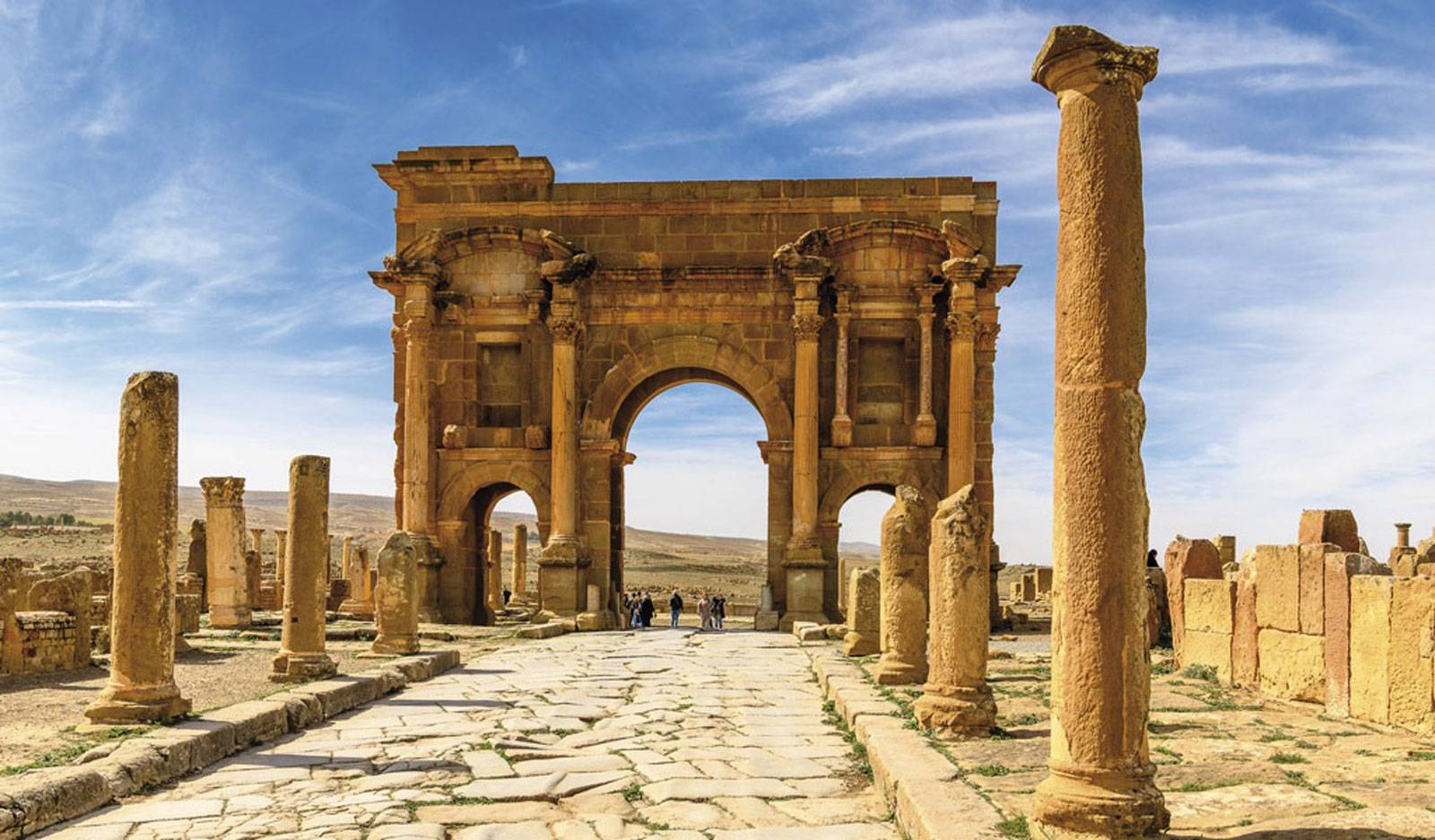
The monumental arch associated with Timgad is among its most recognizable surviving structures.
Such monuments were designed to communicate Roman authority and commemorate important individuals or events.
Triumphal architecture transformed ordinary movement through a city into a symbolic experience.
Passing beneath an arch could remind residents and visitors of the political power of Rome.
The Library of Timgad
Timgad also contains the remains of a structure commonly identified as a library.
The existence of such a building illustrates the importance of literacy and written culture in urban Roman society.
Books in the Roman world were typically written on scrolls or, increasingly during later periods, codices.
A library required:
storage;
cataloging;
maintenance;
and educated users.
Its presence reflects the cultural complexity of the city.
Housing and Daily Life
Roman Timgad was not composed only of monumental buildings.
Most residents lived in ordinary houses and apartments.
Daily life involved:
cooking;
childcare;
craft production;
shopping;
religious activity;
and social interaction.
Archaeological remains allow researchers to study differences between wealthy residences and more modest homes.
From Roman Colony to Expanding City
Timgad did not remain confined to its original plan.
As the population grew, buildings expanded beyond the initial boundaries.
This demonstrates an important reality of Roman urbanism: even carefully planned cities changed over time.
New neighborhoods, religious buildings, and commercial spaces were added as economic and social conditions evolved.
Christianity and Late Antiquity
By the later Roman period, Christianity had become increasingly important in North Africa.
Timgad developed churches and other Christian institutions.
The city also became part of the religious conflicts that affected Roman Africa, including disputes involving the Donatist movement.
These religious disagreements reveal that Christianity in late antiquity was not a single politically unified institution.
Decline and Transformation
Like many Roman cities, Timgad experienced major changes during late antiquity and the early medieval period.
Political instability, economic change, and shifts in regional power affected urban life.
The city was eventually abandoned.
Sand gradually covered parts of the ruins, helping preserve sections of the Roman street plan for later discovery.
Why Timgad Matters
Timgad is one of the clearest surviving examples of Roman urban planning.
It demonstrates:
the structure of a Roman colony;
veteran settlement;
grid-based city design;
public architecture;
Roman engineering;
and the transformation of North African society under Roman rule.
Conclusion
Timgad offers an extraordinary view of how Rome organized urban life far from the Italian peninsula.
Founded as a colony for veterans, the city developed into a complex North African community with baths, temples, markets, libraries, houses, and monumental architecture.
Its surviving streets provide a visible map of Roman urban ideals, while its later religious and political history demonstrates how even a carefully planned city continually changed over the centuries.