Thousands of Ancient Images Cover These Libyan Cliffs—and Archaeologists Are Still Decoding Them
The Messak Settafet plateau in southwestern Libya contains one of the most remarkable concentrations of prehistoric rock art in the Sahara.
Across its sandstone surfaces, prehistoric communities created thousands of engravings over long periods of time.
Animals.
Human figures.
Footprints.
Hunting scenes.
Cattle.
Symbols.
Each image forms part of a much larger archaeological landscape.
The Messak is particularly important because its rock art is not isolated from evidence of prehistoric activity.
Archaeologists have also studied campsites, stone tools, environmental evidence, and other traces of human occupation.
This allows the engravings to be studied as part of an entire prehistoric world rather than as disconnected works of art.
What Is the Messak?
The Messak is a large sandstone plateau in the central Sahara.
It is divided into major areas, including Messak Settafet and Messak Mellet.
Its cliffs and exposed rock faces provided ideal surfaces for engravings.
Over thousands of years, people repeatedly used these landscapes.
The result is an extraordinary accumulation of images.
Why Did People Choose the Rock Faces?
A suitable rock surface could preserve an image for millennia.
Sandstone develops dark surface coatings known as desert varnish or patination.
When artists removed or disturbed the darker surface, the lighter stone beneath could become visible.
This produced a contrasting image.
Over time, the surface could weather again.
Researchers can sometimes study differences in patination to help establish relative chronological sequences, although this does not provide exact dates by itself.
The 10,000-Year Chronology
The phrase “10,000-year engravings” describes the great antiquity of the region's artistic traditions rather than assigning every image a precise age.
Rock art accumulated over long periods.
Some works may belong to early Holocene communities.
Others represent later pastoral societies.
Still later images reflect the arrival of new technologies and animals.
The Messak is therefore best understood as a multi-period archive.
The Animals of the Ancient Sahara
The engravings depict animals that reveal environmental history.
Images may include:
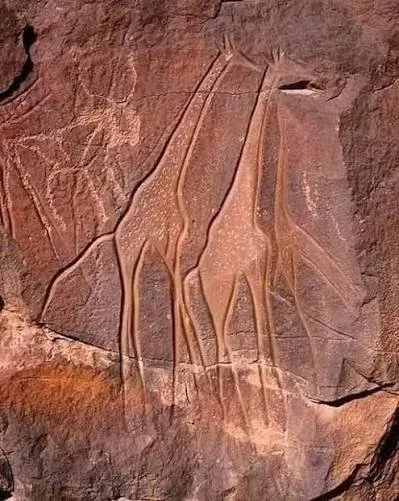
Giraffes.
Elephants.
Bovids.
Ostriches.
Wild cattle.
Other large fauna.
The presence of such animals is crucial.
They indicate ecological conditions dramatically different from those found in the modern desert.
A carved giraffe is not simply a work of art.
It is evidence that the prehistoric artist knew an animal associated with a landscape containing sufficient vegetation.
Hunting Scenes
Many Saharan engravings depict relationships between humans and animals.
Some scenes appear to represent hunting.
These images may preserve information about:
Weapons.
Cooperative activity.
Animal behavior.
Human movement.
But, once again, literal interpretation must be cautious.
A hunting scene may also have symbolic or ritual meaning.
The Emergence of Pastoralism
As prehistoric societies changed, cattle became increasingly visible in Saharan art.
The appearance of domesticated animals reflects major economic and social transformation.
Pastoralism allowed communities to obtain resources from managed herds.
But it also required mobility.
Herders needed to understand the landscape.
They followed seasonal patterns.
They searched for grazing.
They protected their animals.
The rock art preserves this relationship between humans, animals, and territory.
Footprints and Human Presence
One of the fascinating features of Saharan rock art is the presence of human and animal footprints.
A footprint carved into stone may seem simple.
Yet it can be deeply symbolic.
It may indicate:
Presence.
Movement.
Identity.
A particular journey.
Ritual activity.
Researchers continue to debate the meaning of such imagery.
Rock Art as a Landscape
The Messak cannot be understood by examining only one engraving.
The placement of images matters.
A panel near a route may have a different significance from one hidden deep within a rock shelter.
Archaeologists therefore study:
Visibility.
Orientation.
Nearby archaeological remains.
Access to water.
Animal routes.
Geological features.
The entire landscape may have been meaningful.
Why the Messak Is So Important
The Messak Settafet demonstrates that prehistoric art was not an isolated cultural activity.
The people who created the engravings also hunted, traveled, gathered resources, raised animals, and responded to environmental change.
The images were created by real communities living in a rapidly changing world.
And the cliffs of Libya became their archive.
Ten thousand years later, the archive remains open.
The challenge is learning how to read it.