From muddy dragons to 200 ocean mollusks, in the video below we will be exploring some incredible discoveries made underwater. Enjoy!
List of Kings And Queens of England & Britain
In the following video we will be going through a list of the kings and queens of England and Britain. Watch the video to find out more!
Hidden Volcano Abyss: Behind Tonga's Massive Eruption
In January 2022, one of the most powerful volcanic eruptions in recorded history rocked the Pacific islands of Tonga, sending shockwaves around the world. Through first-person accounts of the disaster and eyewitness footage, experience the terrifying power of the eruption and the devastating tsunami that struck the shores of Tonga. Why was this eruption so big, how did it cause the tsunami, and could another disaster loom?
Why did our brains shrink?
We've lost a lemon sized piece of brain. Here's three hypotheses that try to explain what happened. Watch the video to find out!
Gateway to Heaven Created by the Ancient Natural Power
This is the gateway to heaven, created by the ancient natural power. People climbed a hundred stairs, just to get closer to their faith.
This natural formation is located in Tianmen, which is the highest mountain in Zhangjiajie. With an altitude of 4980 feet (1518 meters), Tianmen has been a site of wonder for the Chinese for thousands of years.
Due to the high altitude of Tianmen, the sunrise on the mountain occurs 30 minutes earlier in comparison with the surrounding cities. Because also the sunset happens later, up to 45 minutes, “Tianmen is known as an endless sky without darkness.”
Thank You For Being Extinct
When we hear news that various species are facing extinction it is generally considered to be an utter tragedy, and we often attempt to resurrect these stricken creatures from permanent disappearance.. There are, however, a few creatures that have existed in the long history of our planet that we might be relieved no longer exist. Hang on in there and you may be lucky enough to find out all about a truly enormous millipede - fans of our face-crawling ident will totally love this.
From a ten foot tall ape to the most enormous and furious crocodile ever, here are 20 Terrifying Animals You’re Glad Are Extinct.
Taq-e Bostan on Large Rock Reliefs Carved in the 4th Century AD
Taq-e Bostan, which means Arch of the Garden or Arch made of stone, is a site with a series of large rock reliefs from the era of the Sassanid Empire of Persia, carved around the 4th century CE.
It consists of three main parts which are framed investitures of Ardashir II, the big Taq, and the small Taq. The big one is a masterpiece depicting the kingdom of Khosrow II and the small one is a memorial from Shapur III.
The monument symbolizes power and glory. The carvings of the entrance part of the vault represent parties of the kings and governors wonderfully done by Persian professional artists of those days.
Taq-e Bostan and its relief patterns accentuate power, religious tendencies, glory, honor, the vastness of the court, game and fighting spirit, festivity, joy, and rejoicing.
Sassanid kings chose a beautiful setting for their rock reliefs along a historic Silk Road caravan route waypoint and campground. The reliefs are adjacent to sacred springs that empty into a large reflecting pool at the base of a mountain cliff.
Taq-e Bostan and its rock relief are one of the 30 surviving Sassanid relics of the Zagros mountains. According to Arthur Pope, the founder of the Iranian Art and Archeology Institute in the United States of America, “art was characteristic of the Iranian people and the gift which they endowed the world with.”
The site and its rock relief are one of the 30 surviving Sassanid relics of the Zagros mountains.
12 Most Incredible Archaeological Finds
As someone who’s interested in the ancient world, we're confident that you're just as intrigued by extraordinary discoveries as we are - after all, why else would you be here? Our mission is to bring you captivating stories of incredible finds from distant lands and long-ago times, and this video is no exception. So, without further ado, let's dive into the stories and not waste a single moment!
What Do You Eat in Antarctica? | Antarctic Extremes
Generally, an adult human consumes around 1,600 to 3,000 calories daily. But in colder climates, people need to eat more: Keeping our warm-blooded bodies warm requires a lot of energy. It’s so cold in Antarctica that the average person needs to consume 3,200 to 5,000 calories a day (watch out, Michael Phelps). And because the continent is frozen, no food grows there naturally.
So how do the hundreds of scientists and support personnel who visit Antarctica’s McMurdo Station each year stay fed?
Throughout their one-month stay in Antarctica, hosts Caitlin Saks and Arlo Pérez discover the secret sauce of Antarctic cooking from experts at McMurdo’s galley (Hint: Need to reconstitute a meal? Just add cheese! Need to keep that cheese beyond its expiration date? That’s what freezers are for) and scientists at remote research sites. They glimpse the early days of Antarctic food storage at a long-preserved hut from theTerra Nova Expedition that began in 1910.
Along the way, Caitlin and Arlo discover the glory of 24/7 pizza and “freshies,” the cardboard-like texture of a protein bar several years past its expiration date, and the true meaning of “eat your vegetables.”
Ancient Skeleton Mosaic Uncovered in Turkey Reads “Be Cheerful and Live Your Life”
Archaeologists in Turkey recently unearthed an exceptionally preserved mosaic inside the remains of a building from the 3rd century. One section of the three-panel artwork includes a reclining skeleton with an arm over its head, holding a glass of wine and resting an elbow on a loaf of bread. On both sides of its head reads the phrase “Be Cheerful and Live Your Life” written in Greek.
The purpose of the building surrounding the mosaic, and even when it was made is currently being debated. Some experts believe the triptych was simply the floor of a wealthy person who could afford to have it built, while others think it might be a message in a soup kitchen urging people to get their food quickly and leave.
It was found in 2012 during the construction of a cable car system in the Antakya district of Hatay province Antioch in antiquity, the southernmost province of Turkey.
It is believed to have been the emblema, the elaborate centerpiece of a mosaic floor, in the triclinium dining room of an elegant villa. There are three scenes inside a rectangle with a woven guilloche border. On one end is missing a large section but the head and arms of a servant carrying a flame are visible. This represents the heating of the bath. The middle scene is almost intact and depicts two men moving towards a sundial on a column. The leader is a young man who was of some rank in the household, the son of the owner, perhaps, while the his manservant or butler follows. The sundial is set to between 9:00 and 10:00 PM and the text refers to him being late for dinner. The last panel has the recumbent skeleton, holding a drinking cup in one hand, his other arm thrown casually over his head, two loaves of bread and a wine amphora by his side. The motto “Be cheerful and live your life” is written on both sides of his head.
Writer İlber Ortaylı disputes the eat, drink and be merry interpretation. He reads it as “You get the pleasure of the food you eat hastily with death” and thinks the structure was not a private home of a wealthy person, but a sort of soup kitchen trying to hustle people out the door as quickly as possible.
There’s some confusion over the date of the mosaic. The first article about the find that I read said it was from the 3rd century, which means AD, but later stories by the same press outlet date it to the 3rd century BC. That in turn has been picked up by the international press. Greek was spoken and written by the elites in both periods, so the words are of no particular help.
This one says “Hatay is known for its Roman-era mosaics dating back to the second and third centuries BC,” but those are not Roman dates. Antioch was founded by Alexander the Great’s general Seleucus I Nicator in 300 BC and was ruled by Seleucid monarchs until 64 BC when it was absorbed into the Roman Syrian province as a free city.
Codes Symbols and Hidden Agendas / Knights Templar
The Knights Templar with its mysterious history and secret secrets, the meanings of encrypted symbols, and the trail of the Holy Grail, has captured great interest from researchers and history enthusiasts. In-depth research is conducted to explore the enigmatic world of the Knights Templar, carefully examining past conspiracies and religious connections. This thrilling subject encourages enthusiasts to embark on a journey of exploration and research, empowering them to uncover the veil of the mysterious past. Codes, symbols, and hidden agendas play a significant role in unraveling the secrets of the Knights Templar.
Porphyrios: The Sea Monster that Terrorized the Late Roman Empire
The sixth century historian Procopius, in both his History of the Wars, and The Secret History, mentions a sea monster--a gigantic whale--named Porphyrios that dwelt in the Bosporus Strait and the Black Sea, and which terrorized the shipping lanes around Constantinople for about fifty years, and which causes significant headaches for the Emperor Justinian & the Roman navy. Our information is fairly limited, but what can we say about this real life Moby Dick?
Archaeological discovery made beneath a Paris train station
In today’s video we're going to delve into an incredible archaeological discovery made beneath a Paris train station: an ancient necropolis dating back nearly 2,000 years. Located beneath the bustling Port-Royal station on the historic Left Bank, this lost necropolis belonged to the Gallo-Roman town of Lutetia, which is modern-day Paris. The site was overlooked during the station's construction in 2014 and was only discovered when plans for a new station exit were announced.
The Plain of Jars: megalithic archaeological mystery in Laos
In the video below we will be exploring the Plain of Jars, a megalithic archaeological mystery in Laos. Enjoy!
Secrets of the Sphinx (the ancient Egyptian mystery)
In the following video we will be explaining the secrets of the Sphinx. Watch the video to find out more!
A Day In The Life Of A Viking
In this video, we delve into the vibrant tapestry of Viking society, focusing on the daily lives of free men and women, as well as the contrasting experiences of slaves, both adults and children. Enjoy!
The most impressive historical artifacts with the skillful craftsmanship of Ancient History
In this video we will go through some of the most impressive historical artifacts that constitute material evidence of the dexterous workmanship of old times. Enjoy!
The Dodo Bird: 5 Things You May Not Have Known
Although the dodo became extinct in 1690, this bird was more complex than you would realize.

Dodos were odd birds. According to popular belief, the name "dodo" derives from the Dutch word "dodoor," which means lethargic. But after examining its anatomy, scientists believe it was capable of running quickly.
The dodo, however, was not swift enough to escape its fate. The dodo was ready to believe the human settlers who came to its island because it was living on an island without predators and this led to its eventual extinction. Here are five additional facts about the dodo that you might not be aware of.
1 Weird Appearance
Dodos, which descended from Asian pigeons, lived on the Indian island of Mauritius. It had a massive head, a big hooked-tipped bill, and short legs. It weighed roughly 50 pounds. Most notably, their pectoral muscles weren't powerful enough to fly, and their wings were too short. Most likely, evolutionary biology is what led to this.
Dodos evolved to become larger and lost their capacity to fly since they were no longer need to use flight to flee from predators. Ostriches and penguins are two more birds that once flew but have since lost their ability to do so.
2 Reproduction
Despite the fact that many birds lay multiple eggs at once, it has been assumed based on eyewitness accounts that a female dodo would only lay one egg at a time. They would construct their nests on the ground and encircle them with grass as they were incapable of flying.
Up until 1638, when Dutch settlers began to arrive in Mauritius, the dodo population was thriving. The dodo population never rebounded once people moved in and started killing them; finally, they became extinct.
3 Extinction
The dodo had all the food it needed to survive, thrive, and live in safety in Mauritius for many years. As was previously said, that is, until a Dutch settlement arrived up. Contrary to common perception, settlers didn't enjoy the taste of the dodo bird, and their consumption did not cause the dodo population to decline.
Rats, monkeys, dogs, sheep, and pigs were just a few of the creatures the immigrants brought with them that decimated the dodo population. While humans harmed the trees where the dodos resided, these animals destroyed nests and ate the eggs. Although experts put the period as late as 1690 in 2013, the generally accepted extinction date is 1662.
4 They Weren't Stupid
"Ignorant," "dummy," "moron," and "dull" are a few synonyms for "dodo." However, dodos were not naive. Their brain-to-body ratio, according to research, indicates that they are of average intelligence. Dodos also have a big olfactory bulb, which improved their sense of smell. Birds usually rely on vision, thus this is rare for them.
5 Researchers May Try To Bring Them Back
Beth Shapiro, an evolutionary researcher, explores isolated areas in search of fossils from which to extract the DNA of extinct species. Her research has primarily concentrated on the dodo among other animals. She stated that the dodo had been fully sequenced earlier this year, albeit the results had not yet been made public. She has shown interest in the prospect of reviving the dodo.
According to her in an interview with Smithsonian Magazine, "if the dodo were to be brought back, it could be restored to protected habitats on [the island nation of] Mauritius, where people could go to observe dodos in their native habitat."
Augustus and the "Altar of Peace"
In today’s video we will be exploring a monumental altar in the heart of Rome and the rise of the first emperor. Watch the video to find out more!
Dunkleosteus: One of the largest and fiercest sharks 380 million years ago
The name Dunkleosteus is a combination of two words: ‘osteon’ is a Greek word for bone, and Dunkle is named after David Dunkle. A well-known American paleontologist whose study mostly concentrated on fish fossils and is best known for his work in vertebrate paleontology at the Cleveland Museum of Natural History.

This placoderm is reputed to consume anything, or at least most things, and is extremely fast and powerful. The Dunkleosteus is one of the biggest placoderms ever to have lived and is said to have been one of the fiercest during the Late Devonian era, often known as the ‘Age of Fishes.’
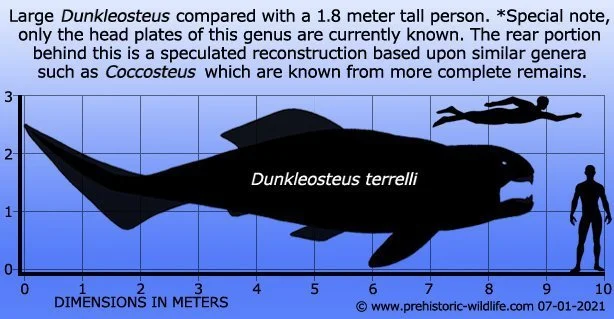
The Dunkleosteus was known to weigh up to 8000 lb (3600 kg) and have a length of up to 346 in (8.8 m). D. terrelli, D. Belgicus, D. denisoni, D. marsaisi, D. magnificus, D. missouriensis, D. newberryi, D. amblyodoratus, and D.raveri are the 10 species of Dunkleosteus.
They are noted for their strength and ability to move their jaws swiftly, allowing them to effortlessly hunt animals. Dunkleosteus fossils have been discovered in North America, Morocco, Poland, and Belgium, among other places.
The Dunkleosteus appears to be an intriguing animal, however, there is little information known about it owing to extinction and age (it existed 360-370 million years ago). While nothing is known about many areas of the Dunkleosteus body, substantial information has been gathered from Dunkleosteus fossils and reconstruction.
The Dunkleosteus was revealed to have a two-part bony and armored exterior. It has two pairs of sharp bony plates that form a beak-like shape. Reconstructions have also revealed that certain Dunkleosteus species possessed pectoral fins, suggesting that the fin pattern in placoderms is heavily impacted by mobility needs.
Dunkleosteus terrelli is distinguished by its shark-like look and a prominent front lobe on its tail. The Dunkleosteus was the most powerful fish alive during the Late Devonian era. It is reported to reach 346 in (8.8 m) long and weigh up to 8000 lb (3600 kg), making it one of the biggest placoderms ever to have existed.
The Dunkleosteus is recognized for its large and muscular physique, as well as its enormous biting force capable of effortlessly chopping ancient sharks. A Dunkleosteus is one of the biggest fish species ever known to exist. They may weigh up to 8000 lb (3600 kg), making them large creatures.
Dunkleosteus was not a particularly excellent swimmer, according to legend. Because it was usually found in shallow seas and oceans, its bone structure was adequate to defend itself against other species, and its abundance did not cause Dunkleosteus to travel deep into the sea in search of food. The Dunkleosteus was a sluggish swimmer due to its thick and bony body and armor-like bone structure.
The Dunkleosteus had a system known as four-bar linkage, which allowed it to extend its jaw quickly and deliver a strong biting force while shutting the mouth. The pressure produced aided the Dunkleosteus in cutting through any cuticle, dental build, or armor.
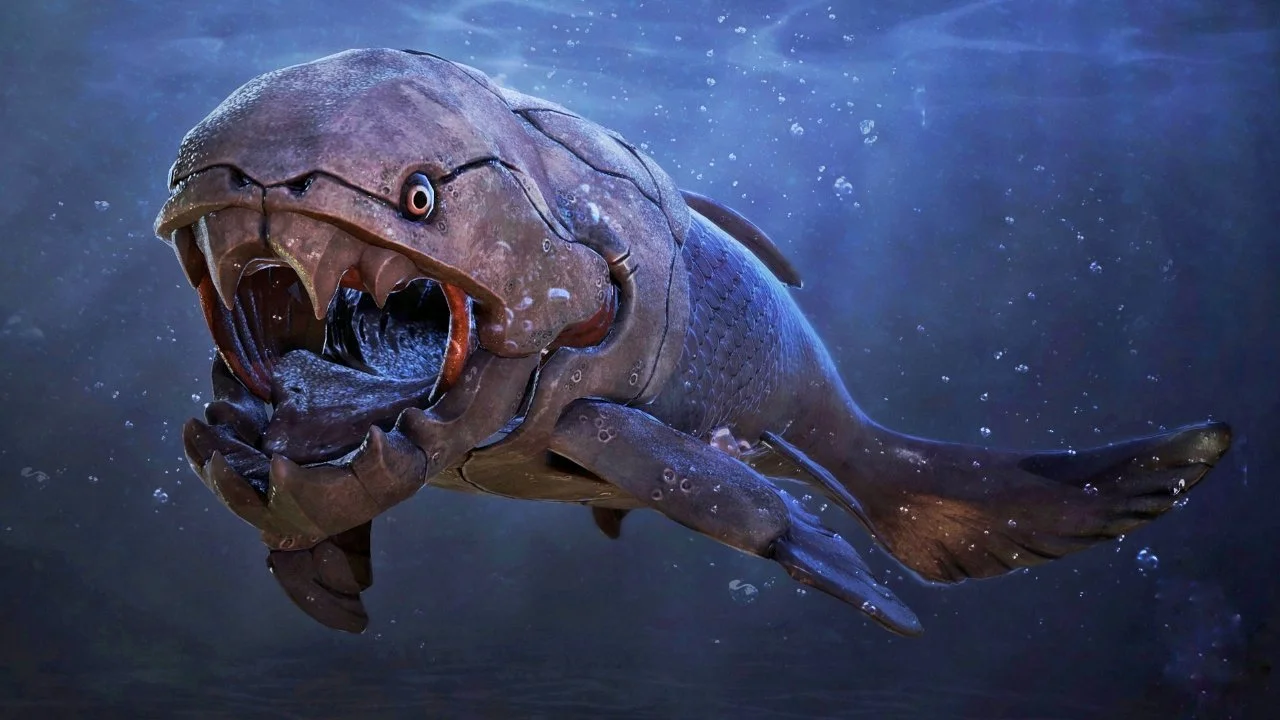
As a result, it is thought that, in addition to ammonites and other placoderm fish, sharks, and other free-swimming species, they are also known to devour fish from their own species when hungry. This is reinforced by the discovery of fish bones and other semi-digested or indigested elements in the fossils.
Dunkleosteus’s habitat is unclear, although it has been reported that Dunkleosteus has been discovered in shallow oceans across the world. It is thought that Dunkleosteus was one of the first creatures to reproduce sexually via the mechanism of egg fertilization. The lifetime of a Dunkleosteus is unclear, although it existed during the Devonian period 360-370 million years ago.
Dunkleosteus is regarded as one of the most hazardous sea predators. Many characteristics have been linked to this armored predator, making it one of the most hazardous placoderms. The major causes are its cannibalistic nature and its ability to bend metal.