Goat's Hole Cave on the Gower Peninsula is one of the most famous archaeological locations in Britain.
It is best known as the place where the Red Lady of Paviland was discovered.
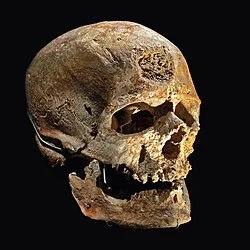
However, describing the site simply as the location of a “Cro-Magnon skull” is misleading.
The archaeological story is much larger.
Goat's Hole preserves evidence connected with early modern human activity, symbolic behavior, Ice Age landscapes, and one of the most famous prehistoric burials ever discovered in Britain.
The Meaning of “Cro-Magnon”
The term “Cro-Magnon” was once widely used to describe early modern humans in Europe.
Modern archaeology and anthropology generally prefer terms such as:
Early modern humans
Anatomically modern humans
Upper Paleolithic Homo sapiens
The older label can create the mistaken impression that “Cro-Magnons” were a separate human species.
They were not.
They were members of Homo sapiens.
The Famous Burial
The Red Lady discovery transformed Goat's Hole into one of Britain's most important archaeological sites.
The individual was originally believed to be female.
Modern scientific analysis demonstrated that the skeleton belonged to a young adult male.
The remains were associated with red ochre and decorative materials.
This indicates deliberate treatment.
The burial was not simply an accidental death followed by natural deposition.
Human action was involved.
A Cave of Symbolic Behavior
The use of pigment and ornaments suggests that the people associated with the burial engaged in symbolic behavior.
Objects can communicate identity.
Colors can carry meaning.
The treatment of the dead can express social relationships.
However, the precise beliefs remain unknown.
Archaeologists must distinguish between evidence and interpretation.
We can identify deliberate behavior.
We cannot reconstruct the complete worldview behind it.
Ice Age Britain
When the individual was buried, Britain formed part of a larger Ice Age landscape.
Sea levels differed dramatically from today.
Connections with continental Europe changed over time.
Hunter-gatherers moved through landscapes according to available resources and environmental conditions.
Goat's Hole was part of this world.
The Archaeological Importance of the Cave
The cave contributes evidence to several major research questions:
When did modern humans occupy Britain?
How did Upper Paleolithic communities treat their dead?
How important was symbolic behavior?
How did humans adapt to changing Ice Age environments?
What relationships existed between Britain and continental Europe?
The site therefore has importance far beyond one famous skeleton.
The History of the Discovery
The excavation history also matters.
The Red Lady was discovered during the early nineteenth century, before modern archaeology developed its present methods.
Contextual information was therefore not recorded with the precision expected today.
This created challenges for later researchers.
Modern archaeology has had to reconstruct the site's history using surviving evidence, documentation, comparative analysis, and scientific dating.
Why Goat's Hole Still Matters
The cave preserves one of the clearest examples of how archaeology can change our understanding of human antiquity.
A skeleton once interpreted as relatively recent was eventually recognized as belonging to an Ice Age individual.
The change was revolutionary.
It helped demonstrate that human history extended far beyond traditional written chronologies.
Goat's Hole therefore stands at the intersection of two histories.
It preserves the history of an Upper Paleolithic human being.
And it preserves the history of modern science learning how ancient humanity really is.