Pontnewydd Cave is one of the most important prehistoric sites in Wales and one of Britain's key locations for understanding ancient human occupation during the Middle Pleistocene.
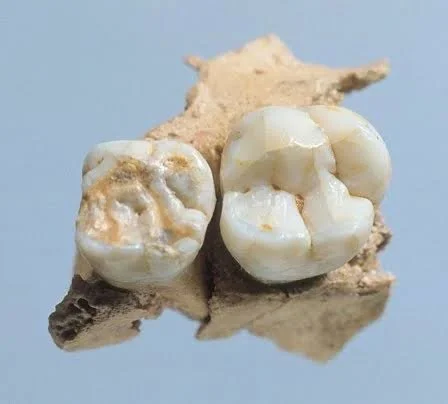
The cave has produced stone tools, animal remains, and fossil human material, including teeth.
These discoveries provide evidence for archaic human populations connected with the Neanderthal evolutionary lineage.
The significance of the site is enormous.
It demonstrates that ancient humans occupied parts of what is now Wales hundreds of thousands of years before Homo sapiens entered Europe.
A World Before Modern Humans
The occupants of Pontnewydd did not belong to our own species.
They lived during the Middle Pleistocene, a period characterized by repeated climatic changes.
Glacial and warmer interglacial periods transformed the landscape.
Human populations could occupy Britain during favorable conditions and disappear during colder periods.
The archaeological record is therefore discontinuous.
Pontnewydd preserves evidence from one of these ancient episodes.
The Importance of Human Teeth
Teeth are among the most durable parts of the skeleton.
They can survive when much of the rest of the body disappears.
Their shape can provide evidence for evolutionary relationships.
Researchers examine:
Crown shape
Root structure
Enamel thickness
Wear
Development
Morphological features
At Pontnewydd, the fossil remains provide important evidence for identifying the nature of the human population present at the site.
Neanderthals and Their Ancestors
The term “Neanderthal” can be used broadly in popular writing, but Middle Pleistocene fossils may represent populations ancestral to or closely related to later classic Neanderthals.
Human evolution was not a simple ladder.
Populations changed over time.
Groups migrated.
Some became isolated.
Others mixed.
Pontnewydd belongs to this complex evolutionary history.
Stone Tools and Ancient Technology
The ancient inhabitants were skilled toolmakers.
Stone tools could be used for:
Butchering animals
Cutting plant material
Processing hides
Working wood
Manufacturing additional tools
The production of a stone tool required knowledge of raw materials and controlled force.
The maker needed to understand how a stone would fracture.
This technological knowledge was passed through generations.
The Ancient Welsh Landscape
The Wales encountered by these humans was radically different from the modern country.
The climate shifted repeatedly.
Animal populations changed.
Large mammals moved through the region.
Human survival depended on understanding this environment.
The cave was likely only one location within a larger territory.
People hunted and traveled outside it.
They entered the cave temporarily.
The archaeological deposits preserve fragments of these movements.
Animal Remains and the Environment
Animal fossils help archaeologists reconstruct ancient ecosystems.
Different species indicate different environmental conditions.
The bones may also preserve evidence of:
Human cut marks
Carnivore damage
Weathering
Burning
Breakage
By combining animal evidence with stone tools and human fossils, researchers can reconstruct the broader world in which the Pontnewydd people lived.
Britain Was Connected to Europe
During periods of lower sea level, Britain was not always separated from continental Europe.
Land connections allowed humans and animals to move between regions.
The ancient inhabitants of Pontnewydd were therefore part of a much larger European population.
Modern political geography has no relevance to their world.
There was no Wales.
No England.
No English Channel in its present form.
There was simply a changing prehistoric landscape.
Why Pontnewydd Matters
Human fossils are rare.
A single tooth can transform scientific understanding.
The discoveries from Pontnewydd demonstrate that archaic human populations reached western Britain during the Middle Pleistocene.
This challenges the idea that prehistoric Britain existed on the edge of human history.
It was part of it.
Pontnewydd preserves evidence of humans who lived hundreds of thousands of years before modern civilization and hundreds of thousands of years before modern humans themselves arrived.