Creatures like the narwhal, okapi, and Komodo dragon are on the short list of mythical creatures proven real. Yet, while scientifically interesting, these examples aren't in the realm of more fanciful and legendary animals like unicorns, Bigfoot, or the more hilarious mythical creatures that cryptozoologists fawn over. Mythical creatures in real life often fail to live up to the expectations formed by old legends, fairy tales, or cartoons.
12 Most Incredible Finds That Scare Scientists
Let's explore some of the most peculiar and enigmatic archaeological discoveries from around the world. These finds challenge our current understanding of the ancient world, and despite our accumulated knowledge, we’re still unable to fully comprehend their significance. Perhaps you can help uncover some of the missing pieces to these mysterious puzzles. Get ready to join the adventure and discover the perplexing secrets of these unconventional archaeological discoveries, some of which have tormented the minds of experts!
Dromaeosaurs: The Strange Carnivores of The Mesozoic Era
Dromaeosaurs represent one of the largest learning curves in all dinosaur groups. These maniraptoran theropod dinosaurs, members of the family Dromaeosauridae, are among the most famous and commonly depicted of all dinosaurs, and were one of the most widespread and successful theropod clades. The family was officially described and established by William D. Matthew and Barnum Brown in 1922, but at this point, many dromaeosaur genera were poorly understood. Dromaeosaurs at this time were portrayed as unobtrusive, generic predators, essentially like small versions of large theropods such as Tyrannosaurus. One man would swiftly change everything, however - American paleontologist John Ostrom. Ostrom was responsible for revolutionising humanity's understsanding of dinosaur posture and appearance, and it was his work on the famous dromaeosaur Deinonychus that sparked it all.
12 Most Amazing Archaeological Finds That Change History
Every archaeologist around the world shares the same dream - to unearth an artefact or make a discovery that could potentially rewrite history as we know it. Such a discovery has the power to challenge and even upend established narratives, revealing new insights into our past and fundamentally changing our understanding of human civilisation. In this video, we're showing you a series of incredible finds that have accomplished just that.
They Drained This Canal For The First Time In Decades, And What They Discovered Is Truly Bizarre
Science can explain almost everything, except for those few things that are so weird and mysterious that they make scientists scratch their heads like a confused cat or throw up their hands like a mime trying to open an invisible box. From a cave without a bottom to an Aztec Temple, here are 20 Mysterious Discoveries Science Still Can’t Explain!
The Reality of Disabled Ex-Soldiers from the Roman Legions
In the following video we will be explaining the reality of disabled ex-soldiers from the Roman Legions. Watch the video below to find out more!
The Largest Civilization in The World
In this video, you’ll find out how many ants there are on Earth, how much they weigh, when they emerged, how they live, how they practice agriculture, why their society resembles human civilization, and much more that will surprise and even shock you. Enjoy!
12 Most Mysterious Archaeological Artifacts Finds Scientists Still Can't Explain
A lot of the objects and buildings created by our ancient ancestors are a total mystery to us. Not only is it the case that experts sometimes can’t tell us what these ancient creations were used for, but sometimes they can’t even tell us how they were made! We love a good mystery on this channel, though, so we’re excited to bring you the stories of these baffling artefacts.
Giant "iron dragon" flying reptile discovered in Australia had gigantic jaws and razor-sharp fangs
Under a sheep farm in Australia, the skeletal remains of a massive flying reptile that lived 96 million years ago were found.

Tyrannosaurus fighting an Ankylosaurus. These pictures come from Dinosaurs in the Wild, a Dinosaur safari in London
The remains are thought to be those of a pterosaur, the first creature known to have developed powered flight.
Greek for "winged lizard" is pterosaur.
The creature possessed enlarged jaws with spiked fangs, a 60 cm long crested head, and wings that were 4 meters long.
"Comparations with related pterosaurs served as the basis for this. Adele Pentland, a PhD candidate and palaeontologist at Swinburne University of Technology, described it as an apex aerial predator.
"This pterosaur had a crest on its lower jaws in addition to a massive crest at the front of its upper jaws.

A Mosasaur Prognathodon
"The latter is broken, and its presence has been inferred from CT scan data."
The pterosaur was given the Latin name Ferrodraco, which means "iron dragon" in English.
The remains were found by sheep farmer Bob Elliot in Winton, Queensland, in the early months of 2017.
He informed the neighborhood museum, and volunteers excavated the area.
Scientific Reports has published an article regarding the discovery that Ms. Pentland contributed to.
She claimed that 96 million years ago, the winged reptile thrived in the Winton area "in a conifer forest with floodplain and river channels."
Long-necked sauropod dinosaurs, carnivorous theropods, ornithopods, and ankylosaurs all lived in the forest.
According to the experts, the Tyrannosaurus rex would have been among the forest's inhabitants.
Australia is home to 15 fossilized pterosaurs.

Pair of Quetzalcoatlus
The amount of pterosaur bones recorded from Australia has now tripled, Ms. Pentland added, with a total of 30 bones preserved, or 10% of Ferrodraco's skeleton.
The Australian Age of Dinosaurs Museum now has the skeleton on exhibit.
One of the most thrilling additions to the organization, according to the co-founder of the museum, David Elliott, was the finding.
"The Winton area has produced the majority of Australia's large dinosaur fossils, so presenting a significant pterosaur skeleton alongside the giants with which it co-existed is a huge bonus for science, education, and regional tourism," he added.
Amazingly Rare Iron Age Wooden Artifacts Found in UK Waterlogged Site 2,000 Years Old
Archaeologists have found a perfectly preserved 1,000-year-old wooden ladder in the UK. Scientists have resumed their excavations at a location known as Field 44 close to the community of Tempsford in Central Bedfordshire, and they have made intriguing new archaeological finds.

Excavating an Iron Age roundhouse. Credit: MOLA
Some of the discovered wooden Iron Age artifacts, according to the MOLA archaeology team, are exceedingly uncommon.
The majority of constructions inhabited throughout the Iron Age (800 BC – 43 AD) were roundhouses, hence wood would have been heavily utilized in earlier times. Typically, the only traces of the roundhouse structures left behind are post holes where the wooden posts have long since rotted away. This is due to the fact that wood, when buried in the ground, decomposes quite quickly.
In fact, there isn't much wood left at any of England's archaeological sites!
How Did Archaeologists Find Some Wood If Wood Decomposes So Quickly?
Fungi and small creatures, such as bacteria, break down wood. However, if the wood is in really moist ground, it may absorb water and swell up. Wood that is buried in wet ground and is dripping with water does not dry out. This indicates that the wood cannot receive oxygen. Without oxygen, the bacteria cannot survive, thus the wood cannot decay.

This 1,000-year-old wooden ladder has been unearthed in the UK. Credit: MOLA
"A shallow valley located in a portion of our excavation area is nevertheless a natural gathering place for groundwater. This basically means that the earth is always soggy and moist. The local community would have utilized these shallow wells to collect water during the Iron Age, thus it would have been the same then. This resulted in highly difficult work for the archaeologists during excavation, but it also produced some amazing finds, according to a press release from the MOLA.

Wattle panels. Credit: MOLA
For 2000 years, a number of amazing wooden artefacts were kept in the soggy ground. One of these was an Iron Age ladder that the locals used to access the shallow well's water supply.
A seemingly basket-like device that is not one has also been discovered by scientists. It is actually daub, which is formed of mud, crushed stone, straw, or animal hair, covering wattle panels, which are made of interlaced twigs and branches. This panel was used to line the waterhole, but for thousands of years, wattle and daub was also employed to construct homes. It is quite rare to find some that have survived from the Iron Age or earlier.

Reconstructed roundhouse. Credit: MOLA
In this image of a recreated Roundhouse, you can see a similar weaving design and daubed walls.
The purpose of some other wood discovered by researchers, including some little posts, is yet unknown.
Archaeologists need to move fast after finding intact wood. The wood must be kept moist until it can be meticulously dried out in a lab by knowledgeable conservators. It will start to decay swiftly and could entirely dissolve if it isn't kept moist.

Excavating the small wooden post. Credit: MOLA
What Lessons Can We Draw From Wood?
These wooden objects have a lot to teach us, I believe. Finding out what kind of wood they used will reveal information about the trees that grew in the area, as well as how people made and used them in their daily life. This can assist us in reimagining the landscape at the time and the evolution of that area over time.
Wood isn't the only material that may be kept in these moist conditions! Insects, seeds, and pollen are also present. These all aid in the construction of a picture of the Bedfordshire and Cambridgeshire landscape from 2000 years ago by our environmental archaeologists. They have already recognized some of the plants that were growing nearby, like buttercups and rushes, by looking at pollen and plants preserved in the water, the MOLA science team said.
Work on archaeology at the location is ongoing. Our conservators are now meticulously drying up the wood so that the experts may inspect these wooden artefacts.
Salt Island in the Dead Sea's middle is where the "Tree of Life" grows
When visiting the world's saltiest body of water, the Dead Sea, you wouldn't anticipate seeing a tree sprouting out of a beautiful white salt island, yet that is just the scene you are presented to close to the beach of Ein Bokek.
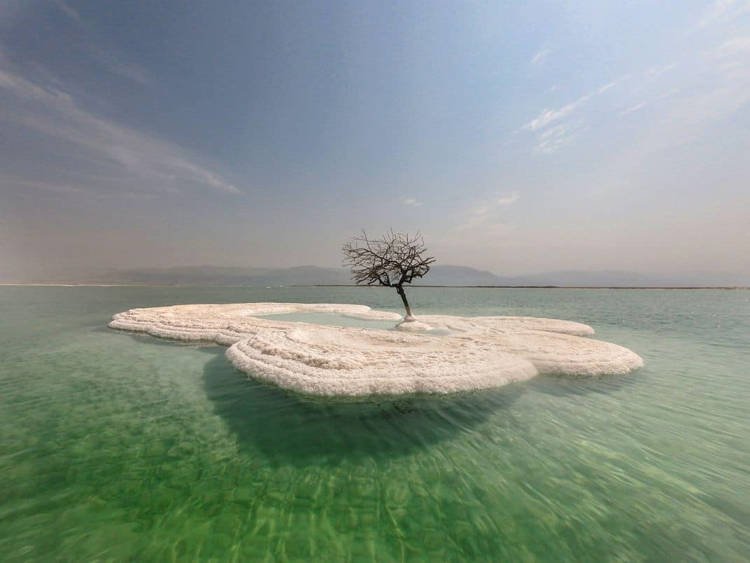
Why is there a tree flourishing in the Dead Sea, and on an island composed of salt, of all places, since the salt concentration there is almost ten times higher than that of the ocean? The famous Dead Sea Salt Island, a bizarre natural creation comprised of brilliant white salt and surrounded by turquoise water, is located within swimming distance of the beach in Ein Bokek, an Israeli resort close to Arad. A tree that doesn't belong there and a shallow pool of enticing water are in the middle of it. Even so...
We’re surprised that the Dead Sea tree hasn't garnered more attention on Instagram and other travel-related social media platforms because it's such a stunning sight. Even if nothing is as it seems, it is extremely odd to observe a live thing thriving in the center of a body of water renowned for its incapacity to support life.
Even while the tree has buds on its branches and roots that reach into the salty crust of the island, this does not necessarily indicate that the tree originated from those locations. It was carried and "planted" on the salt island by a local artist as a unique work of art. He has reportedly been going to the tree every day and covering its base in mud to ensure that it receives all the nutrients it needs to live in this hard climate.
The so-called "tree of life" may be a metaphor for this, or perhaps having something grow in the center of the Dead Sea is the metaphor, as the shoreline of the Dead Sea is itself withering and encroaching on the sea every year. Nobody is truly sure, but then again, nobody really cares either. The tree actually exists, and it's a terrific photo prop for Instagram...
So be sure to check out the tree of life and the lovely sea island it "grows" on if you ever find yourself in the Dead Sea region and drive past Ein Bokek.
Ancient Humans Made Millions Of These - We Don’t Know Why
The Acheulean handaxe was the most common tool of early humans, but we still don’t know what the heck they used it for. Watch the video below to find out more!
Ancient Civilizations You've Probably Never Heard Of
In the following video we will analyze ancient civilizations you’ve probably never heard of before. Watch the video to find out more!
This Discovery In Africa Scares Scientists
Africa is the second largest continent in the world, home to around 18% of the world’s population. So, if there’s a chance you’ll make any weird finds, there’s a good chance they’ll be in Africa. From mysterious elephant deaths to old rock art, here are 20 unsettling discoveries in Africa nobody can explain!
65 Sailors Eaten By Cannibals | The Boyd Massacre
This is the dark story of the HMS Boyd, a tale of cannibals and retribution. Sailing to New Zealand in 1809, Boyd's crew were attacked Māori cannibals in the worst act of violence against Europeans in New Zealand's history. Watch the video to find out more!
Why did it take so long for France to conquer Brittany? (Short Animated Documentary)
The small Duchy of Brittany sat on the north-west frontier of France for over six centuries. Despite France being much larger and much more powerful, its king never managed to conquer the Bretons and instead had to wait to marry into its ruling family. So why not? Why didn't France conquer Brittany in such a long period of time. To find out watch this short and simple animated history documentary.
Atlantis Has Finally Been Found On Ancient Roman Map
Is the lost city of Atlantis a myth, or is it real? The mystery of Atlantis has taken a new mysterious turn! Where was the lost city located? Has Atlantis been finally found on the Ancient Roman Map? Let’s find out!
In the dialogues Timaeus and Critias authored by Plato, there is a description of a mythical city called Atlantis. The search for the long-lost city of Atlantis has been ongoing for centuries with no definitive answer yet, but now we're getting closer to resolving this mystery due to some recent progress.
The Grand Canyon Discovery That Terrifies The Whole World
In today’s video we will be talking about a terrifying Grand Canyon discovery. Watch the video below and enjoy!
Have We Found Remains of Noah's Ark?
Last time on The Genesis Account of Noah’s Ark, we proved that the Earth's sediment explains the Flood's reality. The one thing we still have to find is the Ark itself. Why haven’t we found it yet?
How the Earliest Christians Worshipped (In their own words)
In this video, we examine writings of the early Christians from C. 50AD to C. 155 AD to ask: How did they worship? What were some of their practices? and How were their churches structured?
After a brief look at some of the New Testament books, we dive into non-biblical writings of other ancient Christians. I tried to let these ancient authors speak for themselves as much as possible, to tell us what they were like, in their own words.