King Tut's Inbred Family Tree: How He looked in Real Life

King Tut (1341BCE-1323BCE) (Tutankhamun) was an Egyptian Pharaoh who was the last of his family to rule the 18th Dynasty. His stepmother was the famous Egyptian Queen Nefertiti and he married her daughter/his half-sister Ankhesenamun. King Tut was only 18-19 when he died and his whole life he was plagued with sickness. This could have been due to the fact that his parents were brother (Amenhotep IV/Akhenaten)and sister (The Younger Lady).

King Tut is famous not because of his reign, but because his tomb was found nearly intact which have archeologists great insight into the lives of the Royal Egyptians.

This video we see how he might have looked in real life as well as go through his family tree to see just how inbred he was.

11 Scariest Prehistoric Bugs

In the video below we will analyze the 11 scariest prehistoric bugs. Watch the video to find out more!

12 Most Incredible Recent Finds

What's been going on recently in the field of archaeology? We're glad you asked! That's a question we ask ourselves every day of every year, and when we find answers to the question, we take them and use them to make videos like this one. A lot of great discoveries have come to light in recent times, so buckle up, and we'll show them to you now!

A Day in Pompeii: Full length animation

A Day in Pompeii, a Melbourne Winter Masterpieces exhibition, was held at Melbourne Museum from 26 June to 25 October 2009. Over 330,000 people visited the exhibition -- an average of more than 2,700 per day -- making it the most popular traveling exhibition ever staged by an Australian museum. Watch the video below for more!

Researchers find the largest 'raptor' dinosaurs lived millions of years before we previously thought

On Utahraptor's upcoming birthday cake, 10 million extra candles will be required.

Greg Ludvigson on outcrop of colorful buried soils of the Yellow Cat Member in May 2009. Credit: Matt Joeckel

Geological analysis of the rock formation that included a fossilized specimen of the largest "raptor" in the world reveals that it is 10 million years older than previously thought. The report, which was co-written by a scientist from the University of Kansas, was just published in the Geosciences magazine.

Gregory Ludvigson, an emeritus senior scientist with the Kansas Geological Survey at KU, who worked on the inquiry, said, "We determined the age of the dinosaur Utahraptor and found that it was much older than previously supposed." "That discovery has significant ramifications for the evolution of dinosaurs."

The well-known Utahraptor Ridge site, named for the bigger relatives of the vicious velociraptor dinosaur (familiar to "Jurassic Park" fans), hosted the research.

Stikes Quarry, a quicksand deposit full of dinosaur fossils that are mostly intact and preserved—in essentially the same positions as when they died—is located on the ridge. The Cedar Mountain Formation, a geological unit that has more dinosaur fossils than any other formation in the world, includes Stikes Quarry.

To our total amazement, we also discovered that the rock strata from the Stikes Dinosaur Quarry were deposited during the Weissert Event, Ludvigson added. "This is a discovery that will set the agenda for decades."

In order to answer that question, Ludvigson teamed up with Matt Joeckel, a state geologist and the director of the Conservation and Survey Division at the University of Nebraska-Lincoln, as well as Jim Kirkland, a state paleontologist with the Utah Geological Survey.

Two research strategies were used by the scientists and colleagues they attracted: Zircon crystals could be dated using uranium/lead by examining samples of these minerals that were taken from various depths in the rock strata. In the second, two kinds of stable carbon isotopes that are found in buried organic debris were examined for changes in relative abundance.

The scientists demonstrated that rocks in the Yellow Cat Member of the Cedar Mountain Formation—and the Utahraptor fossils found there—are 10 million years older than previously thought by comparing findings to eras in Earth's history during which it is known that the carbon cycle underwent worldwide alterations.

The rocks and fossils are thought to be 125 million years old, according to earlier calculations.

That much time has passed throughout evolution, remarked Ludvigson. It's sort of a confirmation of something Jim has been debating for a while, but debating doesn't give it a precise age, and that's essential to him.

According to the updated age, the Stikes Quarry rocks are at least 135 million years old. Even earlier strata are included in the Yellow Cat Member's lower portion. The discoveries fill in the gap in Utah's rock record at the juncture of the Jurassic and Cretaceous Periods.

The dinosaur Utahraptor ostrommaysi's original name and description were given by Kirkland in 1993. "Before, we had a 25-million-year gap between them," he stated. "That's more than twice as long as the evolution of hominids and a third of the age of mammals. It's a large period of time. If there are no records of what is happening, anything could happen over a period of 25 million years. Most of that record has been promoted by us.

Source: https://phys.org/news/2023-05-largest-rapt...

Experts Finally Decipher Ancient Message Wrapped Around Mummy

In a refrigerated chamber deep in the bowels of a Croatian museum, two strange artifacts have sat for more than 150 years. From an archaeological perspective, these two relics are quite unlike anything else in the world. In fact, this particular Egyptian mummy — and the mysterious text found wrapped around it — has been a rather infamous puzzle among archeologists for decades. So, that of course begs the question, why isn’t the Zagreb mummy better known to the wider public?

12 Most Amazing Archaeological Discoveries

We all love a good archaeological discovery. Every time something significant is found in the ground, it tells us a little more about the places and people who existed before us, and laid the foundations of the lives we enjoy today. An archaeological discovery doesn’t have to be ancient in order for it to be amazing - it just has to make you sit back and say ‘wow.’ Every discovery you’re about to see in today’s list has the ‘wow’ factor, so enjoy this collection of spectacular archaeological finds from all over the world!

Ancient Laser Cutting Technology Used Around the World

There are many ways to imprint yourself in the memory of posterity. So we still know today of the existence of some ancient peoples who disappeared from the earthly stage hundreds of years ago. In addition to historical records and rediscovered everyday objects, it is above all the preserved buildings that give us a lively insight into the everyday reality of our distant ancestors. However, some of the buildings from that time are in such amazing condition that we wonder how the workers were even able to accomplish such a feat of construction. With their equally complex and precise elaboration, at first glance it seems difficult to imagine that the massive structures were created using the simplest of tools. In fact, for some people, this idea seems so far-fetched that they look for other explanations. A controversial thesis is that the ancients possessed advanced technologies that may have been revealed to them by extraterrestrial visitors! We will now show you which ancient buildings fuel the corresponding theories!

They Found Frozen in Ice What No One Was Supposed to See

Ever since humans have been to Antarctica, scientists have been finding frozen objects buried and preserved in ice for years and years. Below the sea too. And some of them are stranger than others. Some of them happen to be so bizarre that they leave scientists completely mind-blown. And it’s not only objects they have found but secrets... Answers... And even more! Sure, some of these findings are from the ice age, but some are brand new and simply unexplainable. These are some of the most intriguing findings ever!

15 Old Technologies Scientists Still Can't Explain

Sometimes the oldest inventions are the best! Yes, archaeologists have uncovered some fascinating artefacts over the centuries, but some of these incredible items only invite more questions, leaving scientists desperately searching for the answers! These mysterious discoveries suggest that our ancient ancestors were more advanced than we originally thought - and were capable of creating astonishing objects that we still can’t figure out to this day! From the world’s first computer discovered under the sea on an ancient shipwreck, to the 2,000 year old battery pack buried beneath the ground, these are the 15 old technologies scientists still can't explain. Enjoy!

A Greek Mythology Revelatory Found in 54 Corpses

DNA from a 2,500-year-old Sicilian battlefield shows that mercenary troops were not just widespread but also the ideal of Homer.

A mass grave of troops from the second Battle of Himera in Sicily in 409 B.C. One-fourth of the combatants are thought to have been mercenaries, compared to two-thirds in the first Battle of Himera seven decades earlier.

There will always be mercenaries—hired soldiers whose only shared trait may be a desire for adventure—wherever there is an out-of-the-way conflict. Some people enlist in foreign armies or rebel groups because they support the cause, while others do so because the deal is too good to pass up.

This was true in ancient Greece, despite what ancient Greek historians would have you believe. According to them, the polis, or independent Greek city-state, stood for the triumph of citizen equality and civic pride over kingly despotism. In their accounts of the first Battle of Himera, a bloody conflict in 480 B.C. in which the Greeks from several Sicilian cities banded together to repel a Carthaginian invasion, neither Herodotus nor Diodorus Siculus mentioned mercenaries. Mercenaries were viewed as the opposite of the heroic Homeric figure.

According to Laurie Reitsema, an anthropologist at the University of Georgia, "being a wage earner had some negative connotations — avarice, corruption, shifting allegiance, the downfall of civilized society." This makes it understandable why ancient scribes would accentuate the Greeks against. Greeks component of the fights rather than acknowledge the price they had to pay.

However, research reveals that the soldiers defending Himera were not as exclusively Greek as historical chronicles of the time would have it. This information was published in 2022 in the Proceedings of the National Academy of Sciences.

Many people saw the triumph to be a turning point in Greek identity. However, a recent study that examined the degraded DNA from 54 bodies discovered in Himera's freshly discovered west necropolis discovered that the majority of the tombs were occupied by professional troops from distant locations such those now known as Ukraine, Latvia, and Bulgaria.

The discovery supports research from 2021 in which Katherine Reinberger, a bioarchaeologist at the University of Georgia, and her colleagues conducted a chemical analysis of the tooth enamel of 62 deceased warriors buried close to Himera's ancient battlefield, the scene of two significant battles: one in 480 B.C., when Himeran forces defeated the Carthaginian general Hamilcar Mago, and a second battle seven decades later, when Hamilcar's grandson returned for vengeance According to Dr. Reinberger's team, locals made up around one-third of the fighters in the initial conflict but three-fourths of them in the subsequent fighting. Principal author for both papers is Dr. Reitsema.

The new analysis, according to Greek historian Angelos Chaniotis at Princeton's Institute for Advanced analysis, sheds new information on the makeup of the fights at Himera, if not on how they turned out. "It confirms the general picture that we had from ancient sources, while at the same time highlighting the role of mercenaries," he said. Although they frequently hide in plain sight, mercenaries are mentioned in our documentation.

The ruins of the Temple of Victory, built after the first Battle of Himera in 480 B.C. and razed after the city’s capture in 409 B.C.

Their paper "suggests that Greeks minimized a role for mercenaries, possibly because they wanted to project an image of their homelands being defended by heroic Greek armies of citizens and the armored spearmen known as hoplites," according to David Reich, a geneticist at Harvard whose lab generated the data. Armed forces made up of commandos hired for a fee would presumably invalidate this theory.

Tyrants who dominated Greek Sicilian cities during the Hellenic Age enlisted soldiers of fortune for territorial expansion and, in certain cases, as bodyguards because they were so despised by their subjects. Dr. Reitsema claimed that the hiring of mercenaries even led to the usage of currency in Sicily to pay them.

Source: https://www.nytimes.com/2022/10/04/science...

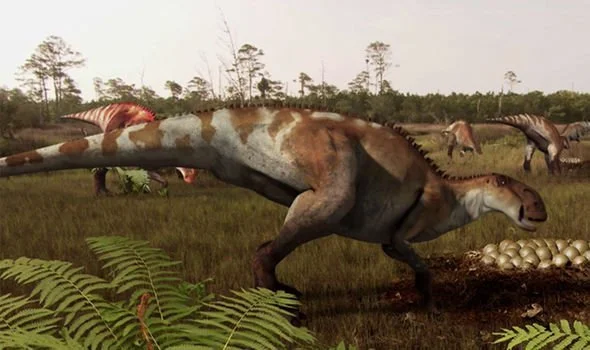
Dinosaur Discovery: How Researchers Discovered an Intact, 77-Million-Year-Old Brachylophosaurus

The body of a mummified dinosaur was discovered by a scientist in Montana, US, and may offer "the best opportunity to bring dinosaurs back to life," according to a documentary.

Nate Murphy uncovered the dinosaur (Image: AMAZON PRIME)

Former curator of palaeontology at the Phillips County Museum in Malta, US, Nate Murphy is a well-known fossil hunter. He discovered a mummified dinosaur in northeastern Montana in 2001 while conducting excavations there. Mr. Murphy and a group of scientists gently chipped away at the rock to free the extinct animal.

In "Secrets of the Dinosaur Mummy" on Amazon Prime, the 59-year-old explained how the team managed to liberate the fossil.

Scientists studied the dinosaur's body (Image: AMAZON PRIME)

When we realized we had a fossilized carcass, he added in 2017, "we had to figure out a means to get a six-and-a-half-ton slab of a dinosaur out of the hills of northeastern Montana.

"Leonardo is our best chance to resurrect the dinosaurs,"

The documentary went on to explain how the Brachylophosaurus dinosaur managed to remain absolutely undamaged for so long.

The dinosaur was uncovered in 2001 (Image: AMAZON PRIME)

It would require several hundred pounds of dynamite and dozens of bloody fingers to liberate the fossil, the narrator said.

"Leo's body had been covered with silt after being buried in water.

"Shortly after passing away, he was oddly mummified.

"Fossilization then occurred as minuscule sand grains replaced the preserved tissue."

Leonardo was taken by the scientists about 30 miles down the road to Malta, a city on the US West Coast.

What Leonardo may have looked like 77 million years ago (Image: AMAZON PRIME)

They X-rayed the body here inside the Great Plains Dinosaur Museum using cutting-edge technology.

His stomach, heart, and liver were all present and undamaged when they discovered him.

They were able to learn more about the species, though, thanks to the dinosaur's skin.

Source: https://www.express.co.uk/news/science/108...

The Aswan Quarry - Was a Huge Megalith Extracted in Pre-Dynastic Times?

In a rarely seen part of the ancient granite quarry in Aswan, Egypt, there is evidence for a gigantic block, possibly larger than the unfinished obelisk being extracted in ancient times. What's more, there are strong indications here that this was done in pre-dynastic times, before the Ancient Egyptian civilization ever begun their own quarrying operations on this site.

Join us as we investigate the so-called 'harbor' area of the quarry, and examine the evidence for pre-dynastic quarry operations, and the removal of a massive block of granite in antiquity.

When Experts Excavated A 2,000 Year Old Grave, They Found An iPhone Shaped Accessory

Archeologists are hard at work, digging into the land exposed by the draining of a large reservoir in the Russian Republic of Tuva in southern Siberia. They find something of great interest: the grave of a woman buried some 2,000 years ago. But what completely throws the researchers is the object that they find in her tomb. Intrigued by this discovery, they decide to call the woman Natasha.

The Connection between Atlantis And Ancient Greece Revealed

When it comes to exploring the topic 'Atlantis,' there is always something challenging to answer or locate. We're back today with another episode to seek explanations for the laborious findings. What connections did Ancient Greece have with the lost city of Atlantis. Let’s find out.

The most perplexing question that all scientists have is the location of Atlantis. According to the narrations, the city is thought to have sunk into the sea following an earthquake or tsunami.Atlantis is a fabled island adapted in Plato's books Timaeus and Critias as the adversary naval power that besieges "Ancient Athens," the pseudo-historic incarnation of Plato's ideal society in the Republic. In the legend, Athens repels the Atlantean onslaught unlike any other nation in the known world, presumably demonstrating the supremacy of Plato's vision of a state. The first ruler of Atlantis, according to Plato, was also named Atlas, but he was the son of Poseidon and the mortal woman Cleito. The story closes with Atlantis falling out of favour with the gods and sinking into the Atlantic Ocean.

Giant Bronze Age Barrow Cemetery Discovered Near Stonehenge

A giant 3,500 to 4,000-year-old round barrow cemetery has been discovered in Wiltshire in England, and so far, 10 Bronze Age burials have been excavated as well as three piles of buried cremation ash.

Wiltshire is well known due to the incredible Stonehenge Neolithic landscape, which is around 8 miles north of the newly excavated site in suburban town of Harnham, near Salisbury. The area has been earmarked for the building of 640 new homes and before the builders went in, archaeologists from Cotswold Archaeology had the chance to excavate.

Watch the video to find out what the archaeologists have uncovered. Enjoy!

The Best-Preserved Roman Temple in Italy

Though not as famous as the Pantheon, two superimposed Roman temples in Brescia have a claim to be the best-preserved - or at least the most unique - in Italy. Watch the video below for more!

Why Male Mammoths Lost the Game

Woolly mammoths, our favorite ice age proboscidean, disappeared from Europe and North America at the end of the last ice age, about 10,000 years ago. Today, we’ve teamed up with TierZoo to solve one of the mysteries about these charismatic megafauna: why do most remains of mammoths found in the fossil record turn out to be male?