We all know various facts about queen Cleopatra. But what about how her tomb was found? Watch the video below to find out!
The Most Mysterious Unexplained Discoveries
In today’s video we will be talking about the most mysterious unexplained discoveries. Enjoy!
How Neanderthal are you? Tracing our genetic ancestry
Scientists examining the evolutionary history recorded within our DNA are uncovering the global human story in greater detail. Watch the film to discover what DNA analyses taught six well-known figures, Maggie Aderin-Pocock, Clive Anderson, Bill Bailey, Kevin Fong, Alice Roberts and Sian Williams about their genetic ancestry. Enjoy!
12 Most Mysterious Archaeological Artifacts Finds Scientists Still Can't Explain
Do scientists and historians understand everything there is about the history of the human race? The answer to that question is no; of course they don't. They're not even close! There are massive gaps in our collective memory, and those gaps are best illustrated by the ancient artefacts that we struggle to make sense of. You're going to see a lot of them in this video, so let's get things started!
Dayuan - The Greeks of Central Asia
In the ancient Ferghana Valley of Central Asia, there were thriving Greek settlements far away from their ancestors. How did these people come to be so far away from Asia Minor, and how did they end up being the kingmakers of the Silk Road?
The Jinn: The Geniuses from Arabic Folklore
In the video below we will be talking about the Jinn, the geniuses from Arabic Folklore. Watch the video to find out more!
Why Did the Saxons Lose to the Vikings? (Medieval Animated Documentary)
In today’s video we will try to deduce why the Saxons weren't able to defend against the Vikings and would go on to lose in many cases. Enjoy!
Irish DNA History
In the video below we will be explaining the history of Irish DNA. Watch the video for more & enjoy!
Arsinoitherium: Ancient Elephant Relatives But The Body Is A Giant Rhino With 2 Horns
The twin-horned Arsinoitherium was more closely linked to modern elephants than rhinos, despite having a similar appearance. Between the Late Eocene and Middle Oligocene eras (45 to 24 million years ago), this extinct genus made its home in Africa and the Arabian Peninsula. Along with existing animals like elephants, manatees, and hyraxes, Arsinoitherium is a genus of paenungulata mammals (nearly hoofed mammals).

Arsinoitherium’s horns were hollow.
Description & Size
A genus of extinct big animals known as Arsinoitherium was found in deposits from the Eocene Epoch, which lasted from 56 million to 34 million years ago. Members of the genus lived throughout the Oligocene Epoch, which occurred between 34 million and 23 million years ago, according to a more recent discovery in other areas.
After Queen Arsinoe I of Ancient Egypt, the species Arsinoitherium was named. She is commemorated by the Faiyum Oasis, the location of the earliest fossils of the genus. This fact is alluded to in the genus name. Arsinoitherium is a member of the extinct Embrithopoda order. Arsinoitherium zitteli and Arsinoitherium giganteus are two well-known species of the genus.
When it comes to appearance, Arsinoitherium is frequently compared to a whimsical rhinoceros. On the nasal bones, it had two huge horns, and on the frontal bones, it had a smaller pair of horns. This mammal's dimensions are similar to those of a huge white rhinoceros. Arsinoitheriums might grow as long as 3.5 meters (11 feet). At the shoulders, they were roughly 1.75 m (5.7 feet) tall.
Arsinoitherium's skeletal system is remarkably similar to that of elephants. They possessed skulls, feet, and hips that resembled elephants. Their twin horns, which could reach a length of up to 2.5 feet, were hollow and constructed of a bone substance similar to that of contemporary cows. The horns most likely possessed a keratin layer that prevented them from breaking. Although both sexes had horns, some scientists have hypothesized that the size of the horns varied according to gender.
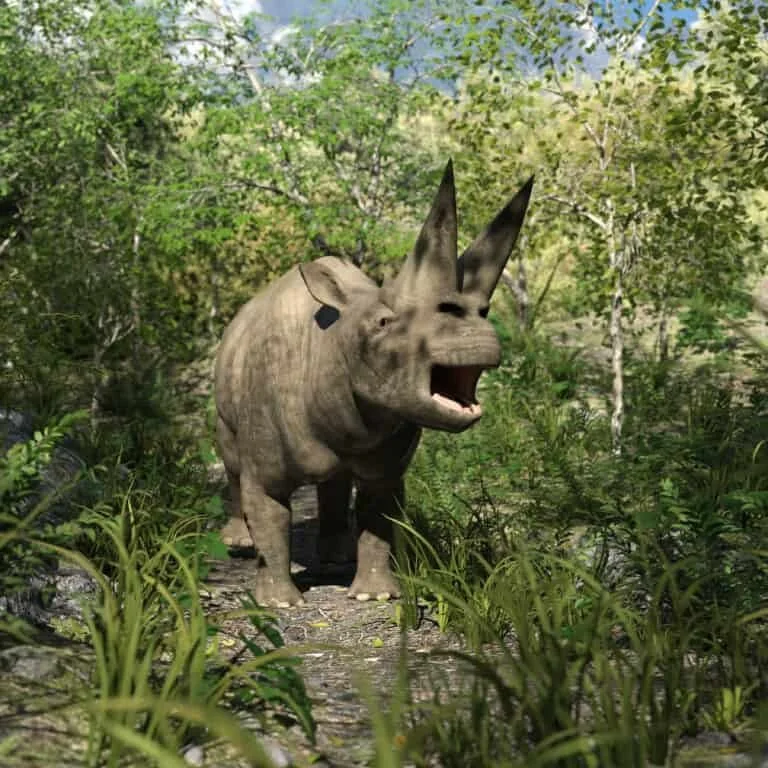
3D illustration of a Arsinoitherium
Diet – What Did Arsinoitherium Eat?
Arsenoitherium was a herbivore that foraged. However, palaeontologists believe it had a specific diet based on the particular tooth structure and jaw muscles. It might have consumed the many bulky fruits and grasses that were present at the Egyptian site of Fayoum Oasis, where it was discovered.
Habitat – When and Where It lived
The Arsinoitherium genus included large, sluggish creatures. It is generally accepted that they, like modern hippos, resided in swamps and semi-aquatic environments. Instead of swinging forward, their forelimbs were designed to pull firmly backward. This trait is typical of animals that prefer to drag themselves across marshes, sticky soils, and other types of shallow water.
The majority of the fossils discovered thus far were found in sediments resembling warm, humid lowland forests with dense vegetation or coastal swamp settings. From the Late Eocene through the Middle Oligocene, the Arsinoitherium was among the largest mammals in Africa and the Arabian Peninsula.

Threats And Predators
Given their enormous size, these mammals had no significant predators that could feed on them. Arsinoitherium didn't need to run because it had no predators to flee from, according to scientists, who say that is why its limbs weren't built for rapid movement.

Discoveries and Fossils – Where It Was Found
The first Arsinoitherium fossils were discovered by paleontologists in the Jebel Qatrani strata of the Egyptian Fayum Oasis. In the Late Eocene to Early Oligocene sediments at this location, there were full bones of this mammal.
The fossil was found in 1901 by paleontologist H. L. Beadnell, who gave it the name Arsinoitherium zitteli a year or so later. The name of the genus, Arsinoitherium, refers to Egyptian Queen Arsinoe I and means "Arsinoe's Beast." The most well-known species in this genus is A. zitteli.
More recently, a larger and more recent species was identified. 2004 saw the discovery of fresh Arsinoitherium fossils by paleontologists researching in Ethiopia's Chilga region. The newly discovered species was around 25% larger than A. zitelli based on tooth comparisons. Arsinoitherium giganteus is the name given to it.
Along with these noteworthy discoveries, paleontologists have discovered a number of fossil fragments, mostly teeth, that belonged to an unidentified species within the genus. Arsinoitherium fossil fragments of an unidentified specie have been discovered in numerous locations throughout Africa and the Middle East.

Extinction – When Did Arsinoitherium Die Out?
About 27 million years ago, arsinoitheriums went extinct. Scientists believe that climate change was the primary factor in the extinction of these and the majority of the other great mammals that were around at the time.
During the Late Eocene, there were significant climatic changes that caused the habitat of Arsinoitherium to be disturbed. The hot, muggy weather changed to a considerably chilly one. Due to this, their moist forested environment was lost, and grasslands and savannahs, which are currently common throughout most of Africa, began to grow.
A few Arsinoitherium persisted for a while in a restricted area of woodland habitats. But as the temperature dropped, grasslands began to appear all over Northern Africa. The Arsinoitherium totally lost their habitat and food source by the Middle Oligocene, which resulted in their extinction.
The War For Europe - Thermopylae 480 BC // Sparta History Documentary
In today’s documentary we will analyze the battle of Thermopylae 480 BC. Watch the video to find out more!
15 Most Powerful Horse Breeds In The World
In the following video we will analyze the 15 most powerful horse breeds in the world. Watch the video to find out more!
Exploring London's Hidden Medieval Metropolis
If you were asked to picture London during the Middle Ages, you might think of The White Tower, Westminster Abbey or Guildhall - some of the capital’s most famous landmarks. But scratch beneath the surface and you’ll find there are lots more clues to this medieval metropolis.
In this video London tour guide Katie Wignall seeks out the London of the Middle Ages - a city of narrow streets and soaring spires, almost completely destroyed by the Great Fire of 1666… and the Blitz during the Second World War. But despite the devastation and centuries of development, not all of that city is lost.
Katie start her tour at the London Charterhouse, which has been home to many significant moments in London's history since 1371. It has been a monastery, grand mansion, boys school and an almshouse, which it remains to this day. More recently, Charterhouse square was dug up as part of London's cross rail construction and a mass burial dating back to the Black Death in the 14th Century was discovered.
Next, Katie visits part of the Roman Wall which used to surround the old city. She then touches upon the history of London Bridge which has undergone reconstruction twice in the few centuries and looks very different from the heavily built upon medieval bridge - home to some of the wealthiest citizens at the time.
After passing several significant medieval palaces, rivers, churches, stones and clinks, Katie arrives at her final destination - St John's Priory. Headquarters of the Knights Hospitaller, the monks who lived there in the Middle Ages took vows of poverty, chastity, and obedience, and were expected to fight on crusade in the Holy Land if called upon.
How Caesar Won the Great Roman Civil War - Animated Documentary
In today’s video we will deal with the events that happened after the death of Pompey in Egypt, including the battles of Alexandria, Nile, Nicopolis, Zara, Thapsus, Hippo Regius, Munda, Lauro and others and the events after the Civil War, including Caesar's reforms and his assassination. Enjoy!
Medieval Biological Warfare? Julius Caesar Did WHAT? Norse Carbon Dioxide Intoxication
Here is some horrible facts of history you might have not heard of before, or have you?
History (derived from Ancient Greek ἱστορία (historía) 'inquiry; knowledge acquired by investigation') is the systematic study and documentation of the human past.
The period of events before the invention of writing systems is considered prehistory. "History" is an umbrella term comprising past events as well as the memory, discovery, collection, organization, presentation, and interpretation of these events. Historians seek knowledge of the past using historical sources such as written documents, oral accounts, art and material artifacts, and ecological markers. History is incomplete and still has debatable mysteries.
History is an academic discipline which uses a narrative to describe, examine, question, and analyze past events, and investigate their patterns of cause and effect. Historians debate which narrative best explains an event, as well as the significance of different causes and effects. Historians debate the nature of history as an end in itself, and its usefulness in giving perspective on the problems of the present.
Stories common to a particular culture, but not supported by external sources (such as the tales surrounding King Arthur), are usually classified as cultural heritage or legends. History differs from myth in that it is supported by verifiable evidence. However, ancient cultural influences have helped create variant interpretations of the nature of history, which have evolved over the centuries and continue to change today. The modern study of history is wide-ranging, and includes the study of specific regions and certain topical or thematic elements of historical investigation. History is taught as a part of primary and secondary education, and the academic study of history is a major discipline in universities.
Herodotus, a 5th-century BC Greek historian, is often considered the "father of history", as one of the first historians in the Western tradition, though he has been criticized as the "father of lies". Along with his contemporary Thucydides, he helped form the foundations for the modern study of past events and societies. Their works continue to be read today, and the gap between the culture-focused Herodotus and the military-focused Thucydides remains a point of contention or approach in modern historical writing. In East Asia, a state chronicle, the Spring and Autumn Annals, was reputed to date from as early as 722 BC, though only 2nd-century BC texts have survived.
Why You Wouldn’t Survive in England
Imagine a grand stage where history unfolded its dramatic acts, from the smoke-laden intrigue of the Gunpowder Plot to the relentless resilience of Winston Churchill. This is the English Parliament, a living, breathing testament to the nation's heritage, set against a backdrop of stone and tradition. This was a world brimming with intrigue and ideals, where every word could precipitate a revolution or cement an empire. Delve into this captivating narrative and discover the untold stories of power, persuasion, and political maneuverings that shaped the life within the English Parliament.
The Majestic White Temple In Thailand Looks Like A Fairy Tale
Despite looking like an elaborate set design for an upcoming Hollywood film, the Wat Rong Khun or White Temple is very much a real temple found in Thailand.
Unsurprisingly it is a tourist hotspot, with many making the journey to catch a glimpse of the stunning feat of architecture. It is actually a very modern piece of architecture, having been constructed in 1997 by Chalermchai Kositpipat.
Truly a work of art, the White Temple features some awe-inspiring designs, not to mention the amazing crisp whiteness maintained across the building.
Sadly it took some damage in a recent earthquake in Mae Loa, but the Buddhist temple will see repairs made to it over the next few years.
Medieval Europe: A Complete Overview
Medieval Europe is a feature length journey through the Middle Ages! It is divided into 5 major timeframes. The Early Middle Ages picks up after the fall of Rome, and deals with the rise of monasticism, the Carolingians, Magyar and Viking invasions, and the feudal and manor systems. Then we head into the High Middle Ages, with a glimpse at village and city life, as well as a tour of each main region, beginning with England. This is followed by a quick overview of the Crusades and religious orders, and then the Late Middle Ages, going over the Black Death, Hundred Years War, and Western Schism. Europe recovers during the Italian Renaissance, as we take a look at the famous artists and humanists of the period, before another short tour of where each region stands as the Medieval age ends. The timeframe goes a bit beyond year 500 to 1500.
What if the Alexander's Empire Lived On? Animated Alternate History
Alexander the Great is one of histories greatest questions. He conquered most of the known world by the age of 32, before he died. People throughout all ages, from Julius Caesar to Napoleon, admired Alexander for his military accomplishments. In this video, we will answer how the Macedonian empire could have gone if he Alexander the Great lived longer.
Where Did a Billion Years Of Earth's History Go?
Did you know that about a quarter of the Earth's geologic history is just... missing? It's not that we can't find evidence. It's that the evidence just doesn't exist. Physically. This is not a joke, or an exaggeration, or a conspiracy. It's a scientific fact that has an equally mysterious name: The Great Unconformity.
Today you will learn:
Where and why did a 14-kilometer layer of soil disappear without a trace across the planet? What is the connection between the Grand Canyon and the mountain ranges in Australia? How did the deadliest winter in the history of the planet become the cradle of vibrant life? Who turned off Earth's magnetic field 500 million years ago?
We're off to explore the mysteries of the grandest events in planetary history. The mystery of the Great Unconformity!
The Stomach-Churning Things Cheyenne Dog Soldiers Did to Captive Women
The Wildest of Wild West, where the Cheyenne Dog Soldiers, a fearsome warrior society, carved their notorious legacy.
A warrior society believed to have been initiated by actual dogs transformed into fierce fighters. Fighters who spread fear and terror for decades.
In today's video we look at The Stomach-Churning Things Cheyenne Dog Soldiers Did to Captive Women... Enjoy!