Introduction
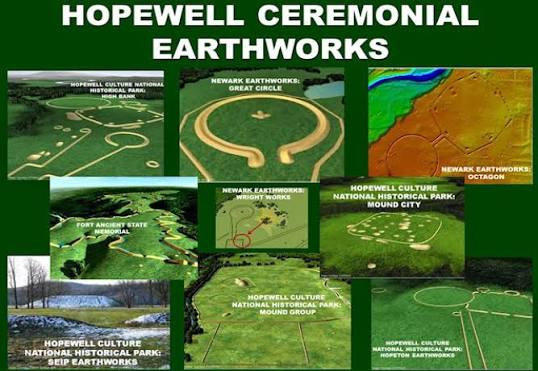
The Liberty Earthworks, situated in Ross County, Ohio, represent another remarkable achievement of the Hopewell culture, dating between 100 BCE and 500 CE. The site forms part of the extensive network of geometric ceremonial earthworks that once covered southern Ohio, showcasing the Hopewell people's extraordinary ability to design large-scale architectural landscapes with mathematical precision. Although portions of the original complex have been lost through agriculture and modern development, archaeological investigations reveal that Liberty Earthworks once served as an important ceremonial center where religious observances, social gatherings, and astronomical observations likely took place.
Architectural Design
The Liberty Earthworks were composed primarily of carefully constructed octagonal and circular embankments connected by straight earthen walls. The octagonal layout demonstrates a sophisticated understanding of geometry, requiring builders to create equal angles and consistent wall lengths over large distances. Earthen embankments were built by excavating nearby soil and transporting it in woven baskets before compacting successive layers to produce stable, durable walls.
The walls maintained relatively uniform heights and widths, indicating careful planning throughout the construction process. Formal gateways connected the different geometric enclosures, creating processional pathways that guided participants during ceremonial events.
Astronomical Knowledge
Many Hopewell earthworks across Ohio display remarkable alignments with celestial events, particularly the movements of the moon. Because Liberty Earthworks share similar geometric characteristics with the Newark Earthworks, archaeologists believe the site may also have been designed to observe important astronomical cycles, including lunar standstills, solstices, and equinoxes.
Such observations would have helped regulate ceremonial calendars, agricultural activities, and seasonal festivals. Rather than serving merely practical purposes, these alignments likely reinforced the Hopewell belief that human communities should remain in harmony with the rhythms of the cosmos.
Community and Religious Functions
The Liberty Earthworks were not defensive structures but ceremonial gathering places that brought together populations from multiple villages scattered throughout the Scioto River Valley. Pilgrims likely traveled considerable distances to participate in rituals, exchange prestige goods, renew alliances, and honor their ancestors.
Ceremonial feasting probably accompanied these gatherings, while skilled artisans displayed elaborate objects crafted from copper, mica, marine shell, obsidian, and finely carved stone. Such events strengthened both social relationships and regional trade networks extending across much of eastern North America.
Conclusion
The Liberty Earthworks highlight the remarkable engineering, astronomical knowledge, and ceremonial traditions of the Hopewell culture. Through precise geometric planning and coordinated communal labor, Hopewell builders created monumental sacred landscapes that reflected both scientific observation and profound spiritual beliefs.