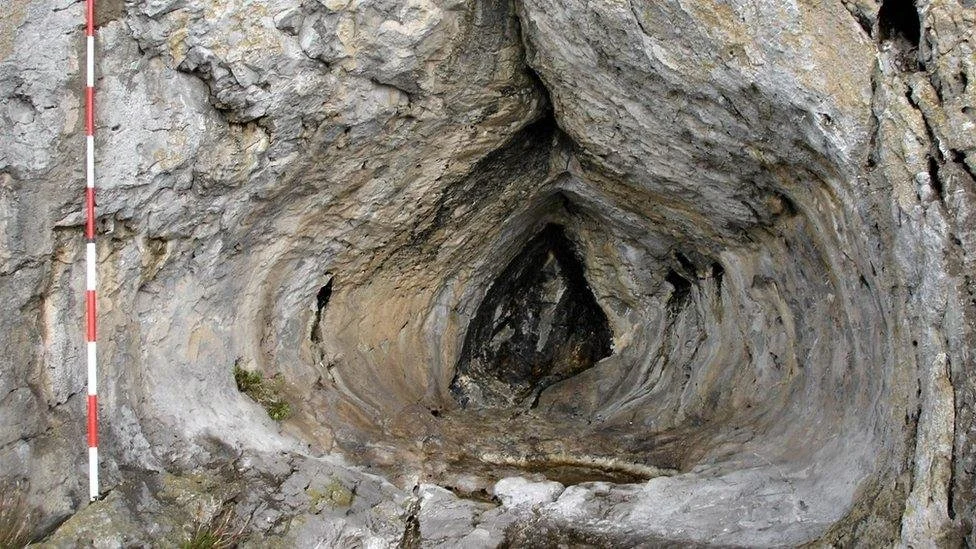
Few archaeological discoveries demonstrate the changing nature of science as clearly as the Red Lady of Paviland.
When the skeleton was discovered in 1823 inside Goat's Hole Cave on the Gower Peninsula, the excavator, William Buckland, interpreted the remains according to the knowledge available at the time.
He believed the skeleton belonged to a woman.
Modern science eventually demonstrated that the individual was actually a young adult male.
Buckland also had no way to imagine that the remains were tens of thousands of years old.
Radiocarbon dating did not yet exist.
The concept of deep human prehistory was still developing.
Today, the Red Lady of Paviland is recognized as one of the most important Upper Paleolithic burials in Britain.
The Discovery in 1823
William Buckland discovered the remains in Goat's Hole Cave.
The skeleton was associated with red ochre and decorative materials.
The striking red coloration contributed to the name “Red Lady.”
The association with ornaments influenced Buckland's interpretation of the individual's sex.
Modern archaeology has demonstrated how dangerous such assumptions can be.
Objects do not automatically identify gender.
Cultural associations between ornaments and sex vary dramatically between societies.
The Red Lady Was a Young Man
Later osteological analysis established that the skeleton belonged to a young adult male.
The famous name remained, however.
The Red Lady is therefore one of archaeology's most famous misnomers.
The correction is historically important because it demonstrates how scientific interpretations change.
The skeleton did not change.
The evidence available to researchers changed.
The methods improved.
And the interpretation became more accurate.
The Meaning of Red Ochre
Red ochre is an iron-rich pigment that has been used by human populations for extremely long periods.
It can be ground into powder and applied to skin, objects, surfaces, or the dead.
Its use in burials often suggests symbolic behavior.
However, archaeology cannot automatically explain the symbolism.
The color red may have represented life.
Blood.
Identity.
Transformation.
Ancestry.
Or something entirely different.
The people who buried the individual left no written explanation.
The pigment provides evidence of deliberate action—not a direct translation of belief.
A Deliberate Burial
The archaeological context suggests that the remains were treated intentionally.
The individual was associated with decorative materials and pigment.
This demonstrates that Upper Paleolithic communities practiced complex treatment of at least some members of society.
The burial may have involved ceremony.
It may have reflected social identity.
It may have expressed beliefs about death.
But the precise ritual remains unknown.
How Old Is the Red Lady?
The age of the burial has been revised as scientific methods improved.
Popular accounts often use an approximate age of around 33,000 years.
However, archaeological dating requires careful distinction between radiocarbon years and calibrated calendar years.
Modern research has refined the chronology and placed the burial within the Early Upper Paleolithic.
Regardless of the exact numerical framework used, the discovery remains among the oldest and most significant ceremonial human burials known from Britain.
Britain During the Ice Age
The Paviland burial belongs to a Britain radically different from today.
Sea levels were lower.
Britain was connected to continental Europe during portions of the Ice Age.
The environment experienced major climatic fluctuations.
The people who occupied the region were mobile hunter-gatherers.
They depended on detailed knowledge of animals, landscapes, seasons, and available resources.
The burial therefore occurred in a world without agriculture, cities, writing, or permanent states.
Yet the evidence demonstrates symbolic complexity.
Why the Ornaments Matter
Personal ornaments are among the strongest archaeological indicators of symbolic identity.
An ornament can communicate information.
It may indicate:
Membership in a group
Social status
Age
Personal identity
Cultural affiliation
Ritual significance
But archaeologists must be cautious.
An object does not come with a label explaining its meaning.
The same type of ornament could have different meanings in different societies.
The Importance of Paviland
Paviland is more than the story of one skeleton.
The wider site contains evidence relevant to:
Early modern human occupation
Upper Paleolithic technology
Symbolic behavior
Mortuary practices
Ice Age environments
The site has also played an important role in the history of archaeology itself.
The original interpretation was wrong.
Later science corrected it.
This process demonstrates one of the strengths of archaeology: conclusions are not sacred.
They can be challenged.
They can be revised.
Why the Red Lady Still Fascinates Us
Archaeologists now know far more about the skeleton than William Buckland could have imagined.
But the most important questions remain unanswered.
Who buried him?
Why was red ochre used?
What did the ornaments mean?
Was the burial connected with religious beliefs?
Was he an important individual?
The archaeological evidence can identify deliberate treatment.
It cannot fully reconstruct emotion.
Yet that limitation creates part of the site's power.
Thirty thousand years later, a young man remains anonymous.
His language is lost.
His beliefs are unknown.
But the people who buried him clearly did not treat his death as meaningless.
That human act of remembrance is what still connects Paviland to the present.