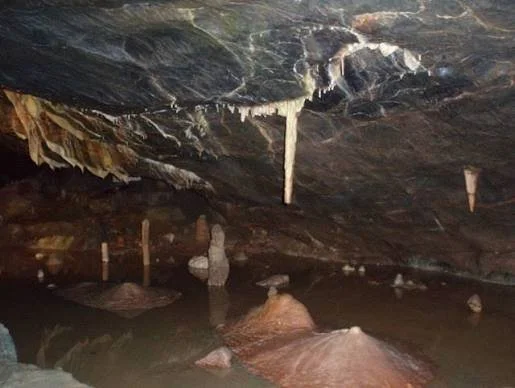
Gough's Cave in Cheddar Gorge contains one of the most disturbing archaeological records in prehistoric Europe.
Around 14,700 years ago, Upper Paleolithic hunter-gatherers processed human bodies inside or in connection with the cave.
The bones reveal cut marks.
They were deliberately broken.
Some contain evidence consistent with human tooth marks.
And several human skulls were carefully modified into objects commonly described as skull-cups.
The evidence is so extensive that cannibalism is strongly supported.
But Gough's Cave is not simply a story about people eating other people.
It is a story about death, symbolism, ritual, and the limits of archaeological interpretation.
A Magdalenian World
The people associated with the most famous occupation of Gough's Cave belonged to the Late Upper Paleolithic cultural world often called the Magdalenian.
This period followed the harshest phases of the Last Glacial Maximum.
As environmental conditions changed, hunter-gatherer populations expanded into regions that had previously been less hospitable.
Britain was part of this changing landscape.
The people who entered Gough's Cave were skilled hunter-gatherers.
They possessed sophisticated knowledge of stone, bone, antler, animals, and landscapes.
The Human Bones
Archaeologists found the remains of multiple individuals.
The bones were fragmented and modified.
Scientific examination identified evidence including:
Stone-tool cut marks
Deliberate breakage
Tooth marks
Removal of soft tissue
Modification associated with marrow extraction
The treatment resembles the processing of animal remains found at the site.
This comparison is essential.
If human bones show the same sequence of butchery-related modifications as food animals, the interpretation of cannibalism becomes much stronger.
Why the Skull-Cups Matter
The modified skulls are among the most remarkable discoveries.
The cranial bones were carefully altered.
Their edges were shaped.
The resulting objects appear to have been deliberately transformed.
If the only objective had been nutrition, such additional work would not necessarily have been required.
This suggests that human consumption was connected with broader cultural practices.
The skulls were not simply discarded.
They were transformed.
Cannibalism and Ritual
The word “ritual” can sometimes become an easy explanation for anything archaeology cannot understand.
Therefore, it should be used carefully.
The evidence does not allow researchers to reconstruct a complete ceremony.
However, the combination of:
Cannibalistic processing
Skull modification
Deliberate engraving
Repeated treatment of human remains
strongly suggests that cultural meaning was involved.
The consumption of human bodies may have formed part of a mortuary tradition.
In other words, the dead may have been treated through practices that combined physical consumption and symbolic transformation.
The Engraved Human Bone
One of the most remarkable artifacts from Gough's Cave is an engraved human forearm bone.
The bone contains a deliberate zigzag pattern.
Microscopic examination distinguishes the engraving from ordinary butchery marks.
The sequence of modifications suggests that the bone passed through several stages.
The body was processed.
The bone was exposed.
The surface was engraved.
This demonstrates that human remains could become objects carrying additional meaning after death.
Was Cannibalism Caused by Starvation?
Probably not as a simple explanation.
The people of Gough's Cave had access to other food resources.
Animal remains demonstrate that the surrounding environment provided opportunities for hunting and subsistence.
This makes a purely starvation-based explanation less convincing.
Cannibalism may have involved nutritional motives, but the archaeological evidence suggests that it was embedded within a larger mortuary system.
Adults and Children
The human remains represent individuals of different ages.
This is important.
The treatment was not limited to a single adult victim.
The broader demographic evidence suggests a repeated or culturally structured practice rather than a simple isolated killing.
However, archaeology cannot determine the exact social relationship between all of the individuals.
Gough's Cave Is Not Cheddar Man
This distinction is essential.
The famous Cheddar Man was a Mesolithic individual who lived thousands of years later.
He was not one of the Magdalenian people associated with the cannibalistic remains.
The association between the two exists because both discoveries come from Cheddar Gorge.
Chronologically, however, they belong to very different prehistoric periods.
What Gough's Cave Teaches About Prehistoric People
The inhabitants of Gough's Cave cannot be reduced to the word “cannibals.”
They were skilled humans.
They hunted animals.
They manufactured tools.
They worked bone and antler.
They created symbolic objects.
They practiced complex treatment of the dead.
The archaeological evidence demonstrates that prehistoric human societies could combine activities that modern people often place into separate categories.
Food.
Death.
Art.
Ritual.
Identity.
These categories may have overlapped.
The Mystery That Remains
The bones tell archaeologists a great deal about what happened.
They are less capable of explaining why.
We can identify cut marks.
We can reconstruct the removal of flesh.
We can recognize deliberate skull modification.
But we cannot hear the beliefs of the people involved.
That silence is what makes Gough's Cave so unsettling.
The archaeological evidence is extraordinarily clear.
The human meaning behind it remains largely invisible.