Introduction
The Newark Earthworks, located in Licking County, Ohio, constitute one of the largest and most sophisticated prehistoric ceremonial landscapes ever constructed anywhere in the world. Built by the Hopewell culture between approximately 100 BCE and 400 CE, the complex originally covered more than 2,000 acres (over 800 hectares) and contained enormous circles, octagons, squares, parallel embankments, and connecting avenues. The scale, precision, and astronomical sophistication of Newark have led archaeologists to recognize it as one of humanity's greatest prehistoric engineering achievements. Today, the site forms part of the UNESCO World Heritage-listed Hopewell Ceremonial Earthworks.
Monumental Engineering
Constructing the Newark Earthworks required the movement of millions of basket-loads of soil using only stone tools, wooden implements, and human labor. Builders created broad earthen walls several meters high while maintaining astonishing geometric accuracy across vast distances.
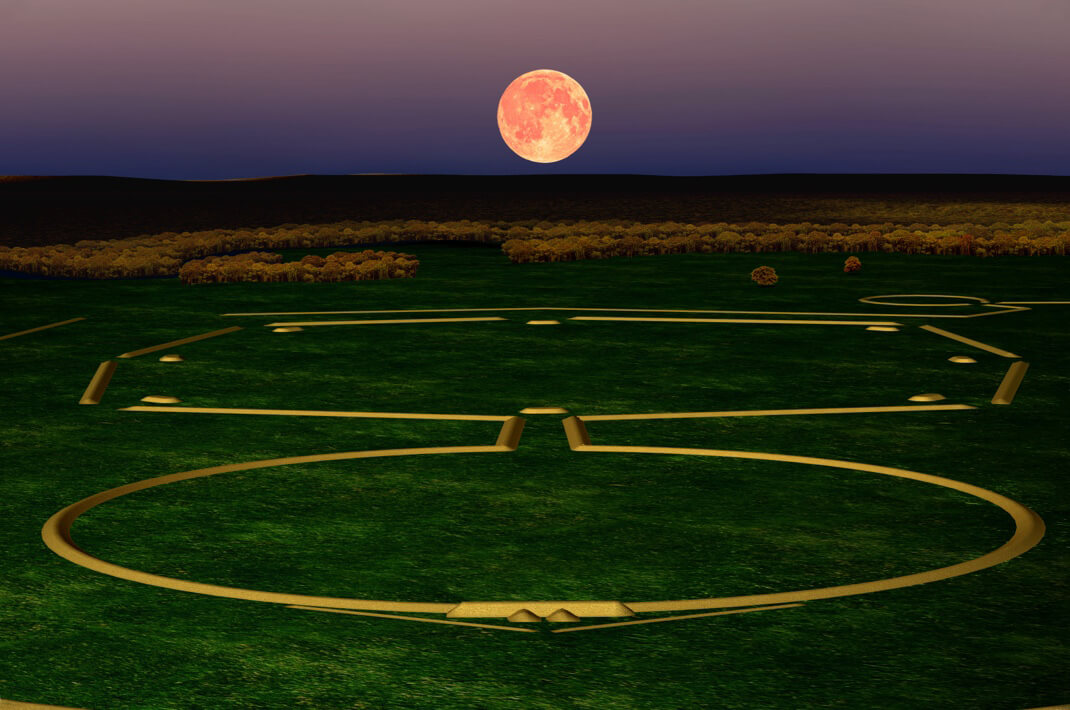
The complex originally included several interconnected components, including the Great Circle, one of North America's largest circular earthworks, and the famous Octagon Earthworks, which remain among the best-preserved Hopewell structures. Long parallel walls linked different sections of the complex, creating an integrated ceremonial landscape unlike any other in prehistoric North America.
Astronomical Observatory
Perhaps the most remarkable aspect of Newark is its role as a sophisticated astronomical observatory. Modern research has demonstrated that the Octagon Earthworks align with the 18.6-year lunar standstill cycle, one of the most complex celestial movements visible to the naked eye. This extraordinary precision indicates generations of systematic sky observation and careful architectural planning.
The earthworks also incorporate alignments related to moonrise, moonset, and seasonal celestial events. Such observations probably governed ceremonial calendars and reinforced religious beliefs concerning the relationship between the heavens and the earth.
Ceremonial Activities
Newark was not a city but a regional ceremonial center visited periodically by communities from across the eastern Woodlands. Pilgrims gathered for religious ceremonies, public feasts, trade fairs, diplomatic meetings, and funerary rituals. The expansive plazas enclosed by the earthworks provided space for large assemblies, while surrounding burial mounds honored important members of Hopewell society.
Excavations have uncovered finely crafted artifacts made from copper from the Great Lakes, marine shells from the Gulf Coast, mica from the Appalachian Mountains, and obsidian from Yellowstone National Park, illustrating one of the most extensive trade networks in prehistoric North America.
Conclusion
The Newark Earthworks stand among the greatest engineering and scientific accomplishments of prehistoric civilization. Their monumental scale, extraordinary geometric precision, sophisticated astronomical alignments, and ceremonial importance demonstrate the remarkable achievements of the Hopewell culture and continue to reshape our understanding of ancient North American societies.