Absolutely incredible: While constructing a pool in his backyard, a father of four finds an 8,000-year-old dolphin

The bones of a dolphin dating back 8,000 years were found by a guy digging a swimming pool in his backyard, which archaeologists have dubbed "the find of a lifetime."

Paul McDonald, 44, uncovered the prehistoric skeleton at his home in Stirling, where it had been preserved in clay at around 80cm below ground level

The prehistoric skeleton was discovered by Paul McDonald, 44, at his Stirling house. It had been kept in clay some 80 cm below ground.

'It's mind-blowing,' said Mr. McDonald, an orthopaedic medical representative who deals with bones every day.

"I've found a few old bottles and coins since we bought the house six years ago, but I've always wanted to find something like this," the homeowner said.

Although the dolphin is believed to have washed up and been eaten by hunter-gatherers when the area was a shoreline sometime after the last Ice Age, his home is kilometers from the water.

Among the bones was a shattered deer antler carving instrument that would have been used to carve the meat.

The father of four, Mr. McDonald, stated: "I recognized it was a dolphin when I saw the roundness of the skull, the nose, and the teeth.

I was certain it had to be old at that point.

National Museums Scotland (NMS) has removed the head so that it may be examined, and the rest of the skeleton will be completely unearthed.

The NMS's head curator of vertebrates, Andrew Kitchener, said: "This is the first time something has come out of the clay like this in my 35 years here. It's a crucial discovery. It appears to be an animal that got stuck there and was preserved for all this time until Paul found it, which is somewhat of a miracle.

Its teeth are worn, indicating that it may be a female, and its size suggests that it is an older animal."

Mr McDonald's home is miles from the sea, but it is believed the dolphin washed up when the area was part of a shoreline some time after the last Ice Age and was eaten by hunter-gatherers (Stock image)

Despite the fact that Mr. McDonald owns the bones, the antler instrument may be designated as treasure, making him eligible for a reward.

Dr. Murray Cook, an archaeologist from Stirling, claimed that the find might be Scotland's first of its kind in more than a century.

There are no recent records of dolphin discoveries, although the last whale bones discovered around Stirling were discovered in 1897.

The 42-year-old wife of Mr. McDonald claimed: "Only Paul could find a dolphin in a half-dug pool."

Source: https://www.dailymail.co.uk/news/article-1...

German Archaeologists Find a Very Rare Medieval Pocket Sundial

In the old town of Marburg, Germany, a unique medieval sundial that is about the size of a matchbox was uncovered.

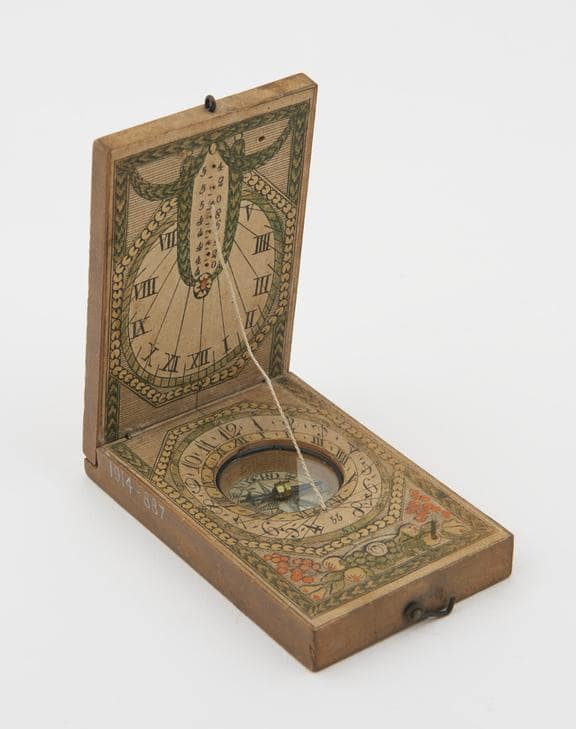
A rare Medieval sundial, which is approximately the size of a matchbox was discovered in the old town of Marburg, Germany.

The sundial was found by students who were clearing a church site in the town, according to a statement from Marburg University. The sundial is made of wood and bronze.

The Brethren of the Common Life, a monastic order that was established in the Netherlands in the late 14th century, is likely to have belonged to the old clock, which is believed to date from the late medieval period. A Dutch Catholic deacon named Gerard Groote founded the community. The Brethren eventually colonized the Netherlands, Germany, and Switzerland. They moved into the old monastery building, built in 1527, in the upper portion of Marburg.

"The sensational find provides a clear insight into the meeting of a high level of knowledge in astronomy and mathematics with specialized craftsmanship on the threshold from the Middle Ages to modern times," explains the head of the educational excavation, Professor Dr. Felix Teichner.

There aren't many remaining sundials of this type, according to Professor Teichner of the Department of History and Cultural Studies at the Philipps University of Marburg, and this is the first one to be discovered in the German state of Hesse.

To identify the relic, investigators matched the unique find with a related one found by archaeologists in a Swiss ministry. Teichner claims that the reason the sundial was found in that particular spot is still a mystery.

A good example of a wooden pocket sundial.Horizontal and vertical dials for use at various latitudes on moving style, Germany, 1776-1800. Photo: Science Museum Group

Sundials were prehistoric timepieces that used the sun's position to calculate the time. They consist of a gnomon that, when the sun shines, casts a shadow on the flat plate. Since at least 1500 BCE, sundials have been used.

Opening this particular sundial reveals a hole that was meant to accommodate a stick for noting the sun's shadow.

Since ancient times, people have carried portable sundials, and by the 1600s, some Europeans were doing the same.

The site is still being excavated in the hopes of finding additional priceless artifacts.

Source: https://arkeonews.net/a-very-rare-medieval...

A meteoritic iron arrowhead kept at the Bern History Museum has been discovered

An arrowhead kept at the Bern History Museum was discovered to have been crafted from meteoritic iron by an international team of geologists and historians. The team details the characteristics of the arrowhead and the origin of the material they think it was composed of in their article that was published in the Journal of Archaeological Science.

Fig. 1. a–b. a) Overview of the Mörigen arrowhead. Note adhering bright sediment material. Remnants of an older label on the left of the sample number. Total length is 39.3 mm. Photograph: Thomas Schüpbach. b) side view of the Mörigen arrowhead. Layered texture is well visible. Point is to the right. Credit: Journal of Archaeological Science (2023).

Prior studies have demonstrated that early humans utilised meteoritic iron in numerous regions of the planet, from Eurasia to the Middle East and Africa. Notably, academics have only come across a limited number of instances of early Europeans using meteoric iron. The group behind this new initiative searched archaeological collections at several sites in Switzerland because they had a suspicion that many similar objects had already been discovered but had not been properly labeled as such.

Testing on an arrowhead discovered in the Bern History Museum revealed that it had aluminum-26 isotopes, which are unnaturally absent from the planet's crust. Additionally, they discovered an iron-nickel alloy that has only previously been identified in meteorites.

When the crew looked into the arrowhead's past, they learned that it had been recovered at Mörigen, a former Bronze Age site. There had been a settlement there between the years 900 and 800 BCE.

The researchers also discovered remains of an adhesive, which they estimated to be tar pitch, on the arrowhead, indicating that the arrowhead had formerly been affixed to some sort of shaft.

The Twannberg meteorite, which is the most likely source of the iron used to build the arrowhead, crashed into the ground fewer than eight kilometers from the spot where the arrowhead was discovered, according to the experts. The team discovered, however, that the concentrations of germanium and nickel did not coincide upon closer examination. They began looking for another supply as a result.

Only three meteorites with the correct mix of metals have been discovered in Europe, according to a geological database search: one in the Czech Republic, one in Spain, and one in Estonia. As an illustration of the wide trade network that was operating throughout the Bronze Age in Central Europe, the research team contends that the one in Estonia was the most likely source of the arrowhead they analyzed.

Source: https://phys.org/news/2023-07-arrowhead-ho...

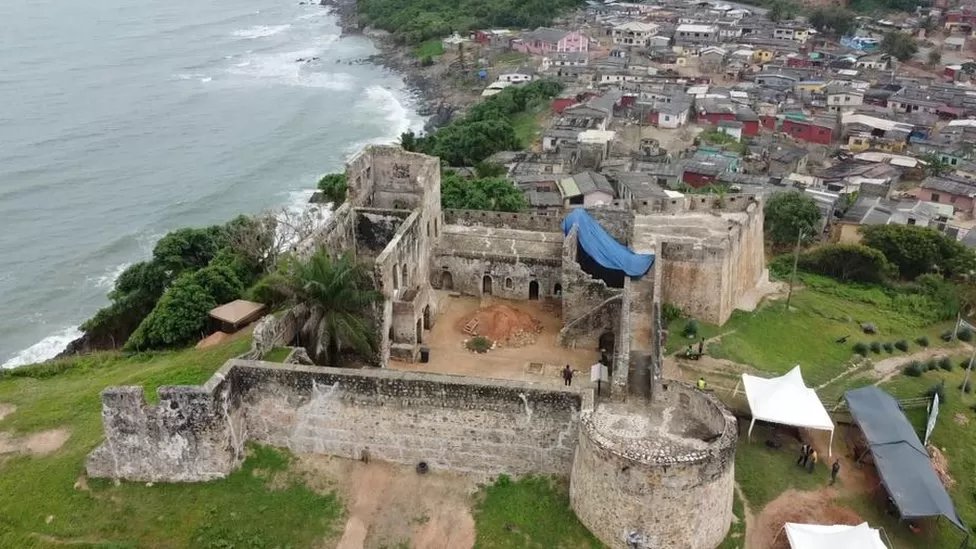
Uncovered on Ghana's coast is the "First English slave fort in Africa."

Christopher DeCorse, an archaeologist, carefully spreads out the priceless artifacts on a temporary table near to the excavation site.

Prof Christopher DeCorse (C) is leading the team of archaeologists in Ghana

The jawbone of a goat, tobacco pipes, shattered earthenware, and gunflint (used in vintage firearms) are all artfully arranged. These abandoned pieces, uncovered from millennia of compacted soil, provide hints about a vanished history.

The lecturer from Syracuse University in the US said with a big smile that "any archaeologist who says they are not delighted when they find something are not being totally true."

He claims that these remains are evidence of "the first English outpost built anywhere in Africa."

Speaking over the wind and the thunder of the Atlantic Ocean waves slamming Ghana's shoreline, the archaeologist is standing in the Fort Amsterdam ruins.

The professor's team is actively excavating what are believed to be the remains of an ancient fort called Kormantine that was lost beneath the ground inside that current fort.

Using soft-bristle brushes and trowels, they are meticulously sifting through separate layers of soil and stones. The trenches' disturbed dirt is properly sieved after removal.

The team and the site are covered from the elements, and the archaeologists continue their work despite the blazing sun and the sporadic downpour.

The name of the neighbouring town, Kormantse, is unmistakably tied to the reference to a Fort Kormantine on ancient maps. Moreover, some of the enslaved people in the Caribbean who were subsequently notorious for slave rebellions were given another name, Coromantee, which was assumed to have been carried from this location.

Yet the precise location of the fort remained a matter of conjecture, which may have now come to an end.

Fort Kormantine, which dates to the 17th century, was located on the Atlantic coast right when Europeans began to become more interested in the trade in people rather than gold.

That was a turning point in their history in Africa that would have a significant impact on the region.

The archaeologists' find may provide some insight into the activities of those early traders as well as those who were sold and their effects on the neighborhood.

The coastal fishing communities of Ghana, famous for their colorful boats and the tunes sung by the fisherman, are still marred by the atrocities committed by the Europeans and by wicked people in the past.

A looming reminder of that time are the slave forts scattered over the area formerly known as the Gold Coast.

Before being carried across the sea in appalling circumstances, hundreds of thousands went through them.

One of the early locations where that voyage began was Fort Kormantine, which the English built in 1631.

Nigerian Omokolade Omigbule says it was "mind-blowing" to see the remains of the English fort

It started off as a trading post for goods like ivory and gold.

Only in 1663, when King Charles II awarded a license to the Company of Royal Adventurers of England Trading into Africa, did the slave trade actually start from there (later the Royal African Company). He granted it exclusive control over the trade in people.

Fort Kormantine was only in English hands for two more years before the Dutch took control of it, but during that time, it was crucial in the development of the slave trade.

It served as a storage facility for the things used to purchase slaves. It served as a temporary detention facility for people who had been abducted in various regions of West Africa before being transported to the Caribbean to work on plantations to advance the sugar industry.

One of the factors that makes locating the Fort Kormantine's foundations interesting, according to Prof. DeCorse, is the lack of information regarding the actual appearance of these early slave trafficking outposts.

The Dutch constructed Fort Amsterdam on the same position as the fort after taking control of it, so its precise location could not be determined, especially after it was designated a United Nations World Heritage Site, which made excavation challenging.

However, preliminary excavations in 2019 in and around Fort Amsterdam, which uncovered some early 17th Century artifacts, provided a possible location.

Early this year, archaeologists visited the area again and started further investigations.

When they began by discovering numerous plastic items that must have been dropped more recently, there was first some dismay. But later a stone that Professor DeCorse identified as a component of a larger construction was discovered by Nigerian graduate student Omokolade Omigbule.

The University of Virginia student describes seeing the remains and the footprints of an actual building that had been buried beneath a new fort as "mind-blowing."

"Being a part of such a dig transports me back a few hundred years, it feels like I was there," the participant said of seeing the effects of these outside forces in Africa firsthand.

A six-metre (20-foot) wall, a door post, foundations, and a drainage system made of red brick were discovered as the excavations went on.

These all point to an English presence earlier than the Dutch fort.

These bowls of tobacco pipes were among the artefacts found at the site

Prof. DeCorse returns to the collection of artifacts that are properly labeled in zip-lock bags and points out the rusted gunflint that he claims was used in England in the early 17th century.

The professor adds that the pipes' small bowls, where the tobacco was placed, are "also extremely unique of the time that we are talking about here." He continues by saying that as tobacco became less expensive and more widely available, the bowls grew larger over time.

Prof. DeCorse offers an answer to the question of why the goat jawbone is significant by stating that it may be evidence of how English settlers domesticated local animals as an alternate source of protein despite living on a beach where fish were abundant.

Work in archaeology is laborious. Each historical relic that it produces must be questioned and analyzed.

The hard work has, however, really only begun in some ways. During the course of the next three years, archaeologists will work to understand Fort Kormantine's whole scope, including its architecture and overall aesthetic. This should help them understand its genuine significance.

Source: https://www.bbc.com/news/world-africa-6635...

An entire ancient city was discovered beneath a man's basement after he renovated his house

“Would have concealed this and constructed the bat cave.”

It seems like everyone is discovering the craziest (and coolest) things in their home, from hidden bunkers to eerie words hidden beneath a layer of wallpaper. The internet has reminded us that a man discovered a complete city under his home back in 1963, if you thought finding a sunken living room or indoor swimming pool was the ultimate too-weird-to-be-true. A city (yes, you read that right.)

According to the well-known Instagram account History Photographed, a Turkish guy was chasing his chicken in his basement during some repairs in the early 1960s when he discovered a hole that led to a network of complicated tunnels and shelters that were up to 280 feet deep.

Further research and extensive excavations led to the identification of the location as Derinkuyu, a massive underground city in Turkey that can accommodate up to 20,000 people. Most historians concur that Derinkuyu was utilized as a hiding spot from foes and conquerors, despite the fact that its exact origins are unknown—some claim it was built by the Hittes around 200 B.C., while others assert that the Phrygians did so in 900 B.C. It's important to note that the infrastructure is first-rate, whoever constructed it. None of the city's floors have ever collapsed, as noted by Atlas Obscura. In fact, many people think that the early Christians who eventually settled Derinkuyu added contemporary improvements like stables, churches, and special locations to produce wine and olive oil. (You know, the basic stuff.)

Despite the fact that Derinkuyu has been excavated for many years and is still open to the public, it seems that those who are only now learning about it would have reacted to the discovery very differently than the homeowner who first told the archaeological authorities about it. He ought to have remained silent, one commenter said. "He would've had a great place all to himself." "I wouldn't have told a soul," a second commenter said. In peace and quiet, I would have loved that aspect of ancient history my entire life. Another person thought it would have made the ideal bat cave if the owner had done so. There is "so much potential," they continued. We would have promptly reserved a room if the owner had placed it on Airbnb, according to a fourth commenter.

Source: https://www.housebeautiful.com/lifestyle/e...

Belgian museums row over which mummy inspired TinTin story

Herge's fictional Inca has sparked a row between rival Belgian tourist attractions, each of which displays a mummy they say inspired Tintin's creator.

The mummified corpse of Rascar Capac thrilled and terrified generations of young fans of the Tintin comic book story 'The Seven Crystal Balls'.

The very serious Art and History Museum is in Brussels' Jubilee Park, near where Herge used to live, and he was known to frequent its collections.

The museum's Andean mummy, squatting upright with knees bent, appears similar to the haunting effigy in the author's illustrated tale of the be-quiffed reporter Tintin's adventure.

Curators thought they had established the link beyond doubt 10 years ago, but the Pairi Daiza safari park in southern Belgium is touting a rival mummy.

Last week, the popular zoo began marketing an exhibit of the 'authentic mummy nicknamed Rascar Capac'.

The royal museum is not taking this well, and has all but accused the zoo park of false advertising.

'We don't attract visitors by promising them pandas,' sniffed museum director general Alexandra de Poorter.

The zoo has expressed regret over an 'argument started by the royal museums' but admits that 'no one can say for sure which mummy inspired Herge.'

If there is confusion, it dates back until at least 1979, when the 2,000-year-old preserved corpse now on display at the zoo appeared in Brussels at an exhibit titled 'Tintin's museum of the imagination'.

The collection was assembled to mark the 50th anniversary of the 1929 release of the boy reporter's first book-length adventure, 'Tintin in the Land of the Soviets'.

Author and illustrator Georges Remi - better known under his pen name Herge - attended the show, adding some credibility to the mummy's significance.

But this, according to the Art and History Museum's curator of Latin American relics, Serge Lemaitre, was a mistake.

The mummy in question had been bought by a Belgian collector in the 1960s, long after Herge published the 'Seven Crystal Balls' book in 1948.

'And in the first frames serialised in 1941 in the newspaper Le Soir, Rascar Capac was hairless and had very bent knees, just like our mummy,' Lemaitre says.

Herge lived near the Jubilee Park - still a popular spot in Brussels' European quarter - and knew the museum and its curator Jean Capart well.

Capart even seems to have been fictionalised as Professeur Bergamotte - or Professor Hercules Tarragon in the English-language version of 'The Seven Crystal Balls'.

Not only that, but items drawn from other pieces in the museum's ethnographic collections have appeared in the Tintin tales, notably a Peruvian figurine that inspired its eponymous twin in 'The Broken Ear'.

The museum is thus confident in its claim, but - as is often the case in a Tintin mystery - the plot may have a further twist, according to independent expert Philippe Goddin.

'We should stop arguing. Herge looked at lots of Inca mummies, but his first sketches of Rascar Capac are essentially based on a drawing in the Larousse dictionary,' he said.

This is an explanation that will not suit anyone in Belgium, where tourist attractions have seized upon any Tintin link to exploit as a key draw.

The drawing in the Larousse was based on a mummy brought back from Peru by the 19th-century French explorer Charles Wiener and is today in the Quai Branly Museum in Paris.

Source: https://www.dailymail.co.uk/news/article-8...

3,000-year-old remains of woman unearthed with 70 hair extensions tied in intricate layers

You may think hair extensions were created for the feisty, fake-tan bearing women of today – but they were in fact being flaunted by Egyptian women more than 3,000 years ago.

The pieces were elaborate creations, with one recently uncovered in an Egyptian coffin made up of 70 elaborate extensions fastened together.

The owner of the hair piece had her body wrapped in a mat, but her name, age and occupation remain a mystery to archaeologists.

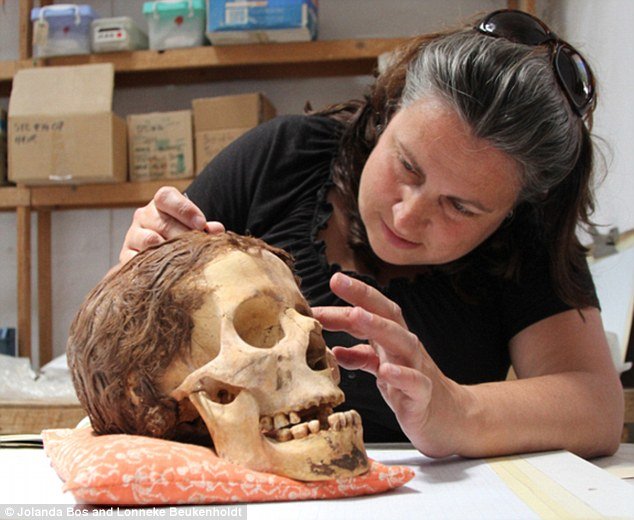
The skull was one of hundreds found in the ancient city of Amarna, many of which had their final hairstyles incredibly well-preserved using fat.

One skull had extensions made of grey and dark black hair suggesting a number of different people donated their hair to create the piece.

However, the latest intricate design of hair extension has left researchers on the Amarna Project baffled.

'Whether or not the woman had her hair styled like this for her burial only is one of our main research questions,' Jolanda Bos, an archaeologist working on the Amarna Project, told Owen Jarus at Live Science,

'The hair was most likely styled after death, before a person was buried.

'It is also likely, however, that these hairstyles were used in everyday life as well and that the people in Amarna used hair extensions in their daily life.'

Out of 100 skulls analysed, 28 still had hair. The type of hair ranged from curly black to light brown and curly, suggesting some ethnic diversity in the region.

Skulls with in tact hair often had curls around their ears, and many also had braids.

'All braids found in the coiffures were simple and of three strands, mostly 0.4 inches wide, with strands of approximately 0.2 inches (5mm) when tightly braided,' Ms Bos writes in the journal article.

People at Amarna also liked to keep their hair short. 'Braids were often not more than 7.9 inches (20cm) long, leaving the hair at shoulder length approximately,' Ms Bos added.

And it appears ancient Egyptian women used a similar technique to hide their greys. Some of the skulls shows evidence of a dye, possibly henna, used on hair.

Source: https://www.dailymail.co.uk/sciencetech/ar...

How did The Silk Road Actually Work?

The Silk Road was the ultimate route for messengers, merchants, and explorers alike. The roads were used in a few manners, with the main being for commercial trade. Watch the video to find out more!

The Mysterious 15 Million Year Gap in Our Evolution - Romer’s Gap

The Fossil Record provides us an invaluable glimpse into past life on Earth, but it is not always a complete record. One particularly notable and mysterious gap in the evolution of life is known as Romer's Gap, apparently obscuring a key point in the vertebrate transition to life on land. Or does it?

Trove of Roman coins from Wales declared treasure

Silver coins dating back nearly 2,000 years to the Roman period and two Medieval rings have been declared treasure about a year after being found in a field by walkers using metal detectors.

The coins and rings were declared treasure, among other items including a brooch and a Bronze Age hoard by saw senior coroner for Cardiff and the Vale of Glamorgan Andrew Barkley at Cardiff Coroners’ Court last week.

The Roman silver coins were discovered by Mr. Richard Annear and Mr. John Player while metal detecting in a field at the village of Wick in the Vale of Glamorgan on 13 December 2014. The coins were found partly scattered by previous ploughing and the finders left the undisturbed portion in the ground before reporting the finds to Mark Lodwick, Co-ordinator of the Portable Antiquities Scheme in Wales (PAS Cymru) and archaeological curators at Amgueddfa Cymru – National Museum Wales. This allowed museum staff to lift it intact for detailed excavation in the museum laboratory.

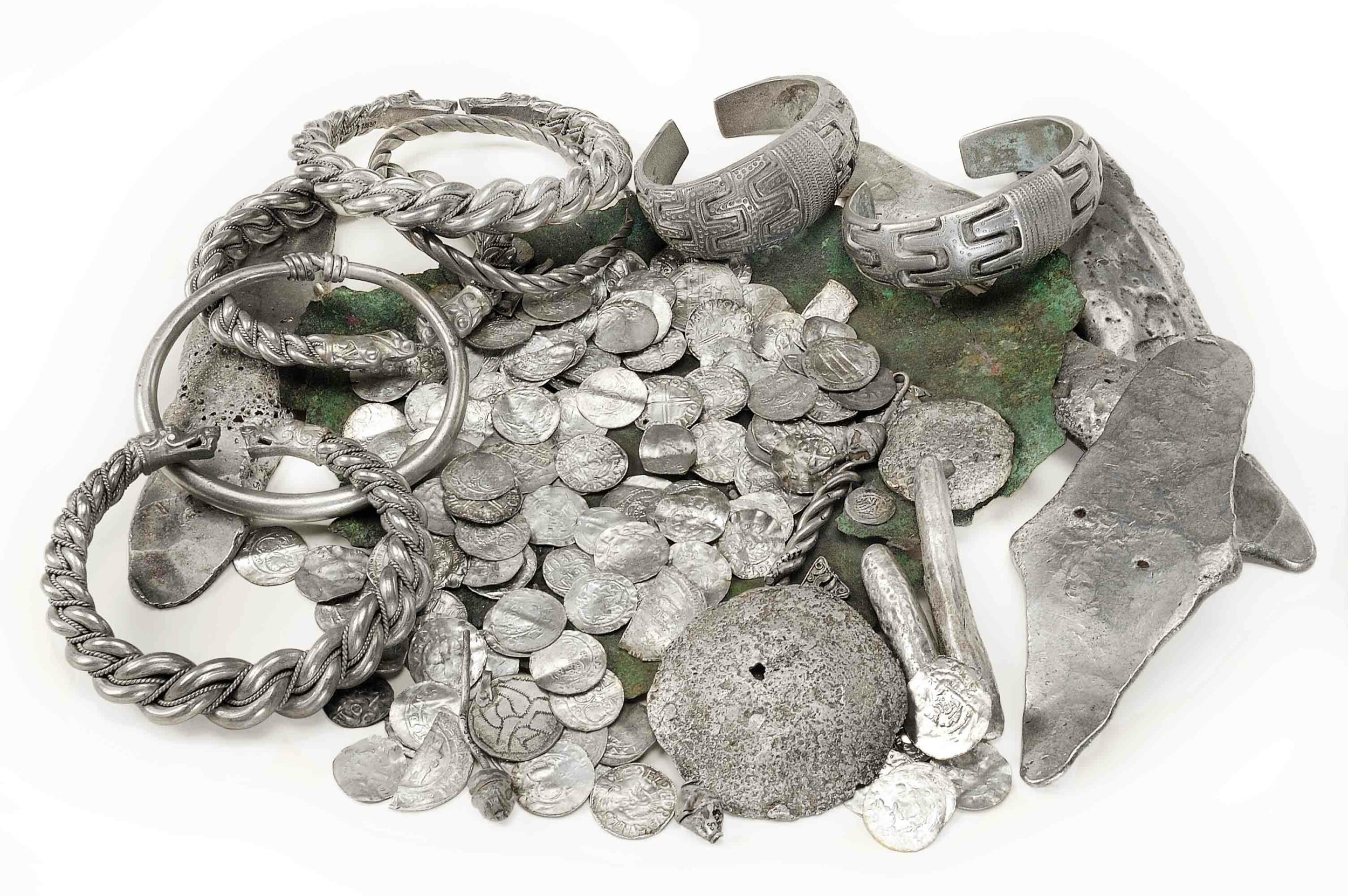
The find comprises 91 Roman silver denarii (coins) which were buried in a locally-made pot. The coins date from the period of Emperor Nero (AD 54-68) to Marcus Aurelius (161-80) and the latest coin was struck in 163-4. Fourteen emperors and empresses are represented. The hoard also contained three coins issued by Mark Antony in 31 B.C., still in circulation after nearly 200 years.

Edward Besly, numismatist at Amgueddfa Cymru – National Museum Wales said:

“Each coin represents about a day’s pay at the time, so the hoard represents a significant sum of money.

“The hoard’s find spot is only a mile (1.6 Km) as the crow flies from that of another second century silver hoard found at Monknash in 2000, which comprised 103 denarii, buried a little earlier, around 150. Together the hoards point to a prosperous coin-using economy in the area in the middle of the second century.”

The two medieval rings were found in Llancarfan in the Vale of Glamorgan by Mr David Harrison in December 2013.

The silver finger ring in the form of a decorated band, tapering away from bezel. The decoration, which extends all along the external face, has been first engraved and then inlaid with niello (now only partially preserved, but represented by dark material in parts of the engraved design). The ring is of twelfth-century date. Parallels include one from the Lark Hill hoard, Worcester (buried c. 1173-4).

The gold decorative ring has a repeating pattern of alternating half-flowers filling triangular panels, separated by a deep zig-zag moulding and considered to be of the late fifteenth-century.

Dr Mark Redknap from the Department of History & Archaeology, National Museum Wales, said: ‘These are finger rings from different centuries – one twelfth-century and the other fifteenth-century – reflecting different traditions of fine metalworking, which are important indicators of changing fashions in south Wales during the medieval period’.

These treasure items will be acquired by Amgueddfa Cymru – National Museum Wales supported by grant funding provided through the Saving Treasures; Telling Stories Heritage Lottery funded project.

Source: https://www.archaeology.wiki/blog/2015/12/...

Top 10 Real Mummies

Let’s crack open the sarcophagi and get this unwrapped. For this list, we're looking at the most famous human bodies to ever be preserved after death through either natural or artificial means.

In tooday’s video we're counting down our picks for the top 10 real mummies.

Blond Mummies, Tocharians and Indo-Europeans of China

Archaeological discovery of mummies in the Taklamakan desert of Western China dating back 4,000 years has captivated the imaginations of researchers, who were surprised to discover that they were caucasians from Europe. The answers to the mystery of who these white mummies were might be found in the later history of Xinjiang province; in the Chinese written records of blue eyed and red bearded merchants such as the Yuezhi and the Sogdians from the West and in the manuscripts written in a mysterious Indo-European language known as Tocharian. Clearly there were both Iranic and Tocharian peoples living in Western China in later times, and the Tarim mummies must have been the ancestors of some if not all of them.

The inhospitable Tarim basin became a vital route for merchants, at the crossroads between East and West, the basin is skirted by oasis towns which were stations for anyone traveling on the Silk Road.The caucasian, Europoid mummies and the ancient Indo-European languages of the region challenge popular misconceptions about the limits of European civilisation in the Bronze Age. The material excavated suggests the area was active for thousands of years, with diverse languages, lifestyles, religions, and cultures present.

12 Most Mysterious Artefacts Finds Scientists Still Can't Explain

If archaeologists and scientists understood every ancient discovery they ever came across, channels like ours would be out of business. Fortunately for us, we never have to worry about that, because there are ancient mysteries to be found almost everywhere we look! Whether they were discovered recently or long ago, these discoveries have left even the best-informed experts scratching their heads in confusion.

Super Kinky Sex Lives Of Roman Gladiators

Gladiators were the rock stars of their day, but there was also a social stigma attached to their existence. They were slaves who embodied some of the greatest virtues held by Roman society, but their status didn't stop women in Rome from desiring gladiator sex or from gladiator sweat as an aphrodisiac as they tried to satisfy their lust for the fierce, manly fighters.

Explorer came dangerously close to the army of China's first emperor, whose tomb archaeologists are afraid to open

When it comes to the tomb of China's first emperor, archaeologists must exercise caution, yet one explorer reportedly had the 'amazing' honor of coming up close to the renowned Terracotta Army.

One of the most significant archaeological finds ever was the Qin Xi Huang tomb complex, which is well known on a global scale.

A complex city-sized fortress that he had constructed had all he would require for his afterlife, including his very own Terracotta Army, a group of clay soldiers created to guard him after he passed away at the age of 49 in 210 BC.

One chamber of the complex of tombs that houses the emperor's tomb and sarcophagus has remained closed, suggesting that the army is also doing its job.

Although there is no reason for the delay in uncovering the tomb—just plain, old-fashioned science—it is not because of any curses.

The famous Terracotta Army. Credit: National Geographic

The terracotta soldiers weren't the simple ones we are accustomed to seeing now; instead, they were painted in vibrant hues when the complex was first uncovered. The figures' paint, however, started to peel off due to the abrupt shift in the environment, and now the majority of them are entirely bare.

It is therefore feared that opening the imperial chamber would have a similar impact on everything inside.

Another reason is that before opening the chamber, the authorities are awaiting new developments in archaeological research and technology, which they hope will enable us to gather as much knowledge as possible or even preserve the chamber.

National Geographic's Albert Lin meeting the Terracotta Army. Credit: National Geographic

According to curator Kristin Romey of the Terracotta Warrior exhibit at Discovery Times Square in New York City, "Nobody has ever been in there where the emperor is buried.

"They realize that nobody in the world right now has the technology to properly go in and excavate it," says the author, "partly out of respect for the elders."

While specialists must exercise caution when navigating certain regions, one explorer once had the opportunity to interact with the emperor's Army, which he described as a "incredible" experience.

National Geographic's Albert Lin described the Terracotta Army, one of the world's great wonders, in a video posted six years ago. "This is the Terracotta Army, 8,000 warriors buried over 2,000 years ago.

"This is the army of the first emperor. In order to wage his wars in the hereafter, he gave the order to have his actual army replicated in clay and buried with him.

"Each face is distinct and individual. Take a look at this place's size; it reveals a lot about the man, his ego, and his afterlife aspirations."

He continued, taking it all in, "What an experience."

With light infantry in the front, heavy infantry in the middle, and even cavalry at the rear, together with 520 life-size horses, Lin claimed that the warriors he could see were obviously "set for battle - exactly like the emperor's real army."

It's an absolutely fantastic feeling to be here, he continued. standing at a place to which few people actually have access.

We are located in the center of this incredible World Heritage Site, which in many ways represents my own cultural heritage and ancestry.

Source: https://www.unilad.com/news/travel/chinas-...

Ancient DNA sheds new light on Machu Picchu, the 'lost metropolis' of the Incas.

From all throughout the empire, including the Amazonas region, workers and retainers were employed at the renowned mountain estate.

According to the results of a recent study that examined ancient DNA recovered at the site, a wide variety of people from all across the Inca empire lived and worked at Machu Picchu, which served as the Inca emperor's royal palace.

The study's findings, which were published on July 26, 2023 in the journal Science Advances, revealed that the laborers and retainers at the estate originated from all around the empire, with some of them even arriving from the Amazonas region.

Source: https://www.jpost.com/archaeology/article-...

Expeditions to This 750,000-Year-Old Workshop Were Made by Ancient Humans

Tools have been made by our prehistoric ancestors for hundreds of thousands of years. According to recent study, Homo erectus foragers relied on possessing a specialized forge to forge tools and weapons as part of their hunting strategy.

When you go back far enough in time, our understanding of our forefathers becomes quite hazy. Nevertheless, over the years, various tools connected to Homo erectus have been found. Homo erectus is thought to be the direct ancestor of modern humans. For instance, tools that may be as old as 3 million years ago were recently found in Kenya and are possibly related with Paranthropus or another ancestor of the Homo genus.

But having a real workshop you can use and leave to your offspring differs from simply constructing a few tools when the occasion presents itself.And as researchers have discovered, our predecessors were able to do both, demonstrating that they were thinking forward rather than simply responding to their current surroundings.

Indeed, scientists have recently verified one of the earliest known human workshops at a flint rock exposure in northern Israel, a location that people probably frequented for tens of thousands of years. The research was published in the journal Geoarchaeology in June 2023.

According to Meir Finkel, a geoarchaeologist at Tel Aviv University in Israel and coauthor of the latest study, "they probably passed this knowledge down through many generations."

Acheulean Tools Discovered in Ancient Workshop

The Hula Valley in northern Israel is home to the well-known archaeological site Gesher Benot Ya'aqov (GBY). Both the elephants' remains and the stone implements used to butcher them can be found at the location. The now-dry area was formerly a lake where huge animals would congregate for water before it was drained in the 1950s.

According to Finkel, it's still unclear if the hominids who inhabited the area hunted elephants and other animals or used the mud as a kind of trap where they could slay animals when they got stranded. In any case, the Hula Valley's GBY and Ma'ayan Barukh adjacent provided the hominids with a consistent food source that they frequented throughout the course of hundreds of thousands of years.

Both sites contain thousands of hand axes and other tools that date to the Acheulian style, a period of typically oval stone tool production that is frequently connected to Homo erectus and lasted from around 1.7 million years ago to about 200,000 years ago. The Ma'ayan Barukh site was created about 500,000 years after the GBY site, which dates to approximately 750,000 years ago.

Where Did The Hula Valley Axes Come From?

There had to be a source for the enormous number of hand axes discovered in these Hula Valley sites. According to Finkel, "the amount attests to continuous exploitation of the same source."

In the most recent research, Finkel and his coworkers broke down samples from 10 hand axes from GBY and 10 from Ma'ayan Barukh before evaluating them with a mass spectrometer, which gauges the concentration of various elements in material.

They needed to locate a match from the source once they got the flint's signature in the tools. About 12 miles to the west of these locations, on the Dishon Plateau, Finkel had previously researched a flint workshop as part of his doctoral dissertation. Thousands of abandoned stone tools, flakes, chips, and other artifacts from the Acheulian tool-making tradition dating back hundreds of thousands of years were discovered at this location by prior studies.

These tools could always be obtained from the Dishon Plateau. But the researchers also wanted to rule out anything else close to validate that fact. They carried out field surveys close to the sites, collecting rock samples from streams that flowed into the valley, the Ramim Ridge, the Safed Mountains, and flint exposures in the Golan Heights.

Comprehensive Review of Flint Tools

The majority of the flint exposures at these locations did not provide as many stone tools as those discovered at the Hula Valley sites. Additionally, Finkel claims that the manufacturing of each Acheulian hand axe resulted in an average amount of waste of 75–80%. Nothing would have provided enough stone for more than a few tools, with the exception of the flint outcropping at Dishon.

However, the researchers used the mass spectrometer to examine samples from each of these locations just to be certain. The 20 flint tools from GBY and Ma'ayan Barukh's signatures matched the stone at Dishon Plateau, indicating virtually conclusively that they all originated from the same location.

Finkel asserts that there is essentially no alternative for that many hand axes anyplace else.

It is likely that the individuals utilizing tools had to plot their route to the Dishon Plateau, which is about 20 kilometers to the west of the Hula Valley and would have involved climbing around 800 meters in height. It's not en route; they must go directly to this location, according to Finkel.

How Does This Finding Affect Us?

In more recent decades, anthropologists have documented hunter-gatherers going on these kinds of journeys, Finkel notes, traveling very far to particular locations to harvest materials for their tools.

The findings in the Hula Valley and Gishon Plateau "may be the first proof of what is seen in ethnographic research," he claims. Whether Acheulian foragers used these axes and other weapons to hunt elephants or simply waited by the prehistoric Hula Lake for trapped animals, they had to be prepared to act quickly.

"Going to get hand axes was great planning," says Finkel.

Source: https://www.discovermagazine.com/the-scien...
Archaeologists Are Afraid To Enter China's First Emperor's Tomb

In an ordinary field in the Shaanxi province of China, farmers made one of the most significant archaeological discoveries of all time in 1974. They unearthed pieces of a clay human figure while digging. Simply put, this was the tip of the iceberg. The field was located over a number of trenches that were crammed with thousands of life-size terracotta replicas of soldiers and war horses, as well as acrobats, esteemed officials, and other animals. This information was discovered through archaeological digs.

The Terracotta Army was buried near the tomb of Qin Shi Huang to protect him in his afterlife.

The task of this Terracotta Army, which ruled from 221 to 210 BCE, appears to have been to protect the nearby mausoleum of Qin Shi Huang. Qin Shi Huang was the imposing first emperor of the Qin dynasty.

Despite the enormous amount of mystery surrounding it, the emperor's tomb has never been uncovered, even though significant portions of the necropolis surrounding the mausoleum have been investigated. Perhaps it has been more than 2,000 years since anyone has peeked into this tomb to see the dreaded ruler imprisoned inside.

This hesitation is mostly due to archaeologists' worries that the excavation may harm the tomb and result in the loss of important historical data. Only invasive archaeological methods may now be utilized to access the tomb, running a great risk of doing permanent harm.

Heinrich Schliemann's excavations of the city of Troy in the 1870s provide one of the best examples of this. His work managed to virtually wipe out all evidence of the very city he had set out to unearth due to his haste and naivete. Archaeologists are confident that they don't want to rush things and repeat similar errors.

The possibility of employing some non-intrusive procedures to examine the tomb has been raised by scientists. Utilizing muons, a subatomic particle created when cosmic rays collide with atoms in the Earth's atmosphere, which can see through objects like an improved X-ray, is one possibility. However, it appears that few of these plans have really taken off.

There may be significantly more urgent and lethal risks associated with breaking open the tomb. Sima Qian, an ancient Chinese historian who lived around 100 years after Qin Shi Huang's passing, describes how the tomb is outfitted with booby traps that are intended to murder any intruders.

Tomb of the First Emperor Qin Shi Huang Di, Xi'an, China.

"For a hundred officials, palaces and beautiful towers were built, and the tomb was stocked with priceless treasure and valuable relics. Crossbows and arrows that are ready to fire at anyone who enters the tomb were ordered to be made by craftsmen. Mercury was utilized to mechanically recreate the movement of the Great Sea, the Yangtze and Yellow Rivers, and the Hundred Rivers.

This report claims that a flood of poisonous liquid mercury might wash across the gravediggers even if the 2,000-year-old bow weapons malfunction. That might sound like a hollow threat, but investigations of mercury concentrations near the tomb have revealed levels that are substantially higher than what would be predicted for a regular plot of ground.

According to the authors of a 2020 publication, "Highly volatile mercury may be escaping through cracks that developed in the structure over time. Our investigation supports ancient chronicle records on the tomb, which is believed never to have been opened or looted."

The Qin Shi Huang tomb is currently closed and hidden, but it is not forgotten. However, it's possible that when the time is right, scientific developments will eventually delve into the mysteries that have been buried here undisturbed for over 2,200 years.

Source: https://www.iflscience.com/archaeologists-...