'Remarkably preserved' human bones in 'mystical' caves along the UK coast

Experts think there is proof that Bronze Age Britons mummified their corpses in a secluded cave on Scotland's northern shore.

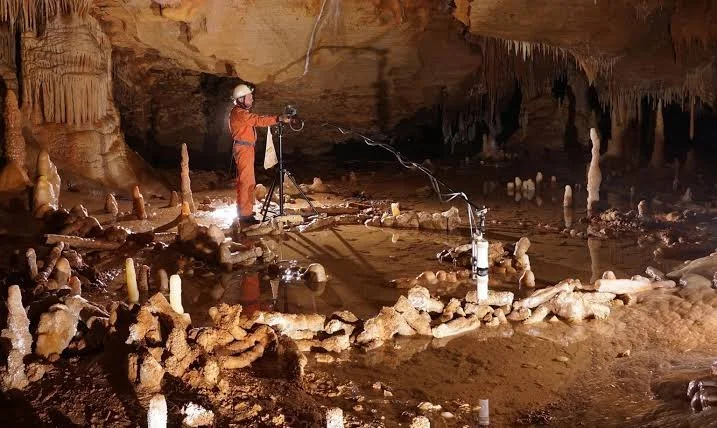
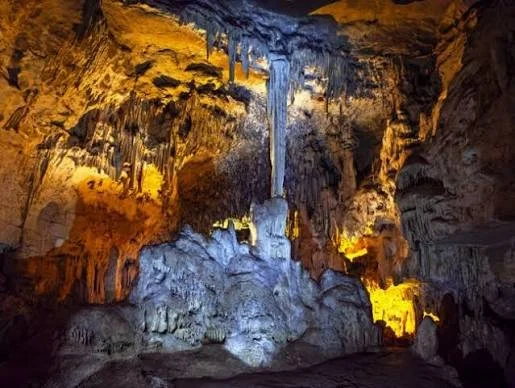
The Covesea Caves range - an almost inaccessible series of caves along Scotland's northern coast (Image: Society of Antiquaries of Scotland)

Archaeologists discovered human bones scattered across the floor of the Covesea Caves range, a nearly inaccessible system of caves close to Inverness, when they began their excavations there. The fact that the bones in the hands still had soft tissue in them and that the remains were "remarkably well preserved" astounded them.

When excavating a site that is 3,000 years old, it's not something we anticipate, according to Dr. Lindsey Büster of the University of Edinburgh. That's a highly important discovery. There is no way to know for sure, but the bone might have once been a component of a fully fleshed corpse.

The investigators also discovered signs that fires had been ignited inside the caves, probably as the bodies were being spread out and preserved by smoke. Dr. Büster thinks this would indicate that people went to the location especially to mummify the remains of their friends and family members.

Archaeologists arriving at the mouth of the cave ( Image: Smithsonian Channel)

She went on to say, "I think once bodies began to be brought into the cave and were behaving in ways they didn't normally do on above-ground sites, those characteristics were probably well noted and became a factory of people coming back again and again over centuries to deposit their dead."

For Bronze Age Britons, who would have routinely made the trip some 3,000 years ago while carrying the bodies of their deceased, the voyage to the caves would have been dangerous. Dr. Büster continued, "For prehistoric people to make the effort and to make the journey would've been really arduous and quite a difficult thing to do."

She asserts that they behaved in this way because "something about this place gave it mystical, perhaps even magical properties." The information was discovered during filming the Smithsonian Channel series "Mystic Britain: Mummies" in 2020.

The first study to demonstrate that Bronze Age communities in all of Britain were purposefully attempting to preserve tissue on dead bodies was completed in 2015. Microscopic decomposition of skeletons from UK locations mirrored that in bones from other places of the world known to have been mummified, according to Dr. Tom Booth of Sheffield University.

The bone may have once been part of an entire fully fleshed corpse, but there's no way to know for certain ( Image: Smithsonian Channel)

Dr. Booth studied bone degeneration caused by bacteria using precise micro-analysis in collaboration with researchers from the Universities of Manchester and London. At the time, he stated: "Our research indicates that deliberate burial in a peat bog and smoking over a fire are two methods that ancient Britons may have employed to mummify their dead.

Other methods might have included organ removal soon after death through evisceration. The bones of the remains matched those of a partially mummified body found in a peat bog in County Roscommon, Ireland, and a mummified sample from northern Yemen.

Dr Lindsey Büster said it's a "really significant find" ( Image: Smithsonian Channel)

"When a person passes away, their gut bacteria spreads out around their body and begins to decompose tissue," continued Dr. Booth. However, if a body is mummified—which can refer to any method of consciously preserving flesh—that stops. Finding a reliable way to recognize mummified skeletons is a challenge for archaeologists, especially when they come across skeletons buried outside of a secure setting.

"To help with this, our team has discovered that by using microscopic bone analysis archaeologists can determine whether a skeleton has previously been mummified even when it is buried in an environment that isn't conducive to mummified remains," the researchers write. However, history fans wanting to find Egyptian-style mummies wrapped in miles of white cloth in Britain will be dissatisfied. "There is evidence that people in the Bronze Age were wrapping bodies up to a certain extent, but it was not quite as elaborate as the Ancient Egyptians," Dr. Booth said.

Source: https://www.mirror.co.uk/news/uk-news/insi...

Archaeologists have discovered a 4,000-year-old steppe pyramid in Kazakhstan

Archaeologists have discovered a large-sized 4,000-year-old steppe pyramid of the Bronze Age in Kazakhstan.

Archaeologists of L. N. Gumilyov Eurasian National University discovered a massive Bronze Age steppe pyramid associated with a horse cult in the steppes of Kazakhstan. Nothing like this has been discovered before in the Eurasian steppes.

Since 2014, the scientists of the Archaeology and Ethnology Department of the Faculty of History of the Eurasian National University have been conducting archaeological excavations at the Kyrykungir complex monument near Toktamys village in the Abai district of the Abai region.

Previous archaeological digs have unearthed groupings of sepulchral hillocks originating from the Hun (4th-6th century AD) and Saka (mid-2nd century BC to mid-1st century AD) periods. These burial sites have revealed an assortment of mortuary contents, encompassing ceramic containers, culinary tributes and intricately fashioned bronze beads.

As a result of the research conducted with the participation of ENU students and masters, a large-scale steppe pyramid was discovered of the early second millennium BC, that is, four thousand years ago, the Bronze Age, not found before in the Eurasian steppe.

“The steppe pyramid is built with great precision, it is hexagonal. There are thirteen meters and eight rows of stones between each face. It is a very sophisticated complex structure with several circles in the middle. The exterior walls of the structure of this complex are dominated by images of various animals, especially horses.

Findings in excavations, ceramics, female gold earrings and other jewelry indicate that this Bronze Age was the center of culture in ancient times. This means that even at that time the cult of the horse was extremely high, as evidenced by the discovery of horse bones around the stone building. There are also images of camels,” Ulan Umitkaliyev, a historian, Head of ENU’s Archeology and Ethnology Department said.

The Eurasian steppe played a significant role in the Bronze Age, a period characterized by the widespread use of bronze for tools, weapons and other artifacts. The steppe region, which stretches from Eastern Europe to Asia, served as a conduit for cultural exchange, trade and the movement of people.

These 5,000 Year Old Artifacts Have Completely Changed Our Understanding Of The Neolithic Period

A team of archeologists have arrived at a village called Waim in the mountains of Papua New Guinea’s Bismarck Range. The evening light is fading so Shaw and archeologists only have time to dig one exploratory trench. Almost immediately, the ground yields an expertly carved pestle. It’s more than 4,000 years old and is the first of many more extraordinary finds to come.

Alexander the Great's Legendary Speech at Opis in Today's Words

In this video we will present the legendary speech Alexander gave to prevent a rebellion at Opis, drawn from Arrian's monumental work, "Anabasis of Alexander." This modernized rendition allows us to peer into the mind of one of history's most captivating figures, preserving the essence of the original while engaging the contemporary audience.

Hear Alexander's passionate words as he addresses his troops at a pivotal moment, bridging the gap between past and present, history and today's relevance. Enjoy!

A Mysterious Chapel Has Been Found in Istanbul

While Istanbul continues to surprise with the richness of its historical heritage, this time a chapel was discovered in Bağcılar. While the historical building, which is not known exactly when and by whom it was built, draws attention to its unprotected and derelict condition, archaeologists suggest excavations in the region.

Located in the Bağcılar district of Istanbul, this structure, which resembles a passage when viewed from afar, draws attention as one of the forgotten historical spots of Istanbul.

While the building is estimated to be a chapel, there are workplaces around it and a school on top of it.

Answering the questions of NTV reporter Sinan Kunter, Archaeologist Ömer Faruk Yavaşçay said that he noticed the historical structure while researching on city maps.

Archaeologist Yavaşcay states that on some old maps, the structure is shown as “Ayazma”, which means holy water for Orthodox.

Noting that there was a Greek village in the region during the Ottoman period, Yavaşçay says that the structure was probably built by the people of the Greek Village in the late 1800s.

Yavaşçay, who also talked to the people of the region about the structure, learned that this place has used as a fountain 25-30 years ago.

Indicating that a detailed excavation work should be carried out in the region in order to obtain more information, Yavaşçay emphasizes that the chapel should be taken care of and protected.

The Bağcılar district is the fourth most populous in the Istanbul Municipality. It name was given due to the abundance of vineyards. The name bağcılar means “vine growers” in Turkish. The district used to be known as Yeşilbağ, which translates to “green vineyard”.

Dragons: History, Mythology, Meaning

Today’s video is an examination of various dragons in myth, primarily focusing on European dragons, and the similarities and differences with East Asian dragons. Enjoy!

Giant Ancient Walls Discovered in the Biblical Libnah

There is a place, sitting a top of the Judean foothills, that for past few years had been dug by archaeologists of the Ariel University. At first, this place seemed to be just a simple ancient town, but when they started digging, they found giant fortification walls, massive gates, and a layer of destruction that dates back a whole millennia before Christ.

So what was this place, why did the construct the giant walls and a fortification, and more importantly why was it destroyed? Watch the video below to find out!

Once-in-a-hundred-lifetimes find

A man in the U.K. has unearthed a 24-karat gold pendant and chain that experts say may be linked to King Henry VIII’s first wife! ABC News’ Will Ganss explains what he plans to do next.

William of Cassingham: the Commoner Who Saved England

Is the English hero William of Cassingham the real Robin Hood?

In the reign of King John, one man stood alone against the tyranny of an unwanted king. Fleeing the authorities for the protection of the deep woods, he raised a band of bowman and launched cunning ambushes on the corrupt knights and lords who travelled through the trees.

Does this sound like the Robin Hood legend to you?

In fact, this is the story of William of Cassingham, a man known as Willikin of the Weald. A forgotten English hero and a man often named as the historical Robin Hood.

But is this true?

Find out all about William’s life and his heroic exploits in the war against Prince Louis and his army of French knights and rebel English barons and discover for yourself if it's anything like the legend of Robin Hood.

How did Japan become Buddhist?

In the following video we will be explaining how Japan became Buddhist. Watch the video to find out more!

Units of History - Nubian Archers - Longbowmen of Africa Documentary

In this documentary we explore the story of the Nubian Archers - Longbowmen of Africa. The video begins with an introduction to the lands of the Nile, its geography, and the entwined development of both Egypt and Nubia. In this context it appears that the Nubian Archers existed from the very start as skilled hunters in southern civilization. Over time they would develop such a reputation that the ancient Egyptians would call the area of ancient Nubia, Tah-Seti, the Land of the Bow.

Both the Egyptian Army and the Nubian Army would clash for centuries along the Nile. Such was the threat from Nubia that the Pharaohs began to fortify the region of the first cataract with a series of Egyptian Fortifications like the Buhen Fortress. Yet even still the Nubian Archers could not be stopped and their armies are said to have regularly managed to storm these bastions. The Egyptians recognized the military prowess of the Nubian Archers and quickly hired them as mercenaries in their own armies. This was a trend that would continue with later Empires that interacted with the Lands of Nubia.

We talk specifically about what the equipment of these Nubian archers, how they were trained, how they were organized, and how they fought in battle. Finally the documentary concludes with an overview of their service history that would span hundreds of years through the Kingdom of Kerma, the Kingdom of Napata, and the Kingdom of Meroe.

What Are Rocks and How Do They Form?

From towering mountains to pebbles along a river, the Earth is made of a huge variety of rocks. In today's video, we're going to follow the rock cycle of a piece of granite in the Himalayan mountains, and as you'll see, every rock has a far-reaching story to tell often millions of years in the making.

Isle of Skye Discovers a Vast Repository of Dinosaur Footprints

Numerous traces found along Scotland's coast demonstrate that enormous, long-necked dinosaurs formerly roamed this area.

The footprints constitute the biggest dinosaur skeleton yet discovered in Scotland. They also demonstrate that sauropods, which were among the biggest dinosaurs ever, were at home near the water.

Long-standing controversy surrounds the enormous dinosaurs' relationship to water. Paleontologists believed sauropods had to wallow in swamps where the water could support their enormous heft throughout much of the 20th century. The "Dinosaur Renaissance" of the 1970s and 1980s, however, removed this outdated vision thanks to discoveries. For their size, sauropods found out to be surprisingly light, more likely to float than to sink to the bottom of a lake. Instead of sweltering wetlands, a new perspective showed sauropods traversing woods.

The new footprints discovered on the Isle of Skye now add to the mounting evidence that some sauropod dinosaurs frequented ancient coastlines and lagoon borders. The Isle of Skye site's geology provided unmistakable proof that the dinosaurs were roaming a brackish lagoon.

A Huge Find

The University of Edinburgh paleontologist Stephen Brusatte examined the Isle of Skye location after a geologist found bones there. "We had gone out to a lonely stretch of coast on the far northeastern tip of the island," he recalls. According to Brusatte, he and fossil fish expert Tom Challands found what appeared to be a pothole after spending the day largely hunting shark teeth and other small fossils. It was the imprint of a dinosaur.

Hundreds of dinosaur tracks cover a newly discovered site on the Isle of Skye.

This first discovery led to the discovery of a series of tracks that covered an area measuring roughly 49 feet (15 meters) by 82 feet (25 meters).

But the tracksite's vastness isn't the only impressive aspect. The Middle Jurassic period, more than 161 million years ago, is when the Isle of Skye footprints were created. This is "one of the least understood periods in dinosaur evolution," according to Brusatte. The traces provide a fresh look at the types of dinosaurs that inhabited the region and their behavior throughout this enigmatic period.

Anthony Martin, a paleontologist at Emory University, adds that dinosaur bones are uncommon in Middle Jurassic rocks, and even fossil skeletons can be moved from the site of the animal's demise. But tracks are a another matter. Martin asserts that the study of footprints "is extremely valuable for filling in gaps in our understanding of dinosaur evolution."

It is unclear exactly which dinosaurs left the footprints. It's typically impossible to link a skeleton foot to a footprint unless a dinosaur actually perishes in its footsteps.

However, the tracks still include enough information for Brusatte and his coauthors to classify them as sauropod dinosaurs, which moved with their legs very close to one another along the midline and included the controversial Brontosaurus and its relatives. A Middle Jurassic dinosaur named Cetiosaurus, which also happens to be one of the first dinosaurs ever named, is an excellent candidate for this kind of trackmaker, according to Brusatte.

Animals in the Lagoon

Another surprise was the old ecosystem in which these dinosaurs roamed.

A sauropod footprint from the new site in Scotland shows the outline of the dinosaur's toes.

Why sauropods consistently avoided the edges of seas, lagoons, and wetlands at the prehistoric Isle of Skye and other places across the world is still a mystery to paleontologists. According to Brusatte, it's possible that the lagoons and beaches offered a food source, safety from predators, or some other allure.

Martin concurs, pointing out that the discovery of sauropod tracks in coastal habitats is not particularly surprising given that these areas "provided paths of least resistance for sauropods moving from one place to another" because of their flat, accessible shorelines, where predatory dinosaurs would have had more difficulty ambushing prey due to the absence of cover.

So, even though sauropods were primarily land creatures, some of them were at least ok with getting their feet a little wet. As Brusatte points out, "Dinosaurs were probably capable of doing a lot more and living in a lot more places than we give them credit for."

Source: https://www.nationalgeographic.co.uk/histo...