5 Mysterious Unexplained Artifacts of Ancient Vikings

Although considered by many to be a ruthless and violent horde, the Vikings have also left behind a few treasures, trinkets, and artifacts which suggest that they were in possession of technologies far beyond what was previously believed.

In the 1990s, on the island of Gotland, Sweden, the excavation of Viking graves turned up a number of pieces of quartz crystal that appeared to have been manufactured into precise shapes.

It was first assumed that these were ornaments until closer examination found that they had been crafted into elliptical lenses and that, as lenses, they performed nearly as well as modern equivalents.

Amongst the weapons, jewelry, and looted treasures that have been recovered from the graves of prominent Vikings, the Visby Lenses are arguably the most astonishing.

Some of the lenses have been treated as jewelry, set in decorative and intricately carved silver mounts, although it is believed that the lenses themselves may be a great deal older than their housings.

The Lenses have been cited as evidence that sophisticated artisan manufacturing techniques were being used more than 1,000 years ago, when the laws of refraction were not yet understood. The precision with which they were made suggests that a primitive turning lathe must have been used.

Some have suggested that the process involved in the making of the lenses may have been a secret shared by just a few master artisans or perhaps held by just one and that all of the Visby Lenses may have been the work of one single pair of hands.

The potential uses for the lenses have been discussed by historians, with various explanations being put forth. Some have suggested that they were used for reading. One researcher stated that, “they could have been used to start fires or to burn wounds and cuts so that they did not get infected.” The most intriguing possible use, however, is as part of a telescope.

If it were the case that the Visby Lenses are indeed elements of what was once a telescope, it would predate the 16th-century Dutch telescope invention by some 500 years...

An Expert Examined This Mysterious Ancient Scroll And Reached A Startling Conclusion About The Bible

A scholarly examination of an enigmatic ancient Scroll has yielded a surprising conclusion regarding the Bible, as determined by an expert.

Almost 140 years ago, a man arrived at the British Museum clutching a set of ancient documents in his hands. Initially hailed as priceless relics, they caused a sensation – before being dismissed as clever forgeries and vanishing into thin air. Now, one expert has returned to the Shapira Scrolls and uncovered a startling revelation about these mysterious texts.

1,900-year-old Roman swords found hidden in a cave in the Judean Desert in Israel

The Israel Antiquities Authority announced the discovery of four extremely well-preserved Roman swords hidden in a cave in the Judean Desert.

Dr. Asaf Gayer of the Department of the Land of Israel Studies and Archaeology at Ariel University noticed the swords in a remote cleft in the cave’s upper portion, as he and other researchers analyzed a Hebrew ink inscription, potentially from the First Temple Period, which was discovered 50 years ago.

Experts believe were captured by the Judean rebels during the Bar Kochba revolt and placed in a narrow crevice in the rock. Also called the Second Jewish Revolt, it was a Jewish rebellion against Roman rule in Judea led by rebel leader Simon Bar Kochba.

“We’re talking about an extremely rare find, the likes of which have never been found in Israel,” Dr. Eitan Klein, one of the directors of the Israel Antiquities Authority’s Judean Desert Survey, said in a video accompanying the announcement of the discovery. “Four swords amazingly preserved, including the fine condition of the metal, the handles, and the scabbards.”

Three of the swords are 60 to 65 centimeters long; one sword is 45 centimeters long. The longer swords are identified as Roman “Spatha” swords; the shorter one is a ring-pommel sword. Preliminary examination concluded that these were standard swords employed by Roman soldiers stationed in Judea.

5,500-year-old menhir discovered in São Brás de Alportel, Portugal

The menhir discovered in Monte do Trigo is of particular importance for the Sotavento region, but is also of regional interest.

The first archaeological work in São Brás de Alportel dates back to the 1870s and 1880s, when the municipality was still a parish of the municipality of Faro, and it was Estácio da Veiga, one of the pioneers of modern archaeology in the Algarve, who made the first inventory of finds.

A century and a half later, the first archaeological excavation in the history of the Municipality of São Brasense began on August 14. This was due to the discovery of a possible menhir in the summer of 2021 at the top of Monte do Trigo, in the Machados district, by a local resident looking for trilobites (fossils) on the ground.

The Regional Cultural Directorate of the Algarve collaborated with the City Council of São Brás de Alportel and the University of the Algarve, and "I immediately became 95 percent sure that we were facing a menhir," professor and archaeologist António Faustino Carvalho told reporters on Friday morning, August 18, during the presentation of the preliminary results of the fieldwork, which ended the same day.

Near an unexplored Beothuk site in central Newfoundland, priceless artifacts were discovered

Everyone on the team realized Don Pelley had made a significant discovery when he spotted the raised sidewalls of a former Beothuk home in 2016.

This clearing is the former site of a Beothuk dwelling, known as a mamateek. It is one of the last archaeological sites on Beothuk Lake.

Where the Beothuk had built walls around 200 years previously, the circular pit was still in great condition. There was no indication that the amateur archaeologists who had combed the area around Beothuk Lake in the past with metal detectors, digging up a variety of objects and leaving little in the ground, had interfered.

For many years, it was the region's most uncommon discovery.

According to provincial archaeologist Jamie Brake, "at the time that it was discovered it was the only known Beothuk house pit in that region … that had not been impacted by erosion or unauthorized digging."

Jamie Brake, Newfoundland and Labrador's provincial archaeologist, says more excavations are planned for the area so as much can be learned as possible before the site is lost to erosion. (Ted Dillon/CBC)

The last place of safety for the Indigenous people of Newfoundland was Beothuk Lake. They contended with diseases imported from Europe, hostile encounters, and the loss of vital migration routes for colonization. The final Beothuk, commonly regarded as Shawnadithit, passed away in 1829.

The final remaining ancient sites could be lost due to water levels on Beothuk Lake, which also serves as a hydropower reservoir, according to locals in the area.

Archaeologists were concerned about erosion after the site was found, according to Brake, and teams have taken steps to get as much information as they can from the house pit before it is engulfed by the lake.

A pair of Beothuk deer spears were uncovered near the site. Brake says they're perhaps the best preserved example of the tool used to hunt caribou.

What has been done to safeguard the location

Drones were used to map the region, and the land in and around the house pit was surveyed. Workers cut down trees that were thought to be at danger of toppling over and causing damage to the location.

The most susceptible areas have been excavated over the course of three summers by archaeologists, who have also removed significant items before they are lost to erosion.

Two deer spears, made of metal rods seized from European villages and sharpened at the tip to kill caribou, were among the objects discovered. They may be the best preserved spears that archaeologists have ever found, according to Brake.

A pointed piece of iron that is an exact match to a drawing made by Shawnadithit of the end blade for a harpoon that would have been used for sealing was another thing that was discovered.

One of the last Beothuk people, Shawnadithit, was taken prisoner by English fur traders in 1823. In 1829, she succumbed of TB.

In order to learn as much as possible before the site is lost to erosion, Brake stated that more excavations are planned for the area.

This harpoon tip was found near the remnants of a Beothuk mamateek on Beothuk Lake. Its presence at an inland site shows the continued importance of coastal seal hunting right to the end of the Beothuk period, says Brake.

Objects have a history

According to Brake, the artifacts allow archaeologists date the location to the late 1700s or early 1800s, which is close to the end of the Beothuk period.

Its position is crucial as well. Before Beothuk Lake was dammed and inundated in the early 1900s, the house pit, which is currently filled with water, would have been placed far inland.

According to Brake, it dates back to a time when the Beothuk were attempting to conceal from Europeans who were encroaching on vital hunting and fishing regions.

Given that there are no seals in the middle of Newfoundland, the discovery of a sealing tool in that situation is puzzling. Despite going farther inland to escape notice, Brake claimed that it demonstrates the Beothuk still had to travel to the coast at some point.

According to Brake, "it's probably a good indication of the continued importance of the coast for these people right to the end."

There may be more discoveries, but leave it to the experts.

The finding of an inland site gives rise to some optimism that others may be found in areas that have not yet been thoroughly examined, not only at Beothuk Lake but also in other regions of the province.

According to Brake, it's crucial that archaeologists carry out the work. He asserted that an artifact that is removed without thorough investigation is lost.

"If it's pulled out of its context, you lose its meaning," Brake said. "[It's] sort of like taking a word out of a page of a book. Once it's taken out of its context, you can no longer understand what it is, what its meaning is."

Brake said there are a lot at risk. To learn more about a people who are no longer with us to tell their own history, every piece counts.

"There's such a small amount of of surviving Beothuk material in existence today," Brake said. "We lose a tremendous sort of opportunity to learn more about these people. We lose a portion of the very limited physical legacy of the Beothuk. So every feature matters enormously. Every artifact and every site."

Source: https://www.cbc.ca/news/canada/newfoundlan...

Israeli teenager unearths 1,700-year-old bronze ring among Greek city ruins

While touring a national park in the Golan Heights, an Israeli adolescent discovered a vintage Hellenistic ring.

View of the Hippos archaeological site at Sussita National Park in the Golan Heights, overlooking the Sea of Galilee, August 1, 2022.

A 17-year-old boy made a remarkable find when he located a 1,700-year-old item in a park near the Israeli-Syrian border.

According to a press release from the Israel Nature and Parks Authority, Itamar Grossman, 13, was visiting the Sussita National Park, on the ruins of the ancient Hellenistic city of Hippos, when something on the ground caught his attention after he went to a vantage point with a cousin to take pictures.

It turned out to be a prehistoric metal ring.

Itamar reportedly stated, "It was a strange and ancient-looking ring," according to All Israel News. My brothers and cousins thought it was just a dropped ring because they were with me and didn't think it was anything old.

Itamar insisted on bringing the ring to his parents and park officials even though his siblings and relatives didn't think it was anything extraordinary.

We knew the ring they discovered was significant the moment Itamar and his mother Liat contacted us and showed us it, according to Sarit Pilachi Miara of the Israel Nature and Parks Authority.

The metal ring was determined by archaeologists to be a Roman artifact, according to the press statement. The ring was found to be at least 1,700 years old, but it may actually be considerably older and may even go as far back as 100 to 300 BCE.

Archaeologists believed the decorative carvings on the ring were produced when it was first cast and they were still clearly visible.

View of the Hippos archaeological site at Sussita National Park in the Golan Heights, overlooking the Sea of Galilee, August 1, 2022. (credit: MICHAEL GILADI/FLASH90)

Ancient hippos ruins

An archeological site preserving the ruins of the ancient city of Hippos is Sussita National Park, which is situated on the Golan Heights close to the Galilee. Despite only having been made a national park earlier in 2023, it has been the scene of several archaeological excavations and discoveries over the past 30 years.

Around 250 BCE, the Hellenistic era saw the founding of the city of Hippos, which flourished throughout the Roman and Byzantine eras. It survived the Muslim takeover in 641 CE up until a devastating earthquake and subsequent abandonment in 749 BCE.

Numerous Roman and Byzantine remnants may be seen throughout the city, including the basilica, the odeon, eight churches, the forum, and the water reservoir in the middle of the forum.

An additional bronze artifact was found at the location in 2015 when archaeologists uncovered a sizable bronze mask that showed the Greek god Pan and was thought to have been made between the first and second centuries BCE.

Source: https://www.jpost.com/archaeology/article-...

Dinosaur Or A Chicken? A new ancient link in the evolution of birds

The earliest step of this evolutionary process is still unknown due to the relatively sparse and spatio-temporally limited fossil record, despite theropod dinosaurs from the Late Jurassic period being the ancestors of non-avialan birds. Knowing the early-diverging species along the avialan line is essential to understanding the evolution of the distinctive avian bauplan and settling phylogenetic arguments regarding the origin of birds.

Life reconstruction of the 150-million-year-old avialan theropod Fujianvenator prodigiosus. (Image by ZHAO Chuang)

A new avialan theropod that was discovered in Zhenghe County, Fujian Province, 150 million years ago was described and studied by a team of researchers from the Fujian Institute of Geological Survey (FIGS) and the Institute of Vertebrate Paleontology and Paleoanthropology of the Chinese Academy of Sciences in Beijing.

Fujianvenator prodigiosus, a recently found species, shares a strange assortment of morphologies with various avian, troodontid, and dromaeosaurian taxa. It illustrates how evolutionary mosaicism affected the development of early birds.

Leading and corresponding author of the study, Dr. WANG Min from IVPP, stated that “our comparative analyses show that marked changes in body plan occurred along the early avialan line, which is largely driven by the forelimb, eventually giving rise to the typical bird limb proportion. However, Fujianvenator is an odd species that diverged from this main trajectory and evolved bizarre hindlimb architecture.”

The exceptionally long lower leg and other morphologies of Fujianvenator suggest to a previously unknown ecology for early avialans, one in which the species was either a quick runner or a long-legged wader, together with other geological finds.

"Besides Fujianvenator, we have found abundant other vertebrates, including teleosts, testudines, and choristoderes," said XU Liming from FIGS, the study's primary author.

Photograph and interpretive line drawing of the 150-million-year-old avialan theropod Fujianvenator prodigiosus, with a phylogeny and paleomap showing the locality of the Zhenghe Fauna (red star). (Image by WANG Min)

Southeast China had a high level of tectonic activity as a result of the paleo-Pacific plate's subduction during the Late Jurassic and Early Cretaceous. Due to contemporaneous fault-depression basins and widespread magmatism, the Fujianvenator was found in these areas. The earlier Yanliao Biota was still existent in north and northeastern China throughout the Late Jurassic in this geological setting.

Dr. ZHOU Zhonghe from IVPP, co-author of the study, said, “The extraordinary diversity, unique vertebrate composition, and paleoenvironment strongly indicate that this locality documents a terrestrial fauna, which we named the Zhenghe Fauna. In-situ radioisotopic dating and stratigraphic surveys constrain the Zhenghe Fauna to the 150–148 Ma period. Therefore, Fujianvenator documents one of the Jurassic avialans’ stratigraphically youngest and geographically southernmost members.”

The discovery of the Zhenghe Fauna offers a novel perspective on the Late Jurassic terrestrial ecology of the planet, and the joint research team from IVPP and FIGS plans to continue investigating Zhenghe and the surrounding area.

Source: https://www.techexplorist.com/chicken-dino...

Under the foliage of a parking lot, an ancient tomb was found in Nara

In what is being heralded as a significant archaeological discovery, shrubbery that was supposed to liven up a dull area of this parking lot turned out to be concealing the tomb of an important ancient figure.

Shrubbery at a parking lot in Ikaruga, Nara Prefecture, hides a sixth century tomb. Photo taken in March 2022 (Provided by the Ikaruga municipal board of education)

Since the spring of 2022, archaeologists have started conducting excavations in the vicinity of the Horyuji temple World Heritage Site.

After excavating centuries' worth of earth from the stone burial chamber, they found several relics, including two iron swords, arrowheads, horse-related objects, amber jewelry, clay pots, and clay jars.

According to scholars from Nara University and the municipal board of education in Ikaruga, the chamber, which measures around 3.8 meters in length, 1.6 meters in width, and 1 meter in height, dates to the late sixth century.

The absence of the stone ceiling led the scientists to surmise that the stones were likely used to construct Horyuji temple, which was finished in the early seventh century.

The Ikaruga palace, where Prince Shotoku (a significant political figure of the time) resided with his family, and Horyuji temple may have been built using the ceiling stones, according to Naohiro Toyoshima, an archaeology professor at Nara University and a member of the research team.

Toyoshima continued, "At that point, the stone chamber could have been buried along with all those items."

When archaeologists began digging, the circular site didn't look particularly interesting. It was about 8.5 meters in circumference and 1.5 meters high, and it was covered in shrubs.

But school board specialists had long assumed that the bushes concealed an old tomb; they termed it the Funazuka kofun burial mound.

But it wasn't until the recent excavation started that their suspicions were validated.

Source: https://www.asahi.com/ajw/articles/1500080...

In Norway, archaeologists discover a Stone Age arrow stuck in the ice

The magnificent Mount Lauvhøe in Norway's Lom Municipality attracts a lot of hikers. However, hiking through Lauvhe is more than simply an exhilarating task for archaeologists who are Secrets of the Ice members. They've been searching the mountain's icy trails for evidence of ancient items for years. With the discovery of a 4,000-year-old arrow shaft, they finally struck gold.

The Ice's Undiscovered Gems

Many arrow shafts from the Iron and Middle Ages have previously been discovered by glacial archaeologists from Secrets of the Ice, a group connected to Norway's Department of Cultural Heritage. The Norwegian archaeologists discovered a Roman sandal from the fourth century AD on one of their expeditions.

After the ice at the location melted, they discovered something considerably older nearby. According to the design and craftsmanship of the arrow, the current discovery predates earlier Lauvhøe relics by at least 2,000 years. The projectile made of pressure-flaked stone is typical of Stone Age engineering. When the field season—the time frame for doing archeological research in the region—is over, the researchers will be able to submit a wood sample for radiocarbon dating with confidence.

Former hunters

This arrow shaft was probably used by reindeer hunters in the distant past. During the summer, these critters would climb to the freezing heights to escape the bothersome insects. This game was probably stalked by Stone Age hunters, who waited for the ideal opportunity to launch their arrows. However, this arrow must have missed because it fell into the snow.

Although the hunter misplaced his arrow, it has been saved for future generations, which is good news for us. "Sad for the hunter but a bull's eye for archaeology!" Secrets of the Ice co-director Lars Holger Pilø told NPR.

This discovery was made at one of Norway's 66 ice locations. Over 4,000 archaeological discoveries have been protected in these chilly chambers. It's like being in nature's own time-stopping museum. The ice is a time machine, as one of the archeologists so eloquently described it, "it brings precious objects from the past to our time in an unaltered state, like sleeping beauties."

We have a unique opportunity to connect with our ancestors and the world they lived in when the ice melts and discloses its secrets. Who knows what historical tales will next emerge from Lauvhøe.

Source: https://www.zmescience.com/science/archaeo...

After 2,000 years, the New Testament location where Jesus is alleged to have healed a blind man was discovered

In Jerusalem, a recent excavation effort uncovered stairs that had been hidden for more than 2,000 years near the spot where the New Testament says Jesus treated a blind man.

An excavation project in Jerusalem, Israel has uncovered the biblical site the Pool of Siloam.

Early this year, it was reported by the Israel Antiquities Authority, the Israel National Parks Authority, and the City of David Foundation that the Pool of Siloam, a holy place revered by both Christians and Jews, will soon be accessible to the general public for the first time in more than two thousand years.

Archaeologists made tremendous headway in their dig in recent weeks, finding eight stairs that led into the Pool and hadn't been seen in 2,000 years, or roughly the time that Jesus was on Earth.

“The ongoing excavations within the City of David — the historic site of Biblical Jerusalem — particularly of the Pool of Siloam and the Pilgrimage Road, serve as one of the greatest affirmations of that heritage and the millennia-old bond Jews and Christians have with Jerusalem,” Ze’ev Orenstein, director of International Affairs – City of David Foundation told Fox News Digital.

“Not simply as a matter of faith, but as a matter of fact,” he continued.

A rendering of the Pool of Siloam site thousands of years ago.

A non-profit organization called the City of David Foundation was founded in 1986, and it is "dedicated to the preservation and development of the City of David and its environs, and is committed to connecting people of all faiths and backgrounds to ancient Jerusalem."

The most important half-mile on earth, according to Orenstein, is the one that runs through the City of David from the Pool of Siloam in the south up to the steps leading up to the Western Wall, Southern Steps, and Temple Mount.

“There is no half-mile anywhere on Earth which means more to more people – not to millions, but to billions — than the half-mile that is the City of David,” he added.

In the seventh century B.C., the pool was initially constructed as a component of Jerusalem's water system, about 2,700 years ago.

Jesus Christ healed a blind man at the pool, according to the Bible.

The two Israeli organizations and the City of David Foundation concur that the construction took place during the reign of King Hezekia, as described in the Bible's Book of Kings II, 20:20.

The Pool of Siloam reportedly underwent numerous construction phases before reaching a 1.25-acre size.

A story from the Gospel of John claims that Jesus healed a man who was born blind at the Pool of Siloam.

The public has had access to a tiny portion of the fully excavated pool for a number of years.

The pool is now being excavated in its entirety, and will either be opened in sections or all at once.

The Congress of Christian Leaders' president, Rev. Johnnie Moore, said in January on Fox News Digital that "In the Pool of Siloam, we find evidence of history preserved for us, revealed at just the right time."

“Theologically, it affirms Scripture, geographically it affirms scripture, and politically it affirms Israel’s unquestionable and unrivaled link to Jerusalem. Some discoveries are theoretical. This one is an undeniable. It is proof of the story of the Bible and of its people, Israel,” he mentioned.

The original pool was first built roughly 2,700 years ago.

In 2004, the Hagihon water company's infrastructure construction found portions of the pool's steps, which by chance led to the discovery of the pool.

Under the direction of professors Roni Reich and Eli Shukron, the Israel Antiquities Authority started a survey.

As a result, the Pool of Siloam's northern and a tiny portion of its eastern perimeters were exposed.

Jerusalem's Biblical legacy is being attacked, whether it be in UN halls, ongoing Palestinian leadership initiatives, or on college campuses, claimed Orenstein.

Orenstein predicted that, in a few years, people visiting the City of David will be able to "see with their own eyes, touch with their own hands, and walk with their own feet upon the very stones their ancestors walked thousands of years ago, as they made their way to Jerusalem on pilgrimage."

Source: https://nypost.com/2023/09/07/new-testamen...

'Find of the century': Metal detector-wielding man stumbles onto trove of gold jewelry dating to 500 AD

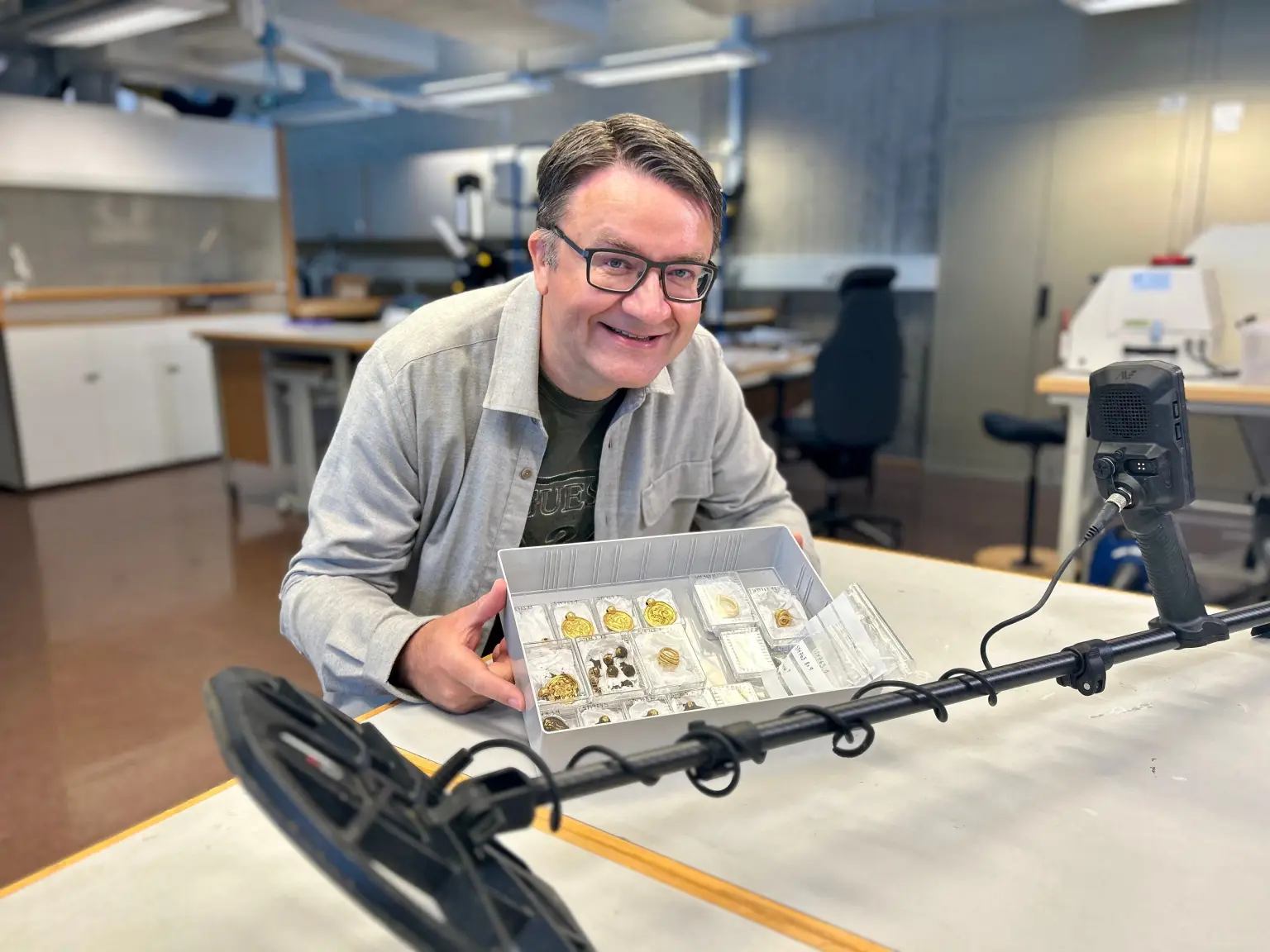
A Norwegian using a recently purchased metal detector discovered rare 6th-century gold jewelry, which archaeologists described as Norway's "gold find of the century" on Thursday. The Norwegian went out strolling on the recommendation of doctors.

Norwegian man Erlend Bore discovered 6th-century gold jewelry while he was walking with a metal detector.

“At first I thought it was chocolate coins or Captain Sabertooth coins,” said 51-year-old Erlend Bore, referring to a fictional Norwegian pirate. “It was totally unreal.”

The cache included three gold rings, nine Norwegian gold medallions, and gold pearls that originally made up an elaborate necklace.

Archaeologists say the find is unique because it contains a design of a Norse mythological horse.

The design on the medallions, which is said to be a species of horse from Norse mythology, makes the discovery special in the eyes of archaeologists.

Erlend Bore bought the metal detector because his doctors told him to get more exercise.

After purchasing a metal detector on the advice of his doctors, Bore, who as a child wanted to be an archaeologist, made the discovery in August on a farmer's field close to Stavanger.

After a day of looking, he was about to return home when the device started beeping suddenly on a hillside.

Erlend Bore made the discovery near a farmer’s land.

He made a call, and archaeologists took charge of the hunt.

The diamonds, which have a weight of a little over 100 grams, are thought to have been made around 500 AD.

The jewels date back to around 500 AD.

“It’s the gold find of the century in Norway,” said Ole Madsen, the head of the University of Stavanger’s Museum of Archaeology. “To find that much gold all at once is extremely unusual.”

Experts are calling it “the gold find of the century.”

The newest comparable discovery in Norway is from the 19th century.

Experts say that finding this much gold in one location is very rare.

“Given the location of the discovery and what we know from other similar finds, this is probably a matter of either hidden valuables or an offering to the gods during dramatic times,” Professor Hakon Reiersen said.

According to Norwegian legislation, a reward will be given to both Bore and the landowner, albeit the amount has not yet been decided.

Source: https://nypost.com/2023/09/07/man-walking-...

Ancient attire: 3,200-year-old Chinese mummy's pants resemble current jeans

The pattern was just as detailed and strong as the modern, factory-made denim jeans. Ancient people had style.

Fashion designers untangled the world's oldest pair of trousers (Credit: M. WAGNER ET AL/ARCHAEOLOGICAL RESEARCH IN ASIA 2022)

Chinese archaeologists discovered the mummified remains of 500 people who had been buried in the Yanghai cemetery in the Tarim Basin in the early 1970s. The Tarim Basin is a large region in northwest China that has produced many significant discoveries regarding the history of ancient humans, from the remains of the earliest-known settlers to the origins of fashion.

The researchers were particularly drawn to one person since it had not only been flawlessly preserved but was also still flawlessly dressed after all this time. The Turfan Man, so named for the nearby Chinese city of the same name, had entered the grave dressed to the nines, donning a poncho, soft leather boots, and a woolen headband embellished with bronze discs and shells.

Even compared to the Egyptian pharaohs, this mummified corpse had quite the wardrobe. The Turfan Man's trousers, which had two tapering leg sections joined at the top by a crotch piece that appears to have given the wearer enormous mobility, were the most amazing of all. The pattern was just as detailed and strong as the modern, factory-made denim jeans.

The original cause of Fashion Week

The Turfan Man's trousers, which have been dated to at least 3,200 years old, are thought to be the earliest pair of trousers ever found, providing experts with a general idea of when this now-essential article of clothing was initially created. Science News states that in the past, "Europeans and Asians wore gowns, robes, tunics, togas or — as observed on the 5,300-year-old body of Ötzi the Iceman — a three-piece combination of loincloth and individual leggings."

A significant part of human history is fashion, yet its roots and importance are frequently ignored. This is somewhat a result of our own biases. When compared to things like economics, politics, science, philosophy, or the fine arts, clothing is frequently viewed as being less significant because it is "synonymous with frivolity, excess, and luxury," according to costume scholar Olivia Warschaw in an article on the philosophy of fashion studies.

Additionally, most fabrics don't typically retain as well as bones do, which makes it extremely difficult for archaeologists to paint a clear image of how fashion evolved in the ancient world. However, fashion is a cultural universal, and the development of prehistoric clothing reveals much about the similarly prehistoric people who wore it, from the concepts underlying their cultural and religious activities to their travels across different parts of the world.

Untangling the oldest pair of pants in the world through fashion studies

It turned out to be far simpler to determine when the Turfan Man's trousers were manufactured than how they were made. However, the atoms themselves do not tell anything about the methods or influences that ancient craftsmen used to join them together to construct a pair of pants. Carbon dating and other sorts of study can give us reasonably accurate age estimations.

The Turfan Man’s trousers were recovered from China’s Tarim Basin, a hotbed for the remains of ancient humans. (Credit: NASA / Wikipedia)

The German Archaeological Institute's Eurasia Department's scientific director, archaeologist Mayke Wagner, put together a team of geologists, chemists, and fashion designers to investigate the Turfan Man's rumored attire. In order to reenact the original manufacturing procedure and unravel the garment's greatest mysteries, their goal was to research the weaving techniques.

In the March 2022 edition of Archaeological Research in Asia, Wagner's team discussed the results of their investigation. They discovered, in essence, that the Turfan Man's trousers were woven by a single machine and that up to four different weaving methods were employed by its artisans. It was discovered that two of these were exclusive to this particular pair of pants. These textiles were referred to as "Yanghai weft twining" and "Yanghai dovetailed twill tapestry."

Wagner's team hypothesized that the Turfan Man's trousers were woven rather than sewn together since the fabric of the pants exhibited no traces of cutting or knitting. Their assumptions turned out to be accurate; a preliminary study of the antique clothing indicated that the trousers were constructed using the twill weave method, which is a method of weaving.

The fabric is less rigid and more elastic thanks to the twill weave type, which creates a diagonal pattern of parallel ribs, giving the wearer more mobility. This revelation is not all that shocking given that the people buried at Yanghai belonged to a society of herders and horse riders.

What is surprising, though, is that when the Turfan Man's pants were constructed, twill weave was still a novelty. The earliest known fossil examples of twill weave, according to textile archaeologist Karina Grömer of the Natural History Museum Vienna, were found on pieces of woven cloth that were discovered in an Austrian salt mine, thousands of miles from China's Tarim Basin. The Turfan Man's trousers were thought to be at least 200 years younger than these textiles.

Like today's jeans

Because twill weaving is so uncommon, significant concerns must be asked regarding the cultural influences that may or may not have influenced these early Chinese artisans. It was also evidence of their competence. The same method is used in contemporary denim jeans, which are renowned for their durability. "This is not a beginner's item," Grömer, who looked at the garment previously but wasn't involved in Wagner's study, told Science News. "It's like the Rolls-Royce of pants," someone said.

The fabric around the knees was woven using a separate technique called as tapestry weaving. When compared to twill weaving, tapestry weaving produces a layer of fabric that is thicker, which in this case would have protected the wearer's joints while mounting a horse. A strong yet surprisingly flexible waistband was made using a third weaving technique on the upper border of the pants to keep them in place.

Fashion designers were able to identify the weaving patterns with ease, but they had no idea what tools the craftsmen would have used. Archaeologists have no clue what an ancient loom from this area might have looked like, and no weaving implements have ever been discovered at or close to Yanghai. Wagner speculates that the artisans might have employed a loom that could be operated while seated, but this is all conjecture.

According to Wagner's research, their best chance is to create additional reproductions using various historic and modern weaving techniques, then identify which of these replicas is most similar to the original. The researchers hired a skilled weaver to create their duplicate, who used the same material as the ancient Chinese artisans: yarn spun from coarse-wooled sheep. Future duplicates would be made of the same material.

Putting the past back together one fiber at a time

"Clothes make the man," as the saying goes, takes on new significance in textile archaeology. We may learn a lot about ancient civilizations, especially those without their own writing systems, by studying the methods used to make clothing and the purposes for which it was worn. In just a few decades after his passing, mobile populations all over Eurasia were donning trousers, proving how influential The Turfan Man was in setting fashion trends.

According to other archaeological investigations, the rise in popularity of trousers and the development of horseback riding are related. Little wonder. As previously indicated, the Turfan Man's trousers' twill weave and flexible crotch piece coupled a snug fit with enhanced mobility—garment attributes that are helpful when you have to climb and ride horses on a regular basis.

Before the Turfan Man, ancient humans like Ötzi the Iceman wore tunics and togas. (Credit: Andre Schade / Wikipedia)

The crotch piece has been expertly crafted by Yanghai artisans. The Turfan Man's crotch piece was different from other Central Asian trousers in that it was wider in the middle than it was at the ends. Wagner's team tested the replica on a man riding a horse bareback to better understand the purpose of the design and discovered that the trousers fit comfortably while yet allowing the rider to firmly wrap his legs around the animal.

Ancient style

The designs on the clothing can provide insight on the cultural and economic ties in the Turfan Man's community, just as the shape of the crotch piece can provide information about his way of life. According to Wagner's research, ceramics from Siberia and Kazakhstan, as well as bronze containers from China, have the same interlocking T-pattern embellishing the knees.

The simultaneous emergence of this odd pattern in both Central and East Asia suggests that despite their geographical separation, the two regions were closely linked by long-term communication. This happened at the same time as West Eurasian herders entered Asia on horses, which after domestication made it simpler to move to and from remote areas.

The stepped pyramid pattern on the Turfan Man's trousers is similar to another pattern found on pottery from the Petrovka culture of Central Asia, which flourished between 3,900 and 3,750 years ago, as well as to the architectural styles of societies in southwestern Asia and the Middle East that date back more than 4,000 years.

The migration of Eurasian herders eastward and the potential origins of twill weaving in Eastern Europe, among other archeological findings, all point to the idea that the development of the world's first pair of pants was the result of a cultural and economic exchange between groups of people who, up until that point in history, had hardly interacted with one another.

Because of this, anthropologist Michael Frachetti of Washington University in St. Louis has described the Turfan Man's trousers as "an entry point for examining how the Silk Road transformed the world." Wagner wholeheartedly concurs. Eastern Central Asia "was a laboratory where people, plants, animals, knowledge, and experiences from different directions and sources came... and were transformed," the archaeologist told Science News.

Source: https://bigthink.com/the-past/chinese-mumm...

A Fresh Perspective on One of the Oldest Weapons

Alexander Langlands only recently began to whittle sticks. The archaeologist had a subconscious need for the activity. In his 2017 book Craeft: An Inquiry Into the Origins and True Meaning of Traditional Crafts, he states, "It's addictive." Evidently, it runs in my blood.

Langlands couldn't recall a period when his father wasn't carving beautiful designs into walking sticks when he was a child. But Langlands had no idea that he would be enjoying the activity in his father's place.

In regards to moulding logs or branches into tools or weapons, Langlands has a fascinating notion. "Sticks are probably where the story of craft begins—the point at which our very distant ancestors progressed from animalistic existences to lives materially enhanced by the objects around them," he adds.

Langlands began to question if stick-making hadn't been passed down from our earliest ancestors after developing a newfound love for the craft of whittling, which his father had taught him. In fact, he questioned whether creating sticks wasn't just as "sophisticated" for early man as making stone tools—that is, well planned out and requiring a lot of expertise.

It’s “almost inconceivable that Australopithecus, Homo habilis, erectus, neanderthalensis, and sapiens did not develop this technology to the same degree of sophistication as they had stone-tool technology,” Langlands writes. “But because of wood’s inability to survive in the archaeological record, it will forever be a story that remains untold and one merely hypothesized by the daydreaming of experimental archaeologists such as myself.”

However, the tale is now being told. It is true that wood decays (thanks to fungi). However, there are exceptions, and scientists are starting to closely examine them. The 300,000-year-old Schöningen spears, discovered in Germany in the 1990s, predate modern humans. After being buried for so long and avoiding any exposure to oxygen, the weapons, which include a few exquisitely carved tiny double-pointed "throwing sticks," show "outstanding preservation," according to Nature.

A recent investigation undertaken by University of Reading archaeologist Annemieke Milks centers on one of the Schöningen throwing sticks. She and her colleagues examined the stick, which was carved from a branch of a spruce tree, both figuratively and literally. Milks and associates also employed a microcomputed tomography, or microCT, scanner to produce a 3-D model of the stick. The wood was then chemically evaluated, its tree rings were inspected, and numerous microcuts and areas where the wood had higher compression were observed. This assisted the researchers in determining the throwing stick's "cultural biography"—its origins, methods of production, maintenance, and disposal.

GET TO THE POINT: One of the 300,000-year old double-pointed “throwing sticks” uncovered at the Schöningen excavation site, in Germany. Photo courtesy of Milks, A., et al. A double-pointed wooden throwing stick from Schöningen, Germany: Results and new insights from a multianalytical study. PLOS One (2023).

The branch's difficult-to-work-around knots were carefully attended to by the original stick carver, who shaped "all but two of them down to be flush with the surface," Milks and her coworkers write. "The aim of this was likely to improve handling for ergonomic purposes, and to improve aerodynamics by reducing drag. An absence of significant surface or internal drying cracks suggests the wood dried slowly and evenly. Cut wood loses its natural moisture until it is in equilibrium with the surrounding environment, and if freshly cut and debarked wood is allowed to dry too quickly it can develop significant cracks and can also warp."

The Schöningen spears demonstrate how well developed stick-making technique was. The throwing sticks may be simpler to use than larger wooden spears because they are lightweight, suitable for pursuing rabbit-sized game. The Schöningen hominins "had the capacity for remarkable planning depth, knowledge of raw materials, and considerable woodworking skill, resulting in an expertly designed tool," wrote Milks and colleagues.

The throwing sticks are currently on display at the Forschungsmuseum in Bonn, which is close to the Schöningen excavation site. The weapons considerably contribute to our understanding of Homo heidelbergensis, the early human species that existed between 700,000 and 200,000 years ago, according to museum scholars, who share the researchers' conclusions. The museum tells us that among his skills were "planning, communication, technological skills, sophisticated hunting strategies, and a complex social structure were among his abilities."

Langlands may need to reevaluate his stick-making technology hypothesis. The Schöningen sticks provide evidence that our ancestors were skilled woodworkers as well as stone carvers.
Source: https://nautil.us/a-new-look-at-one-of-the...

A terrible destruction of an ancient Roman city. Its enormous plaza has now been discovered

Recently, in Spain, the ruins of a sizable Roman square that was there approximately 2,000 years ago were discovered.

A large Roman forum has been unearthed in Spain, archaeologists said. It is the oldest known plaza on the Iberian Peninsula. Photo from the University of Zaragoza

According to a press statement from the University of Zaragoza, it is the oldest public square that has ever been discovered in the interior of the Iberian Peninsula, which includes Spain, Portugal, and some of France.

According to academics, the excavation took place in La Cabaeta, an archaeological site near the Ebro River in northeastern Spain.

It is home to the ruins of a strange, tragic Roman city that was built around 200 B.C. A civil conflict less than a century later resulted in the horrific destruction of the unnamed city.

In July, archaeologists returned to the location after an almost ten-year absence. The central region, where the remnants of a sizable square were discovered, was the focus of their excavation.

According to specialists, a portico with tiles that had been painstakingly built around the buried square. Additionally, there were a number of rooms that were probably utilized for business.

The size and intricate architecture of the discovery make it extremely significant. It will aid researchers in understanding how the Iberian Peninsula, where the Roman Empire previously had several provinces, has adopted Roman architectural styles.

According to co-director of the excavation Borja Daz, the grid-organized city presumably previously operated as a transportation center for traders transporting commodities up and down the river.

However, burned remnants suggest that the city met its demise around the year 70 B.C., Daz told the publication, adding that he hadn't ruled out the prospect of coming across human remains.

According to a 2022 study published in the Journal of Roman Archaeology, the city was destroyed during the Sertorian War, a terrible struggle in contemporary Spain related to the First Roman Civil War.

The study found that confrontations were marked by "assaults and sieges of towns that habitually ended with them being burned to the ground or destroyed, and with severe punishments meted out to the populations."

Numerous large Roman constructions have been discovered all across the Mediterranean. According to information from McClatchy News, a vast Roman-period edifice with hot baths was found in France earlier this year, while a stadium-lake construction from the Roman era was found in Greece in 2022.

Source: https://www.kansascity.com/news/nation-wor...

Stone balls were made deliberately by early humans 1.4 million years ago

According to an examination of ancient stone balls, early people were creating spherical shapes on purpose around 1.4 million years ago and were aware of geometry and symmetry.

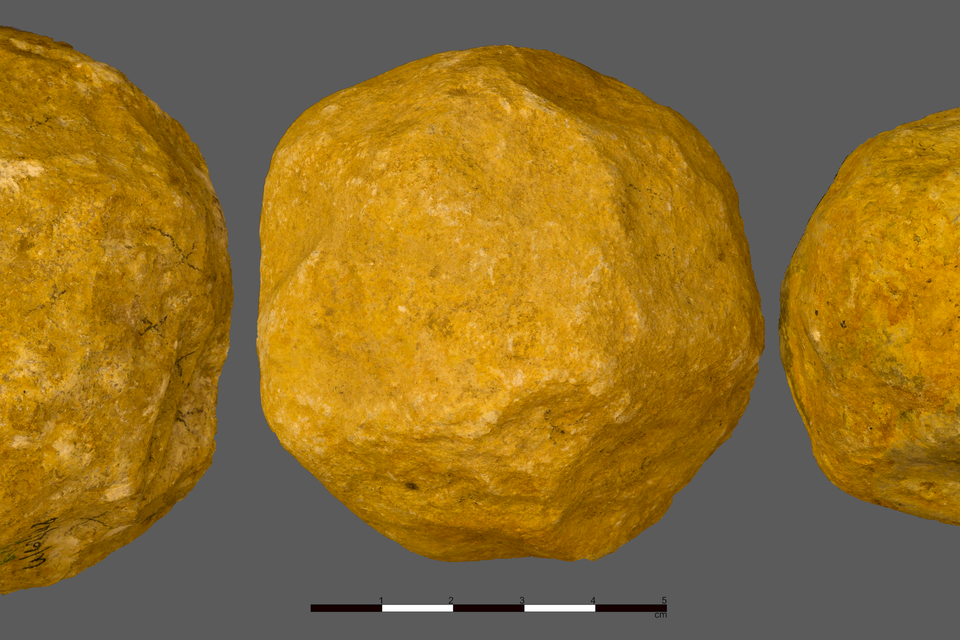
Limestone spheroids found at ‘Ubeidiya in Israel (Leore Grosman/The Hebrew University of Jerusalem)

'Ubeidiya, an archaeological site in the Jordan Rift Valley in Israel, produced 150 limestone balls, or spheroids, which were examined by specialists from The Hebrew University of Jerusalem.

The process used to build these spheroids was recreated by the researchers, and they discovered that the patterns on the artifacts were designed with "a preconceived goal to make a sphere" in mind.

The theory that the spheroids were accidental byproducts of other efforts, according to the researchers, is called into question by their findings, which were published in the journal Royal Society Open Science.

The fundamental significance of the finds, according to Antoine Muller, a researcher at The Institute of Archaeology at The Hebrew University of Jerusalem, is that these spheroids from 'Ubeidiya appear to have been built deliberately in order to achieve a spherical.

“This suggests an appreciation of geometry and symmetry by hominins 1.4 million years ago.”

Nearly two million years ago, early humans used spheroids in their daily lives, but it is still unknown exactly what they were used for.

Based on the markings and geometry of the spheroids, the researchers employed 3D analytic techniques and other cutting-edge technology to reconstruct how these perplexing objects were made.

The team surmises that these items may have been purposefully "knapped"—a process that involves striking stone to form it.

The bits of limestone, according to the researchers, were "reduced" to form spherical shapes.

The researchers said that this metamorphosis into a perfect sphere requires extraordinary knapping abilities and a well-defined objective.

The spheroids' function, however, is still unknown.

We still can't be certain of what they were used for, according to Mr. Muller.

“A lot of work needs to be done to narrow down their functionality.”

Source: https://www.belfasttelegraph.co.uk/news/uk...