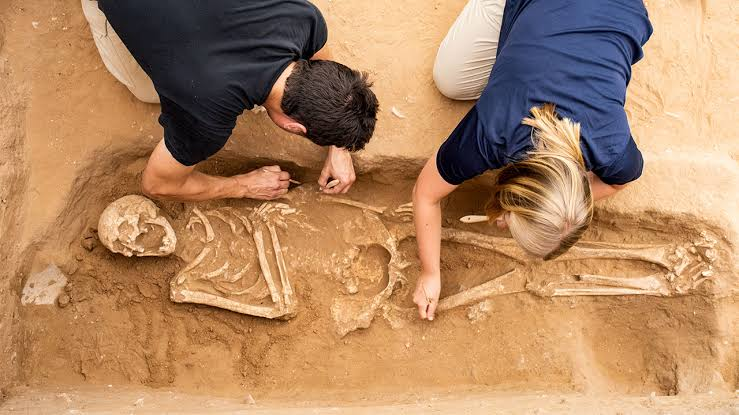
The three-day study is anticipated to reveal traces of historic building foundations and indications of earlier settlements, potentially sparking additional archaeological investigations that may help reveal more about the long history of the kirk.
It's great to be doing this now, according to Phil Baarda of the local community council, who almost accidentally uncovered two pre-medieval carved stones in the kirkyard two years ago. "There has been very little archaeological work done at Contin, so it’s quite exciting to be doing this now. I’m pretty convinced we will find something. This is a fascinating place, but its history has been fairly neglected over the years with other sites seeming to take precedence. Yet the signs are that this must have been a well-known centre for many centuries," he adds.
The remnants of a chambered cairn, which is located inside the family tomb of the Mackenzie of Coul, and the Bronze Age Contin Henge, also known as Achilty Henge, are both nearby.
The monk's body is claimed to have been transferred there after he was ambushed and killed by robbers at Urquhart on the Black Isle, then taken to his monastery at Applecross for burial. The area is now overgrown and known as Preas Mairi, which means "the thicket of Maelrubha."
He was a descendant of Niall, King of Ireland, and originally from Bangour, County Down. In 671, he traveled to Scotland with a group of other monks as part of the second wave of missionaries that followed St. Columba.
The monk who founded the monastery and founded at least 22 churches while traveling from Applecross, in Pictish territory, via Skye, Lewis, and farther east to Forres and Keith, did so in 673. He was the man who gave Loch Maree its name.
Irish chronicles mention both his journey to Scotland and the founding of the monastery, indicating that his mission was thought to be particularly important in the spread of Christianity and Gaelic culture among norther Scottish Picts.
While a variety of traditions and customs were formed in his honor as a result of his influence, some of them persisted for generations after his passing.
The people of Contin continued to sacrifice bulls to honor the saint on his feast day, August 25, according to research presented in publications by the Ross and Cromarty Heritage Society, which was based on minutes of the Presbytery of Dingwall written in 1656.
The "mentally disturbed," also known as St. Mourie's afflicted ones, received the sacrificed flesh.
It continues that 22 years later, more sacrifices were made in an effort to help a sick woman, and that at the beginning of the 19th century, a fair day held in his honor, Feill Moire, involved "several days of drinking and fighting," prompting the local Laird, Sir George Mackenzie of Coul, to order the celebrations to be moved to Dingwall instead.
The burial cemetery of the Contin Kirk would have been safe from the attention of wild animals because it is located on an island in the Blackwater (Abhainn Dubh). An overpass over the road connects it to the remainder of the community.
A series of violent incidents have occurred there over the years, including an invasion on the saint's feast day in the ninth century that resulted in the massacre of some 100 men and women by either Danes or people from the Western Isle.