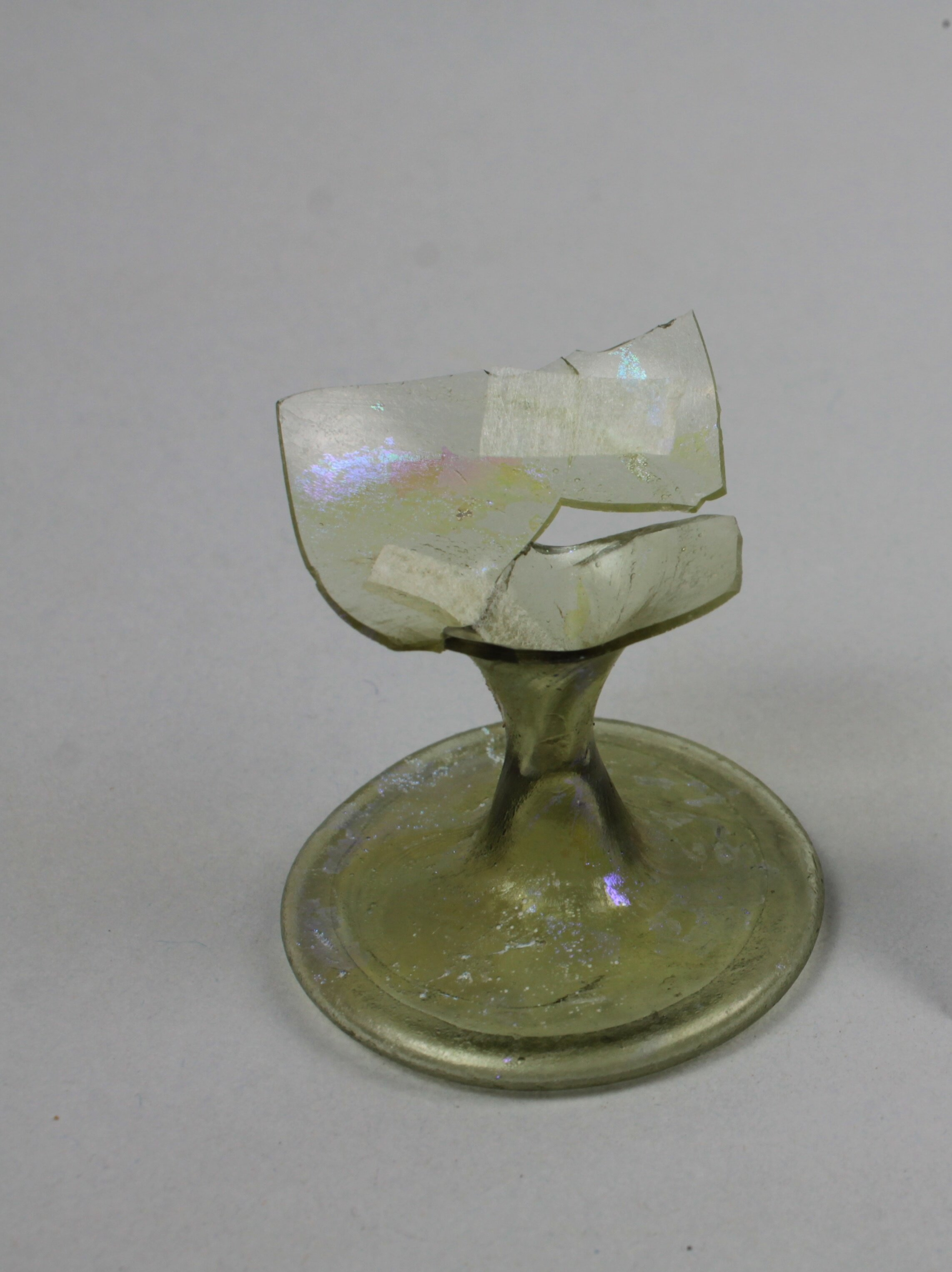
Early medieval chalice from San Pietro di Castello, similar to those analyzed, currently being restored.
When we think of Venetian glass, we often picture Murano’s blazing furnaces, delicate filigree, and vibrant Renaissance colors. But this iconic image only tells part of the story. For centuries, Venice’s Early Medieval glassmaking history remained largely overlooked, seen as merely a precursor to Murano’s later fame.
Recent research shows that Venice’s glass history is far older, more complex, and technologically advanced than previously thought. Minute fragments are shedding light on a long-forgotten past.
A study published in Archaeological and Anthropological Sciences by Margherita Ferri (Ca' Foscari University of Venice) analyzed Early Medieval glass from San Pietro di Castello, on the island of Olivolo—one of Venice’s original nuclei, strategically located at the harbor entrance. The research, conducted with Elisabetta Gliozzo (University of Florence) and Eleonora Braschi (CNR—Institute of Geosciences and Earth Resources), examines 45 fragments—including vessels, production waste, and a steatite crucible—excavated in the early 1990s by the Superintendency for Archaeology, Fine Arts, and Landscape for the Metropolitan City of Venice.
These analyses, dating from the 6th to 9th centuries, reveal Early Medieval Venice as a hub of trade and technological innovation, showing that as early as the 8th century, the city was advanced, connected, and capable of producing sophisticated glasswork.
A New Technology
A key development in ancient glassmaking was the transition from natron-based glass—used since Roman times—to plant-ash glass, driven by the scarcity of Egyptian natron. Researchers have long debated which centers first adopted this new technology.
Ferri explains: “Fragments of plant-ash glass from San Pietro di Castello date to as early as the 8th century. Chemical analysis shows they originated in the Syro-Levant, indicating Venice’s trade networks were highly efficient. Venice was among the first Italian centers to access and master this cutting-edge technology.”
A single blue mosaic tessera revealed the coexistence of two opacifying agents: calcium antimonate (an ancient technique no longer used after the 4th century) and lead stannate (a modern method). This indicates recycling, with artisans melting older Roman tesserae to reuse materials, blending old and new techniques.
Venetian artisans also produced blue using cobalt-rich metalworking slag instead of refined pigment, demonstrating sophisticated material knowledge and a proto-circular economy through intelligent reuse.
Early Medieval Venice and Its Trade Networks
Provenance analyses show Venice as a major trade crossroads, receiving glass from Egypt and the Levant in roughly equal proportions. The lagoon was not merely a recipient of goods; it actively participated in a dynamic Mediterranean exchange network.
Venice imported both raw glass and finished luxury items. Plant-ash beakers from the Levant were reshaped locally using traditional natron-based techniques, while conical glasses, typical of Syrian production, were imported as finished luxury goods.
This dual supply chain shows that Early Medieval Venice managed a sophisticated system, importing materials for local workshops while also acquiring high-value products for direct use, reflecting a city deeply integrated into international trade and technological innovation.