Webuild has been awarded section T1 of Rome Metro Line C, strengthening its global role in metro systems and sustainable urban mobility delivery.
leader in metro construction and sustainable urban transport. The announcement comes shortly after the Group won new contracts related to the Riyadh Metro extension and additional works on the Naples metro system.
Delivering a Key Section in Northern Rome
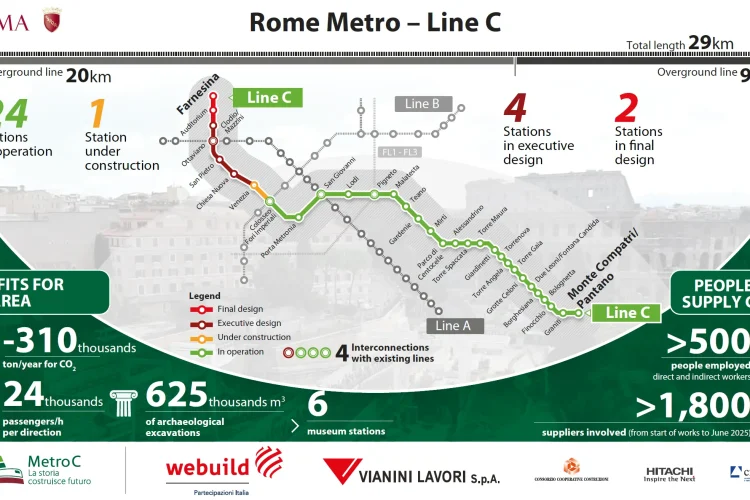
As part of the Metro C Consortium, led by Webuild in partnership with Vianini Lavori, the company will design and construct the section connecting Clodio Mazzini and Farnesina stations in northern Rome. The overall contract is valued at €776 million, with €268 million allocated to Webuild’s share. The scope covers both engineering design and full construction.
Building on Recent Milestones
The award follows the opening in December of the Colosseo Fori Imperiali and Porta Metronia stations. These new archaeo-stations extend Line C by three kilometres and create a vital interchange with Metro Line B. Their development involved highly complex construction techniques to safeguard Rome’s archaeological assets, including the careful handling of over 625,000 cubic metres of archaeological material along the route from Monte Compatri Pantano to Clodio Mazzini.
Integrated Construction with Section T2
Section T1 will be developed in close coordination with section T2, which is currently undergoing executive design and will feature the first tunnel crossing beneath the Tiber River. This integrated strategy allows tunnel-boring operations to continue seamlessly from Farnesina to Piazza Venezia, reducing interruptions and avoiding fragmented construction. Work at Venezia station is already advancing as part of the project’s second major development phase.
A Growing Network and Global Impact
When fully completed, Metro Line C will span 29 kilometres and include 31 stations, of which 24 are already operational. The project further strengthens Webuild’s international portfolio, which now includes more than 890 kilometres of metro lines constructed worldwide, contributing to greener, more efficient, and technologically advanced urban mobility systems.