A number of videos and images created by artificial intelligence that claim to accurately depict ancient Rome have been circulating online. However, these images are far from historically accurate, says one historian.
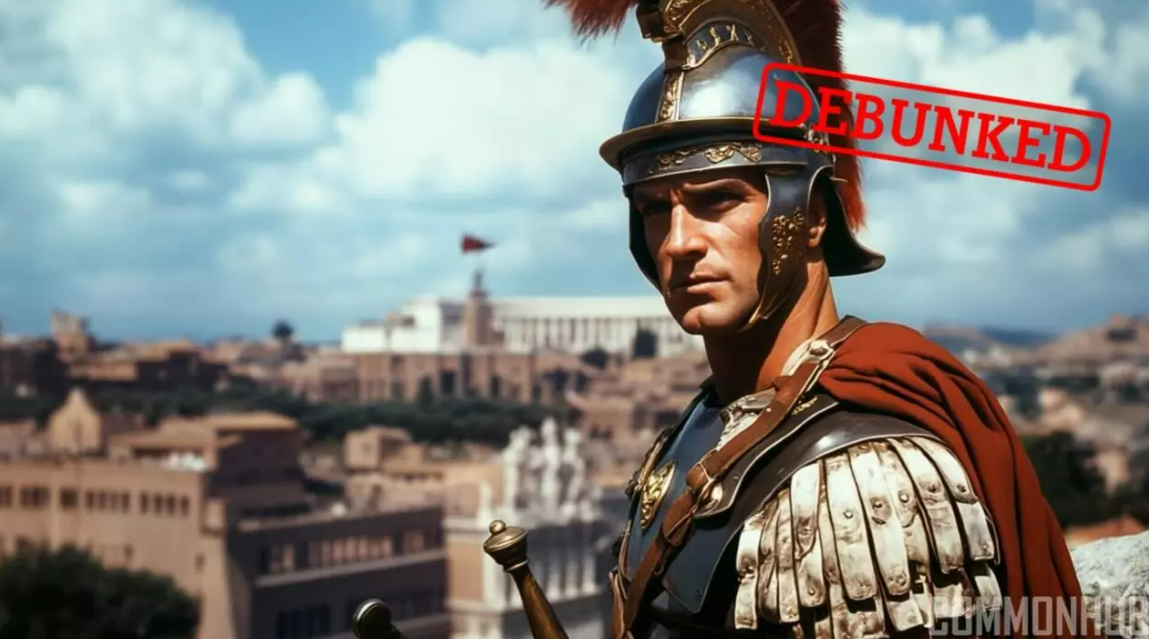
This video generated by artificial intelligence claims to show an accurate depiction of ancient Rome but is, in actuality, full of errors. It was posted on YouTube on November 9, 2024
“A Journey Through Time with Artificial Intelligence,” reads the caption of a YouTube video posted on November 9, 2024. Titled Ancient Rome | AI Generated Video, it invites viewers to explore the Roman Empire and claims that artificial intelligence can reveal new insights into Roman society, architecture, warfare, and everyday life.
In recent months, similar AI-generated videos and images have become increasingly common online, often presenting themselves as realistic depictions of the past, particularly of ancient Rome. Despite their impressive appearance, many of these reconstructions fail to reflect historical accuracy.
To assess these claims, our team consulted Sarah Kourdy, a professor of Art History and Archaeology at the University of Bordeaux Montaigne who specializes in ancient Greek and Roman civilizations. She highlighted several inaccuracies found in such visuals.
One example from the “Ancient Rome” video illustrates these flaws clearly. At the 47-second mark, a Roman soldier is shown standing before what is supposed to be an ancient Roman setting, yet the background includes a building style that belongs to the 20th century rather than antiquity.
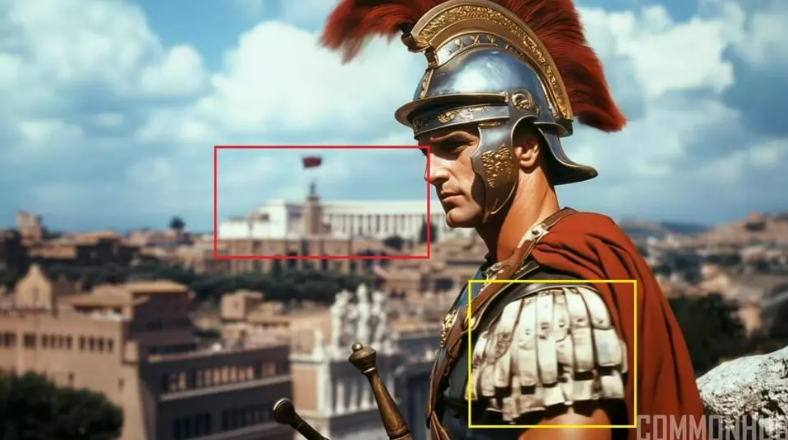
There is a 20th-century building in this scene meant to show ancient Rome in the YouTube video "Ancient Rome".
However, one of the buildings in the image is from another era entirely.
"The building in the background looks a lot like the monument to Victor Emmanuel II, [Editor’s note: built in 1911 to honour the first king of a united Italy], which is clearly anachronous.”
The soldier is wearing what’s called a lorica segmentata, a jointed breastplate worn by Roman legionnaires. However, Kourdy says that there are also issues with this uniform:
"The metal bands are too thin and are arranged vertically. Usually, they are of a decreasing size and arranged parallel and horizontally to better protect the soldier.”
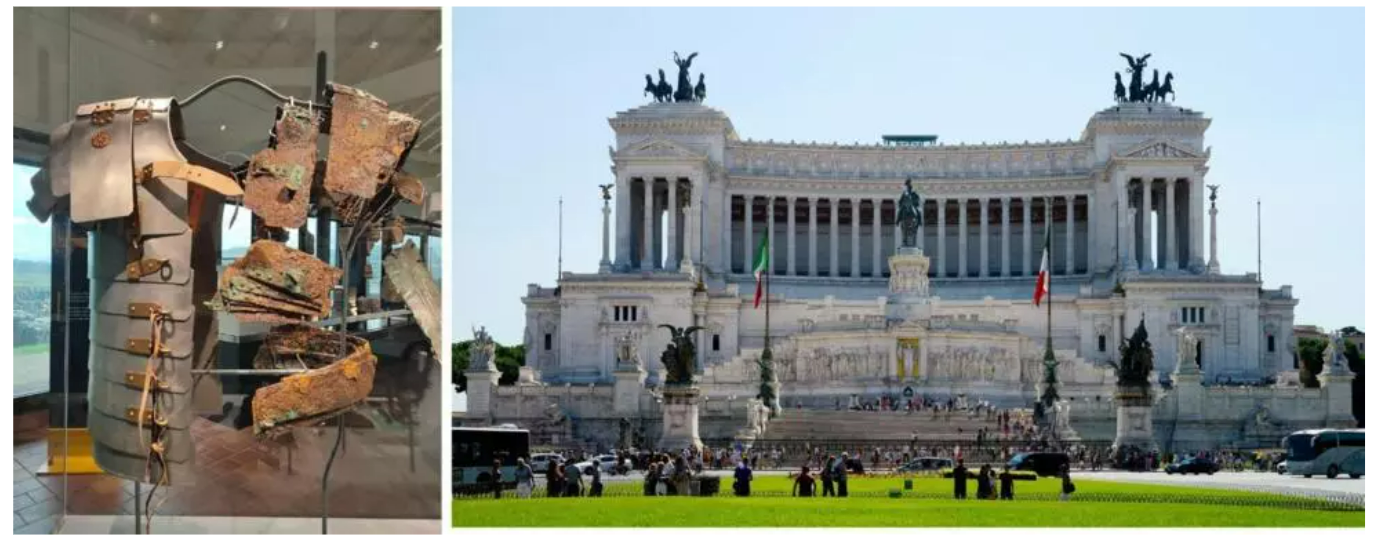
At left is a lorica segmentata, where you can see that the metal bands are horizontally placed. At right is the monument honouring Victor Emmanuel II, which was inaugurated in 1911.
The video’s depiction of Circus Maximus contains several errors. According to Sarah Kourdy, the seating tiers look too uniform and modern, unlike the original irregular terraces made of wood and stone that were rebuilt over time. The spina is shown as plain, whereas it was historically decorated with obelisks, statues, and fountains. The audience is underrepresented compared to the estimated 150,000 spectators the stadium could hold. The chariots are also inaccurate, with wheels too wide, horses too small, and too few participating in the race. These mistakes significantly distort the portrayal of Roman public spectacles and architecture.
A widely shared image, claiming to depict the Baths of Caracalla, has attracted 592,000 views on X and circulated across several Facebook history groups. The baths, built by Emperor Caracalla in 216 AD, were among the most opulent in the Roman Empire. The image presents the natatio, or swimming pool, beneath an elaborately decorated ceiling of white marble and gold.
Kourdy points out that the AI-generated image of the Baths of Caracalla is historically incorrect.
The image shows the baths in a Baroque style, even though the Baroque movement only began in the 16th century. Additionally, the baths were constructed from bricks and mortar, not white marble. The AI’s lavish gilding would not have suited the humid environment of the baths, as such decoration was reserved for salons and libraries.
The depiction also exaggerates the scale: the real Baths of Caracalla had impressive dimensions, but the AI image shows an enormous swimming pool with massive columns rising directly from the water, which never existed.

A scientific reconstruction of the Circus Maximus created by the University of Caen.