Introduction
The use of poisoned arrows is documented in different parts of the world, where hunters and warriors developed ways to make projectiles more effective. Natural substances derived from plants, animals, or other sources could be applied to weapons, potentially changing how an injured animal or person responded after being struck. Although historical accounts and ethnographic research describe a range of poisoning traditions, identifying the same practice in the distant archaeological past is considerably more difficult.
The challenge lies in preservation. Many toxic compounds are organic and can break down through exposure to moisture, oxygen, heat, microorganisms, and other environmental processes. Even when a substance survives, researchers must establish whether it was deliberately applied to an arrow or entered the artifact through soil, handling, or conservation.
The study of ancient arrow poison residues brings together archaeology, toxicology, chemistry, and the study of animal remains. It raises questions about how researchers distinguish a genuine technological trace from contamination, how projectile evidence can be connected to hunting practices, and how much can reasonably be inferred from a chemical result.
Why Poisoned Arrows Matter
A poisoned projectile could change the relationship between a hunter and the animal being pursued. Depending on the substance, dose, delivery, and animal involved, the effects might be delayed rather than immediately fatal. This could allow hunters to follow an injured animal or reduce the need for a projectile powerful enough to cause rapid death through physical trauma alone.
However, the use of poison cannot be inferred simply from a small arrowhead or a lightweight weapon. Projectiles varied according to hunting conditions, prey size, bow design, and the skills of the people using them. A small arrow might have been entirely effective without any toxic substance.
If poison use can be established in a particular archaeological context, it may reveal specialized knowledge of local plants or animals, methods of preparing substances, and the transmission of technical skills. Such knowledge could have been important within a community, but researchers must first demonstrate that poisoning actually occurred.
What Counts as a Residue?
Archaeological residues are traces of materials that remain on or within an object after its original use. On an arrowhead or shaft, these may include organic compounds, mineral deposits, fibers, adhesives, or traces of substances that contacted the surface.
The difficulty is that an artifact's history does not end when it is buried. Soil water moves through the deposit, microorganisms alter organic materials, and minerals accumulate on exposed surfaces. Excavation introduces additional changes through handling, cleaning, packaging, and conservation.
A chemical substance detected on an arrowhead could therefore have several possible origins. It might be connected with the weapon's original use, but it could also have come from the surrounding soil or from modern materials used during excavation.
Researchers must investigate these alternatives before interpreting a residue as evidence of poison.
The Challenges of Organic Toxins
Many natural toxins are chemically complex. Some degrade rapidly under ordinary environmental conditions, while others may survive longer when protected from oxygen, light, or microbial activity. Their preservation depends on the substance itself as well as the conditions in which the artifact was buried.
Even if the original compound no longer survives, researchers may sometimes detect breakdown products. However, a breakdown product is only useful if its chemical identity is sufficiently distinctive and its relationship to the proposed original substance can be established.
The absence of a detectable toxin does not prove that poison was never used. The material may have degraded completely, or the residue may have been too small for the available analytical methods. Conversely, detecting an organic compound does not prove that it was intentionally applied to a projectile.
These limitations make negative and positive results difficult to interpret without a clear understanding of preservation conditions and laboratory sensitivity.
Chemical Analysis of Ancient Residues
Modern analytical chemistry provides several methods for investigating complex residues. Chromatography can separate compounds within a mixture, while mass spectrometry can help identify them through their chemical characteristics. Other analytical techniques may provide information about elemental composition, molecular structure, or the physical distribution of material on an artifact.
The choice of method depends on the research question. A technique that identifies broad categories of organic matter may not be able to distinguish a specific toxic substance. Likewise, the presence of a particular element does not necessarily reveal the compound in which it originally occurred.
Researchers should document how samples were collected, stored, and prepared. The amount of material available may be very small, especially when the artifact is fragile or culturally significant. Sampling decisions must balance scientific value with the need to preserve the object.
A chemical identification becomes more persuasive when it is supported by appropriate reference materials and, where possible, an independent analytical method.
Contamination and the Risk of False Interpretation
Contamination is one of the most serious problems in archaeological residue research. Modern adhesives, protective coatings, cleaning agents, packaging materials, and handling can introduce compounds that were not present during the artifact's original use.
Environmental contamination is equally important. Plants, microorganisms, and other organic material in the surrounding soil may contain compounds that resemble substances of archaeological interest. Groundwater can also transport dissolved material from other parts of a site.
A reliable investigation therefore compares the artifact residue with samples from the surrounding sediment and other relevant materials. Laboratory blanks can reveal contamination introduced during sample preparation, while carefully documented controls help researchers determine whether the detected substance is likely to be ancient.
The physical location of a residue may provide additional context. Material preserved in a protected groove or beneath an undisturbed layer may have a different history from material found on an exposed surface. Nevertheless, location alone cannot prove that the residue was deliberately applied.
What Zooarchaeology Can Contribute
Zooarchaeology examines animal remains to reconstruct relationships between people and animals in the past. In studies of hunting weapons, animal bones may reveal which species were hunted, how carcasses were processed, and whether animals survived particular injuries.
A projectile embedded in bone can provide direct evidence that a weapon struck an animal. In some cases, healing around an injury may show that the animal survived for a period after being wounded. However, neither observation establishes that poison was used.
The effects of a toxin may leave no distinctive skeletal trace. An animal's death could result from blood loss, organ damage, infection, or other consequences of the wound, making it difficult to distinguish poisoning from an ordinary projectile injury.
Zooarchaeological evidence is therefore most useful when combined with the study of projectile technology, residue chemistry, and the broader context of hunting activity.
Interpreting Projectile Design
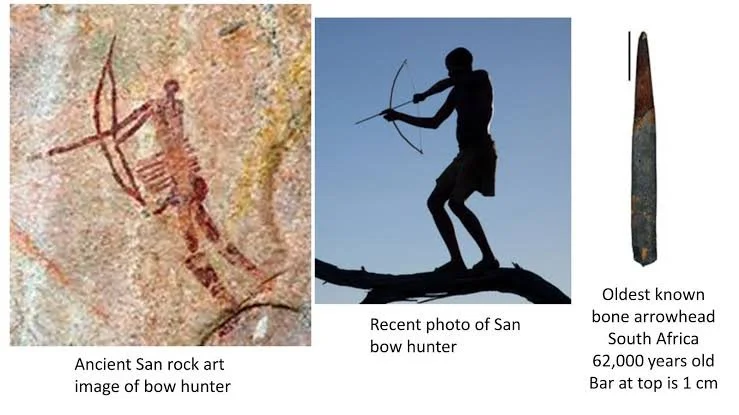
Arrowheads vary in size, shape, material, and method of attachment. Some designs emphasize penetration, while others may have been intended to create a wound that made the projectile difficult to remove. The shape of an arrowhead can suggest how it functioned, but it cannot establish whether a toxin was applied.
Researchers examine manufacturing marks, wear, breakage, and the relationship between the point and the shaft. Adhesives or binding materials may preserve evidence of how the projectile was assembled. However, these substances may also complicate residue analysis because an ancient adhesive can contain organic compounds unrelated to poison.
Experimental archaeology can help investigate how particular projectile designs performed under controlled conditions. Such experiments can clarify mechanical function, although they cannot establish the historical use of a toxic substance without additional evidence.
Ethnographic and Historical Comparisons
Historical accounts and ethnographic studies describe different traditions of preparing and using poisoned projectiles. These sources can help researchers identify possible research questions and understand the kinds of evidence they might seek.
However, a practice documented in one community cannot automatically be attributed to an earlier population living in the same broad region. Traditions can change, disappear, or develop independently. Similar environments may also provide different plants and animals that communities use in different ways.
Comparative evidence is most useful when it helps generate testable hypotheses. It should not replace the need for direct archaeological evidence.
Researchers must also account for the limitations of historical descriptions. Some accounts were written by outsiders who misunderstood local practices, while others may have exaggerated the effects of a poison or confused several different substances.
Reconstructing the Preparation and Use of Poison
If convincing residue evidence were identified, researchers would still need to investigate how the substance was prepared and applied. The chemical trace alone might not reveal whether the material was applied fresh, mixed with another substance, or transferred to the weapon through a container or tool.
Associated artifacts could help reconstruct the process. Containers, grinding equipment, plant remains, and other materials might indicate the handling of substances, although their presence would not automatically connect them to arrow poison.
The archaeological location is also important. A suspected preparation area might contain evidence of several activities, and substances could have been used for medicine, hunting, craft production, or other purposes. Researchers must compare competing explanations rather than selecting the most dramatic interpretation.
Safety and Conservation
Potentially toxic archaeological residues should be handled by qualified specialists using appropriate safety procedures. Researchers should not touch, scrape, or attempt to identify suspicious substances through direct exposure.
Conservation introduces another concern. Some treatments can alter the chemical composition of an artifact or remove residues that might otherwise be analyzed. Where possible, researchers should document the object's condition and consider residue sampling before applying treatments that could affect the evidence.
Scientific testing should also respect the object's archaeological and cultural significance. The desire to obtain a sample does not automatically justify destructive analysis, particularly when the expected information is uncertain.
What a Convincing Discovery Would Require
A strong case for ancient arrow poisoning would need more than an unusual chemical signal. Researchers would need to establish the artifact's date and archaeological context, demonstrate that the residue is not readily explained by contamination, and identify the substance with an appropriate level of chemical confidence.
Additional evidence linking the residue to projectile use would strengthen the interpretation. This might include a distinctive distribution of the material on the weapon, compatible manufacturing evidence, or independent findings from the same context.
Even then, researchers should distinguish between identifying a compound and explaining its purpose. A toxin detected on an arrowhead would be significant, but the interpretation would depend on whether the evidence demonstrates deliberate application rather than accidental contact.
The investigation of ancient arrow poison illustrates the difficulties of reconstructing technologies that depended on perishable substances. Unlike stone points or metal weapons, poisons may leave only faint and ambiguous traces. Advances in analytical chemistry can help investigate these traces, but reliable conclusions depend on careful sampling, contamination controls, contextual evidence, and a willingness to acknowledge uncertainty.