Dental calculus, commonly known as hardened dental plaque, has become an important source of information for archaeologists studying the everyday lives of past populations. It can preserve microscopic traces of food, plant materials, environmental particles, and other substances that entered the mouth during a person's lifetime. Because calculus forms gradually on the surface of teeth, it may capture small details about diet, hygiene, and activities that are rarely preserved in more conventional archaeological evidence. The possibility of identifying traces of personal ornaments within dental calculus raises an especially interesting question: could these microscopic remains reveal how people wore, handled, or produced decorative objects?
Personal ornamentation has long played a role in human societies. Beads made from shells, stones, bones, seeds, teeth, and other materials have been recovered from archaeological sites across different periods and regions. Such objects could communicate social identity, group membership, age, status, personal taste, or participation in particular traditions. Their meanings, however, were not necessarily the same everywhere. A shell bead might have been valued because it was difficult to obtain, because it came from a distant location, or because it held cultural significance within a community. In other situations, beads may simply have been common decorative objects worn by many people.
Most archaeological beads are identified through their physical remains, including perforations, polishing, manufacturing marks, and patterns of wear. They may be discovered in graves, settlement layers, workshops, or locations where people carried out daily activities. Finding a bead directly associated with a person's teeth would be unusual, but it is important to distinguish between a complete bead and microscopic particles that may have broken off from an ornament. A full-sized bead would not ordinarily become incorporated into dental calculus in the same way as tiny particles. Small fragments, mineral grains, or residue from the manufacture and handling of beads are more plausible candidates for investigation.
Dental calculus develops when plaque accumulates on the teeth and becomes mineralized. During this process, microscopic materials can become trapped within the hardened deposit. Archaeologists have used this preservation process to study ancient diets and aspects of human interaction with the surrounding environment. However, the presence of a particle inside calculus does not automatically establish how it arrived there. A fragment might have entered the mouth through food, airborne dust, contact with the hands, or an activity involving materials used in craft production. In the case of a suspected bead fragment, the interpretation would depend on its composition, shape, manufacturing characteristics, and precise position within the calculus.
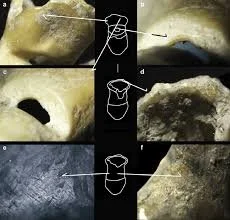
The identification of decorative material requires careful laboratory analysis. Researchers would first examine the sample under magnification to determine whether the particle has a recognizable manufactured shape or surface. Microscopic grooves, polishing, drilled surfaces, or traces of pigment could help distinguish a worked fragment from an ordinary mineral grain. More advanced analytical techniques might identify whether the material is shell, bone, stone, glass, or another substance. Even then, identifying the material would not necessarily prove that it came from a personal ornament. Similar materials may have been used for tools, containers, ritual objects, or other everyday items.
Contamination is another major concern. Archaeological remains can acquire particles from surrounding soil, storage containers, excavation equipment, laboratory surfaces, or handling after recovery. Burial sediments may contain mineral grains and fragments that become attached to exposed tooth surfaces. To establish that a particle was genuinely embedded during the formation of dental calculus, researchers would need to document its location carefully and compare it with material collected from the surrounding sediment. Laboratory blanks, control samples, and consistent handling procedures would help determine whether the suspected evidence was introduced after excavation.
The wider archaeological context would also be essential. If a settlement contained bead-making tools, unfinished ornaments, raw materials, and discarded manufacturing debris, researchers might reasonably investigate whether some of the particles found in dental calculus were connected to craft activities. Evidence of repeated bead production could support the possibility that individuals handled decorative materials regularly. However, the presence of a bead workshop near a burial would not prove that the person buried there was a craft worker. Archaeologists would need to consider other explanations and avoid assigning occupations or personal identities based on a single microscopic observation.
The relationship between ornamentation and the human body offers several possibilities for future research. Some ornaments were worn close to the face, while others were attached to clothing, hair, or objects carried on the body. People may also have handled beads while repairing necklaces, sorting raw materials, or preparing decorations for exchange. In particular contexts, decorative objects could have been chewed, held in the mouth temporarily, or manipulated during production, although each possibility would require independent evidence. Microscopic traces could potentially contribute to these discussions if researchers establish a convincing link between the material and a known activity.
Dental calculus is valuable precisely because it preserves details that are easily overlooked. Yet its scientific usefulness depends on careful interpretation rather than dramatic claims. A particle that resembles a bead fragment should be examined using transparent methods, compared with known materials, and evaluated against alternative explanations. Without such evidence, it would be premature to describe it as proof of personal ornamentation. If future studies establish reliable examples of decorative material preserved within ancient calculus, they could open a new avenue for understanding how people interacted with ornaments and craft materials in their daily lives.