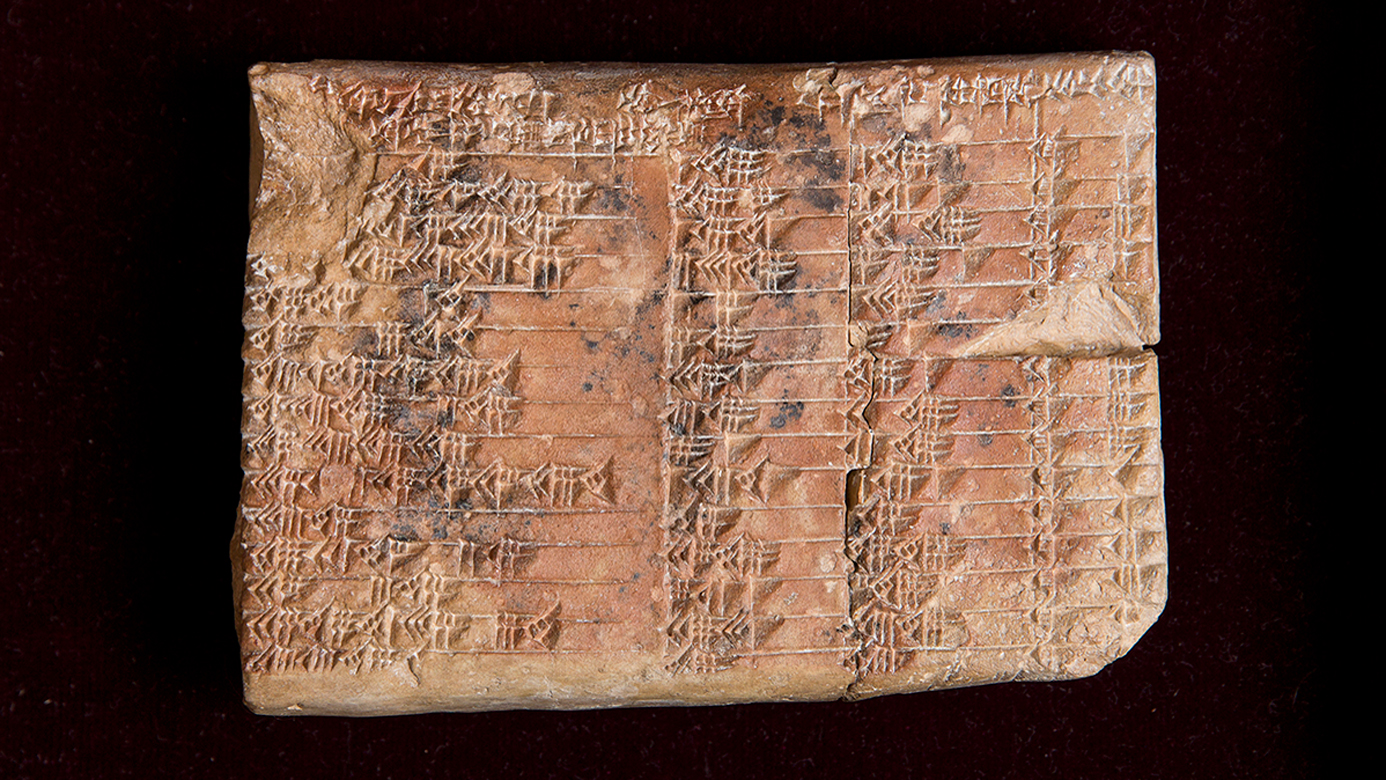
Ancient Babylonian Mathematics: Did They Discover Trigonometry Before the Greeks?
The short answer is yes. Recent mathematical and historical analysis of a famous ancient Babylonian clay tablet, known as Plimpton 322, suggests that the Babylonians developed a form of trigonometry over 1,500 years before the Greeks.
1. The Plimpton 322 Tablet
Discovered in the early 20th century in modern-day Iraq and dating to around 1800 BCE, Plimpton 322 is a small clay tablet that has intrigued mathematicians and historians for decades.
The Artifact: Written in cuneiform script, the tablet contains 15 rows of numbers organized into four columns, representing a set of Pythagorean triples.
The Mathematical Relationship: The numbers satisfy the Pythagorean theorem:
$$a^2 + b^2 = c^2$$
Where $a$ and $b$ are the sides of a right triangle, and $c$ is the hypotenuse.
2. The Trigonometric Table Debate
For a long time, the purpose of Plimpton 322 was debated. While some historians saw it as a tool for teaching arithmetic or number theory, recent analyses—such as those by researchers at the University of New South Wales (UNSW) in 2017—argue that it is a highly accurate trigonometric table.
Babylonian Trigonometry vs. Modern Trigonometry: Unlike modern trigonometry, which relies on angles and approximations, the Babylonian system was exact and based entirely on the ratios of the sides of right-angled triangles.
Base-60 Numerical System: The Babylonians utilized a sexagesimal (base-60) system, which allowed for precise fractional measurements. They used these ratios for land surveying, measuring steepness, and large-scale architectural projects.
3. Comparing Cultures: Babylon vs. Greece
Historically, the invention of trigonometry was attributed to the Greek astronomer and mathematician Hipparchus of Nicaea (c. 190 BCE), who is widely regarded as the "father of trigonometry." However, the evidence from Plimpton 322 pushes this innovation much further back in history.
Greek Approach: Centered on circles, chord tables, and angle measures.
Babylonian Approach: Centered on the geometric proportions of right-angled triangles using a sexagesimal number base.