The Walls of Constantinople: The Engineering That Withstood a Thousand Years
Built in the early 5th century under the direction of Praetorian Prefect Anthemius during the reign of Emperor Theodosius II, the Theodosian Walls formed one of the most formidable defensive systems of the ancient and medieval worlds. Stretching across the neck of the Constantinople peninsula, these fortifications protected the Byzantine capital from invasion for over a millennium.
1. The Triple-Wall Defense System
The genius of the Theodosian Walls lay in their layered, concentric defense system, which forced attackers to breach multiple obstacles while under fire from defenders on higher ground.
The Moat (Fosse): The outermost layer, a wide ditch measuring up to 20 meters wide and 10 meters deep, was often left dry to function as an anti-personnel obstacle that disrupted siege towers and heavy equipment.
The Outer Wall (Proteichisma): Standing behind the moat, this wall was about 1.5 to 2 meters thick and 8 meters high. It was interspersed with 96 towers, allowing defenders to unleash missile weapons on attackers who managed to cross the moat.
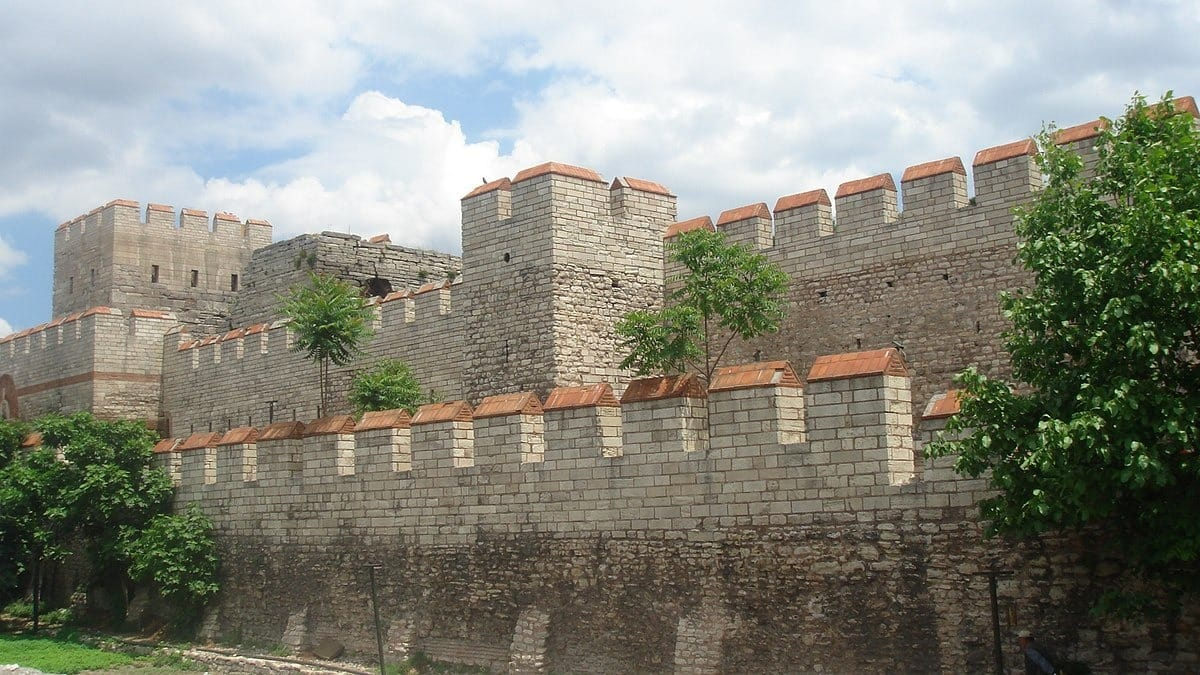
The Inner Wall (Mega Teichos): The main line of defense was up to 5 meters thick and 12 meters high, backed by a wide terrace. It was reinforced with 96 massive towers (typically square or octagonal), rising up to 20 meters tall, which commanded a clear line of sight over the outer wall and the surrounding terrain.
2. Advanced Materials and Engineering
Byzantine engineers designed the walls to withstand both the kinetic force of siege engines and the destructive impact of earthquakes.
Alternating Masonry: The walls were constructed using alternating courses of limestone blocks and bands of Roman brick (often 3 to 5 layers thick). This alternating design distributed structural stress and provided excellent dampening against seismic activity.
Flexible Lime Mortar: The mortar used was rich in lime and crushed brick, giving it a degree of elasticity. This prevented the walls from fracturing during earthquakes and allowed them to settle without collapsing.
Deep Foundations: The fortifications rested on deep, wide concrete foundations set into the bedrock, preventing the ground from shifting under the immense weight of the masonry.
3. Tactical Resilience Against Sieges
The engineering features of the walls were perfectly matched to the siege tactics of the era, from the Avars and Arabs to the Ottomans.
Thermal and Ballistic Defense: The space between the outer and inner walls (the peribolos) allowed defenders to amass troops for counterattacks and absorb the shock of catapulted stones or fire.
Subterranean Defense: The thickness of the foundations and the composition of the soil made it difficult for enemy sappers to dig tunnels beneath the walls without being detected or causing the heavy stone to crush them.
The Golden Gate (Porta Aurea): Serving as the triumphal entrance, this structure was built of solid marble blocks and heavily reinforced with secondary walls and a triple-arch design to ensure the weakest point of the city's defenses remained heavily fortified.