Introduction
Dogs have lived alongside human communities for thousands of years, participating in hunting, guarding, herding, transportation, and companionship. Evidence for the relationship between people and dogs comes from skeletal remains, burial contexts, footprints, images, and other archaeological sources.
One question is how dogs were physically managed. Leashes, tethers, collars, and restraints can influence how animals move and interact with people. However, direct archaeological evidence for ancient leashes is often scarce because ropes, leather, and plant fibers decay under many burial conditions.
The study of osteological evidence for tethering investigates whether patterns in animal bones may provide clues about restraint, workload, injury, or long-term management. Such interpretations must be cautious: bones rarely reveal tethering on their own.
What Counts as Osteological Evidence?
Osteology is the study of bones. Animal osteology can help researchers identify species, estimate age, examine skeletal development, and investigate injuries or disease.
In dogs, the shape and condition of bones can reveal aspects of body size, movement, health, and physical activity. Healed fractures, joint changes, and other skeletal modifications may indicate past injuries or repeated mechanical stress.
However, these features are not unique to tethering. A dog that worked in hunting, guarding, hauling, or herding might develop changes associated with activity, while an animal could also suffer injuries through accidents or disease.
Osteological evidence is therefore best used to investigate broader patterns of animal management rather than to claim that a particular dog was definitely tied to a post.
Direct Evidence for Restraint
The strongest evidence for tethering would be a preserved restraint or a secure association between a dog and a tethering installation. In favorable environments, organic materials such as leather, rope, or plant fibers may survive.
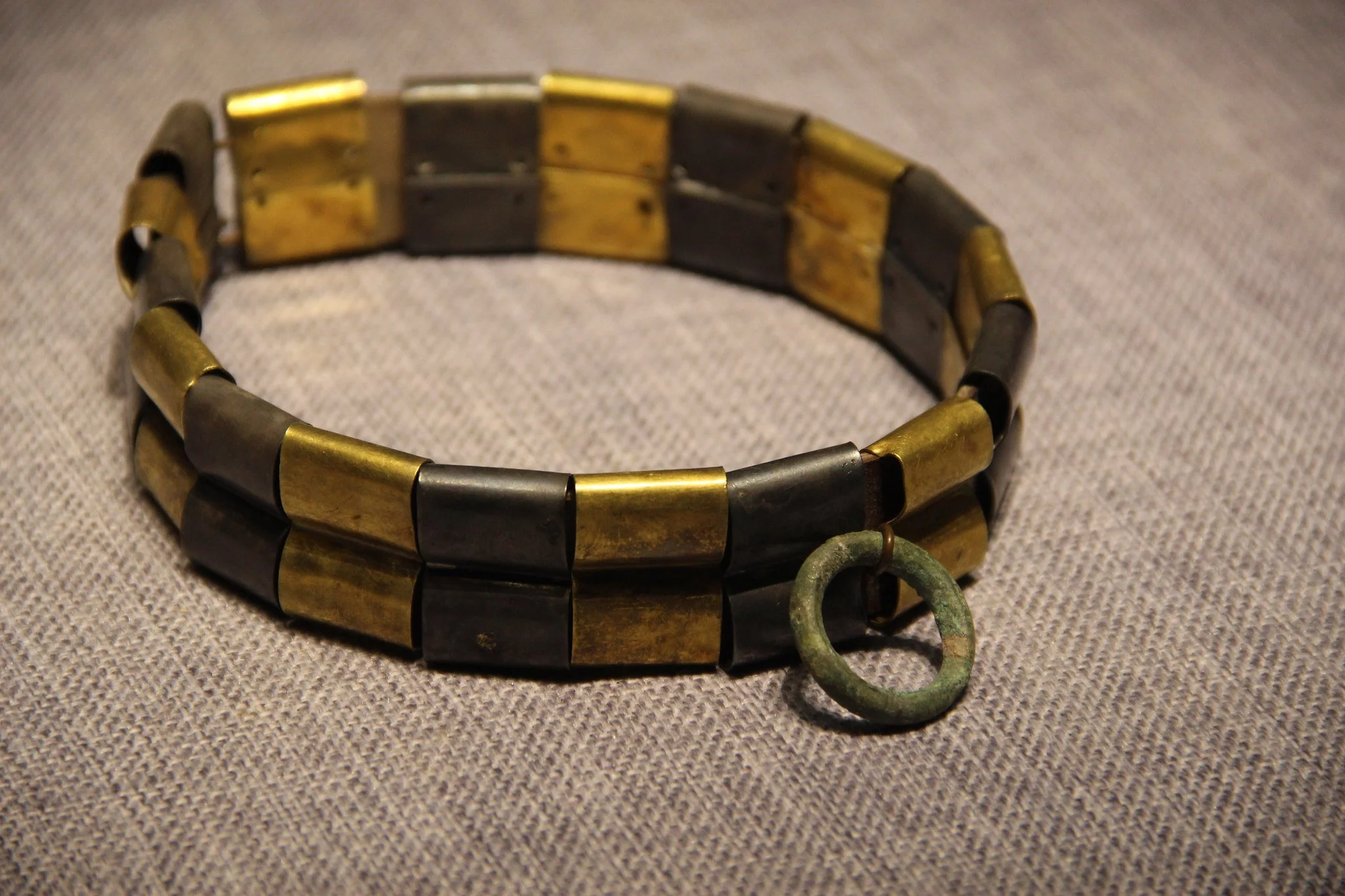
Other possible evidence includes collars, fittings, rings, or structures interpreted as attachment points. Yet these objects must be examined in context. A ring may have served another function, and a collar-like object may have been decorative or used for identification rather than restraint.
Images and written descriptions can also provide evidence of how dogs were controlled, although their meaning and relevance vary by period and culture.
Could Bones Show Repeated Tethering?
Researchers sometimes investigate whether chronic restraint might affect an animal's skeleton through restricted movement, repeated strain, or injury.
In principle, long-term management can influence skeletal health, particularly if an animal is kept in poor conditions or subjected to repeated physical stress. But the effects depend on the animal's age, health, activity, nutrition, and the type of restraint used.
There is no single bone pattern that reliably identifies tethering in every dog.
A dog with joint damage may have experienced heavy work, an accident, infection, or age-related degeneration. A dog kept on a tether may show no distinctive skeletal changes at all.
The hypothesis therefore requires supporting evidence from the wider archaeological context.
Collars, Harnesses, and Working Dogs
Dogs have served many roles, and their equipment could vary accordingly.
A collar may help control or identify an animal. A harness may distribute force across the body, while a tether may limit movement around a particular location.
However, these functions can overlap. A dog wearing a collar may not have been regularly tethered, and a working dog may have been controlled through training rather than physical restraint.
Archaeologists should avoid assuming that all dogs in a settlement were managed in the same way. Different animals may have had different roles, and those roles may have changed over their lifetimes.
Skeletal Stress and Activity
Animal bones can reveal some effects of physical activity. Repeated loading may influence joints, while injuries can leave traces of healing or abnormal bone growth.
Researchers compare the affected bones, their distribution, the dog's age, and evidence from other individuals. They may also use modern veterinary knowledge and experimental studies to understand possible causes.
Even with these methods, skeletal stress usually provides evidence of a physical condition rather than a specific human practice.
To connect an injury with tethering, researchers would need a plausible mechanism and independent contextual evidence.
Burial Context and Human-Animal Relationships
Dogs found in burials or placed near human remains can provide clues about the relationship between people and animals.
Some societies buried dogs individually, while others placed them with humans or included them in broader deposits. These patterns may reflect affection, status, practical value, ritual activity, or several meanings at once.
A dog burial does not automatically demonstrate that the animal was a companion in the modern sense. Likewise, the absence of a formal burial does not mean the animal lacked social importance.
The treatment of dog remains must be interpreted within local cultural traditions and the circumstances of deposition.
Isotopes, Diet, and Management
Scientific methods can help reconstruct aspects of a dog's life. Stable isotope analysis may provide information about diet and the environments in which the animal obtained food.
In some circumstances, isotopic patterns may suggest that a dog consumed food similar to that eaten by humans or relied on particular ecological resources.
These findings can illuminate feeding practices and relationships with settlements. They do not, however, directly establish whether the dog was tethered.
A comprehensive study may combine isotopes, skeletal health, burial context, equipment, and settlement evidence to reconstruct different aspects of animal management.
Ethical Interpretation of Animal Remains
Animal archaeology can reveal how people depended on animals and how they treated them. It can also raise questions about welfare, workload, and the conditions in which animals lived.
Researchers should avoid projecting modern categories of pet ownership onto every ancient society. The relationships between humans and dogs varied, and animals could occupy several roles within a community.
At the same time, it is reasonable to investigate whether skeletal injuries indicate suffering or difficult working conditions, provided the evidence is described accurately.
Conclusion
Ancient dog leashes are an important subject for understanding how people managed animals, but direct evidence for tethering is often difficult to recover because restraints were commonly made from perishable materials.
Osteological evidence can reveal injury, physical stress, age, health, and activity. Yet these features do not independently prove that a dog was tethered. They must be interpreted alongside collars, fittings, preserved restraints, settlement features, images, and other contextual evidence.
By combining these sources, archaeologists can build a more nuanced picture of how dogs were controlled, cared for, and incorporated into human communities. The central lesson is that bones can tell us much about an animal's life, but specific claims about restraint require more than skeletal changes alone.