Introduction
Religious practice in the early medieval period was not limited to large churches, monasteries, and public ceremonies. In many historical settings, devotion also took place within homes, during travel, and in smaller community spaces. Portable religious objects could make prayer and contemplation possible where permanent religious architecture was unavailable or inaccessible.
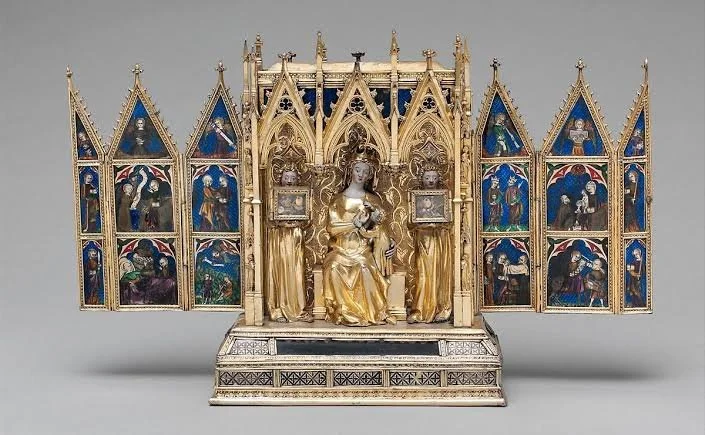
A portable altarpiece is a movable object or compact arrangement associated with devotional practice. In later medieval Europe, portable altars and devotional panels are well documented, but the term must be used carefully when discussing the early medieval period. Surviving objects are unevenly distributed by region and date, and not every small religious object functioned as an altar.
The archaeological and historical study of portable altarpieces can illuminate the relationship between domestic space, religious identity, mobility, and material culture.
Defining a Portable Altarpiece
An altarpiece is generally associated with an altar and may include images, reliefs, or other devotional features. A portable version can be moved between locations or used in settings without a permanent altar.
Related objects include small reliquaries, devotional panels, crosses, folding images, and containers for sacred objects. These categories overlap in some historical contexts, but they are not interchangeable.
A small cross may have been used in personal prayer without functioning as an altar. A reliquary may have contained sacred remains and been carried during travel, while a portable altar could have served a specific liturgical purpose.
Researchers must identify an object's form, function, and historical context before assigning it to a particular category.
Domestic Religion in the Early Middle Ages
The early medieval period covered diverse societies and changing religious practices. Christianity expanded and developed differently across regions, while local customs and older traditions continued to influence everyday life.
Homes could contain religious objects, but the evidence varies. Some objects may have been displayed, others kept in containers, and others carried on the body or during journeys.
Written sources sometimes describe household prayer, blessings, and religious instruction, although such texts may focus on elite or clerical settings rather than ordinary domestic life.
Archaeological evidence must therefore be interpreted with caution. A religious object found in a house indicates a connection with that space, but it does not automatically reveal who used it or how frequently.
Why Portability Mattered
Portable devotional objects could serve people who moved between locations. Clergy, travelers, members of religious communities, and individuals undertaking long journeys might carry religious items with them.
Portability could also matter in households where religious practice took place within a limited space. A movable object could be brought out for prayer and stored afterward.
However, mobility should not be assumed solely from an object's small size. A compact object may have been designed for permanent display in a domestic shrine rather than for travel.
Evidence such as hinges, handles, protective cases, wear patterns, and historical descriptions can help clarify whether an object was designed to be moved.
Materials and Craftsmanship
Portable religious objects could be made from wood, metal, ivory, bone, stone, or combinations of materials. The choice depended on local craft traditions, cost, availability, and the object's intended function.
Metal fittings could protect wooden panels or secure small compartments. Precious materials and elaborate decoration might signal the resources invested in an object, while simpler objects could still hold substantial devotional significance.
Unfortunately, organic materials often survive poorly in archaeological contexts. Wooden panels may decay, leaving only metal fittings or small fragments.
The absence of a complete object does not necessarily mean that portable devotional practices were absent. It may reflect preservation bias.
Images, Symbols, and Religious Meaning
Portable devotional objects could feature crosses, saints, biblical scenes, inscriptions, or symbolic designs. Their imagery might help users focus on prayer, remember religious teachings, or express allegiance to a particular tradition.
Yet the meaning of an image depends on its context. Similar motifs could appear in personal objects, church furnishings, manuscripts, and decorative items with different functions.
Researchers should examine the iconography, inscriptions, construction, and historical setting together.
It is also important not to assume that every object bearing Christian imagery was used in private devotion. Some objects could have been gifts, status symbols, protective items, or components of formal religious practice.
Archaeological Evidence in Houses
A portable altarpiece found in a domestic setting would be especially significant, but establishing that context can be difficult.
Objects may be displaced during building alterations, abandonment, or later occupation. A religious object found in a house could have been stored there, inherited, traded, or brought into the building after its original use ended.
Researchers examine the object's position, associated artifacts, floor deposits, storage features, and the history of the building.
Where a group of related objects appears together in a carefully documented context, it may be possible to reconstruct a more specific pattern of domestic religious activity.
Private Devotion and Social Status
Portable devotional objects could express personal belief, but they could also communicate social position.
An elaborate object might have been commissioned by a wealthy household or presented as a gift. A simpler item could have been used by someone with fewer resources.
However, material value does not directly measure religious commitment. An inexpensive object may have been deeply meaningful to its owner, while an elaborate object might have served several social and ceremonial purposes.
Interpretation should distinguish the economic value of an object from the devotional significance it may have held.
Portability, Travel, and Religious Networks
Portable religious objects could travel through trade, pilgrimage, migration, military movement, and exchanges between religious institutions.
Their distribution may therefore help researchers investigate connections between regions. Similar craftsmanship or materials may suggest shared workshops or artistic traditions.
Yet resemblance does not prove direct movement from one place to another. Objects can be copied locally, and similar forms may develop independently.
Provenance studies, inscriptions, historical records, and archaeological context can help establish more reliable connections.
The Limits of the Evidence
The early medieval period is particularly challenging because the survival of objects varies greatly. Many religious objects were made from perishable materials, while metal items could be melted down and reused.
Written sources also preserve uneven perspectives. Elite and ecclesiastical records may describe practices that were not representative of all households.
Researchers should therefore avoid claiming that portable altarpieces were common in every region or that domestic worship followed one uniform pattern.
Conclusion
Portable altarpieces and related devotional objects offer a valuable way to investigate religious practice beyond the walls of churches and monasteries. They raise questions about household prayer, travel, personal identity, and the relationship between movable objects and sacred space.
However, the category must be defined carefully, particularly when examining early medieval contexts. Small religious objects did not all serve the same purpose, and the presence of a devotional item in a house does not reveal its precise use without additional evidence.
By combining archaeological context, object analysis, iconography, and historical sources, researchers can explore how religious practice was incorporated into daily life. Portable objects remind us that devotion could be expressed through personal possessions and familiar domestic spaces as well as through monumental religious architecture.