In the minds of the ancient Egyptians, creation was not a distant, one-time historical event. It was a continuous, fragile cosmic cycle that had to be actively maintained every single day to prevent the universe from slipping back into a state of total chaos (Isfet).
Because Egypt was composed of powerful, competing religious and political capitals, different priesthoods developed their own distinct theological models to explain how the universe came to be. The two most influential and intellectually profound models were the Heliopolitan Creation Myth, which focused on physical generation through light and blood, and the Memphite Creation Myth, which introduced a stunningly abstract philosophy of creation through pure thought and spoken word.
1. The Common Primordial Stage: The Nun
Despite their theological rivalries, nearly all Egyptian creation myths began with the exact same primordial setting: The Nun.
The Nun was an infinite, dark, silent, and chaotic cosmic ocean that existed before time, space, or life. It possessed no boundaries and no structure. Hidden inside this dark abyss was a dormant, unawakened divine potential.
Every creation myth began at the precise moment this primordial ocean receded, allowing a single, solid mound of earth—the Benben—to rise above the waters. This primeval mound represented the birth of structure, light, and fertile ground, mirroring the real-world annual receding of the Nile floods that left behind rich, black soil ready for new life.
2. The Heliopolitan Myth: The Physical Emergence of the Ennead
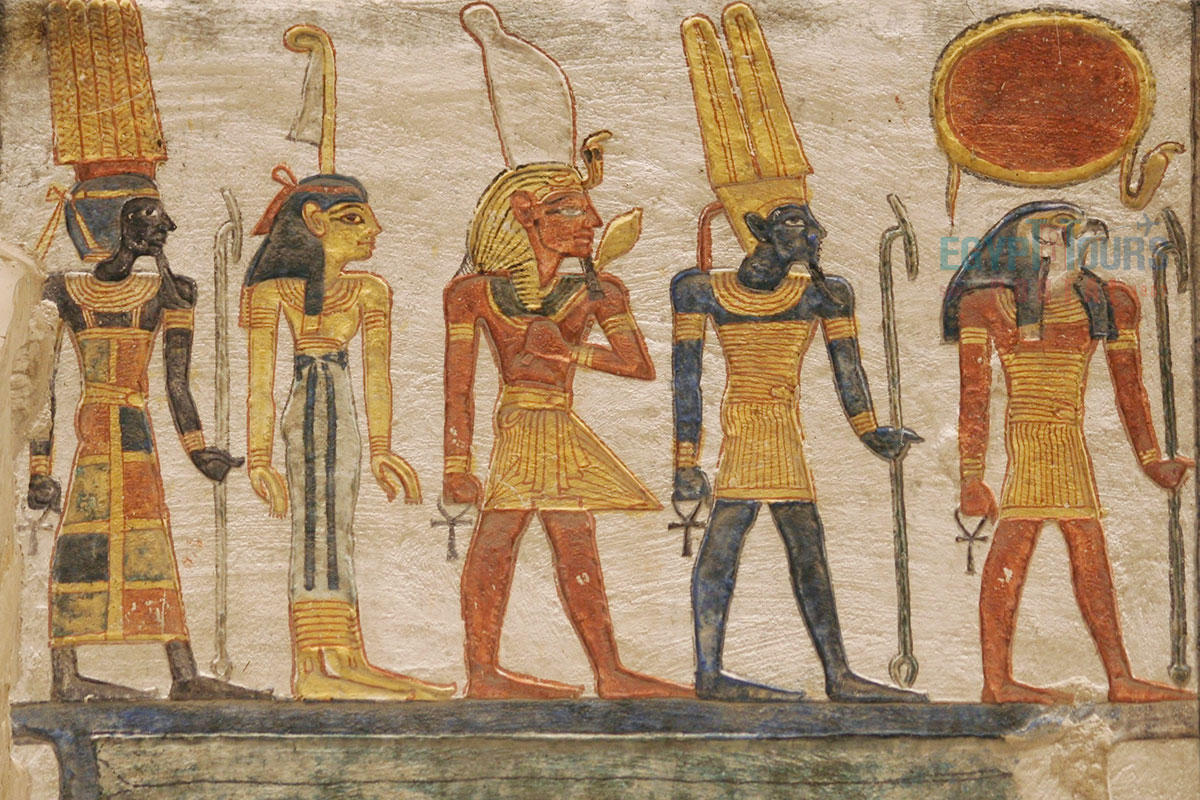
Centered in the ancient solar city of Heliopolis (known to the Egyptians as Iunu), this creation myth was championed by the powerful priesthood of the sun god. It is a highly physical, genealogical epic that traces the lineage of the cosmos down through nine distinct deities, a group known collectively as The Ennead.
Atum’s Self-Creation
According to the Heliopolitans, the god Atum (later merged with the sun god Ra) created himself out of pure willpower while drifting inside the Nun. Seating himself upon the primordial Benben mound, Atum looked out at the vast emptiness and realized he was completely alone.
To bring order and life into the void, Atum performed a singular, physical act of self-generation. Through the act of masturbation (or, in alternative texts, by spitting), Atum used his own bodily fluids to generate the universe's first physical pairs of opposites:
Shu: The god of dry air and wind.
Tefnut: The goddess of moisture, rain, and dew.
The Separation of Earth and Sky
Shu and Tefnut coupled and gave birth to the next layer of cosmic architecture: Geb (the physical Earth) and Nut (the canopy of the starry Sky).
Initially, Geb and Nut were locked in an eternal, passionate embrace, leaving no room between them for life to exist. To fix this, their father Shu (Air) stepped between them, lifting Nut high above his head to form the atmosphere, while holding Geb flat below. This act created the physical open space required for sunlight, vegetation, animals, and humans to thrive.
The Generation of Order and Chaos
Locked in their separate realms, Geb and Nut managed to conceive four final deities who bridged the gap between the cosmic elements and human civilization:
Osiris: The god of fertility, resurrection, and the prototype for divine kingship.
Isis: The goddess of magic, wisdom, and maternal protection.
Set: The god of storms, deserts, foreigners, and structural chaos.
Nephthys: The goddess of mourning, thresholds, and the night.
Through this physical family tree, the Heliopolitan myth successfully linked the raw, blinding power of the sun directly to the political institution of the Egyptian Pharaoh, who ruled as the earthly representative of this divine lineage.
3. The Memphite Myth: Creation Through Intellectual Logos
When the Pharaohs of the Old Kingdom established the city of Memphis as the administrative capital of unified Egypt, the local priesthood sought to elevate their patron deity, Ptah—the master craftsman and architect of the gods—above the solar theology of Heliopolis.
Recorded on the famous Shabako Stone (an 8th-century BCE black basalt monument copying a much older Old Kingdom papyrus), the Memphite Theology introduces a startlingly sophisticated, philosophical worldview that directly anticipated later Greek and Christian concepts of the Logos (creation through the word).
The Mind and the Tongue
The Memphites did not deny the Heliopolitan Ennead; instead, they boldly claimed that Ptah was the ultimate source behind Atum's creation. The text explains that Ptah created the universe not through physical masturbation or bodily fluids, but through an internal intellectual process involving two primary organs:
   [ THE HEART / SIA ] ──────► Conceives an Idea (Intellectual Thought / Intellect)
                                      │
                         (The Creative Logos Process)
                                      │
                                      ▼
   [ THE TONGUE / HU ] ──────► Speaks the Name (Spoken Word / Magical Projection)
                                      │
                                      ▼
                      [ MATERIAL REALITY MANIFESTS ]
The Heart (Sia): To the Egyptians, the heart was the absolute center of human thought, consciousness, and intellect (equivalent to the modern mind). Ptah first conceived the blueprint of the entire universe—its laws, its geography, and its gods—as a silent thought inside his divine heart.
The Tongue (Hu): To bring this internal thought into the physical world, Ptah used his tongue to speak the names of those thoughts aloud. The moment Ptah uttered the word for "tree," "mountain," or "Atum," the vibration of his voice projected that concept out of the abstract realm of thought and materialized it into physical reality.
The Craftsman of Reality
By framing creation as a cognitive and linguistic act, the Memphite myth elevated Ptah to the ultimate supreme intelligence. The Shabako Stone notes that after Ptah spoke the universe into existence, he rested, seeing that his work was good.
He then established the cities, carved the statues of the gods out of wood and stone, and provided the life-force (Ka) that allows humans, animals, and plants to move and breathe. Every time a craftsman carves a statue, an architect draws a blueprint, or a human speaks an intelligent thought, they are actively channeling the creative energy of Ptah.
4. Summary of Creation Epistemologies
The Primary Engine: Heliopolis relies on physical generation, using bodily fluids, lineage, and sexual duality to create elements. Memphis relies on cognitive generation, using intellectual thought and spoken language (Logos) to manifest matter.
The Role of Atum: Heliopolis views Atum as the self-created apex predator of the cosmos who generates all things out of his own body. Memphis subordinates Atum, framing him as a mere tool or physical executor created by the prior thoughts of Ptah.
Primary Deities: Heliopolis elevates Atum-Ra and the Ennead (Solar/Cosmic line). Memphis elevates Ptah (The Divine Architect/Intellect).
The Core Metaphor: Heliopolis mimics the biological reality of human birth and genealogical inheritance. Memphis mimics the artistic and technological reality of a master craftsman transforming an idea into a physical product.
The creation myths of Heliopolis and Memphis reveal the immense intellectual depth of ancient Egyptian theology. While Heliopolis satisfied the need for a cosmic family tree that validated the physical elements of nature and the royal lineage of the pharaoh, Memphis pushed Egyptian thought into the realm of abstract metaphysics. By demonstrating that the physical universe could be understood as the externalized speech of a single, supreme cosmic mind, the priests of Memphis proved that more than three thousand years ago, humanity was already grappling with the profound philosophical boundary where thought ends and reality begins.