The Roman Emperor Hadrian (who ruled from 117 to 138 CE) was one of the most enigmatic, complex, and traveled rulers in the history of the Empire. Unlike his militaristic predecessor Trajan, Hadrian focused on consolidating imperial borders and unifying Roman culture. He was a passionate philhellene (lover of Greek culture), an amateur philosopher, and, above all, a deeply hands-on architect.
Hadrian used architecture not just to project raw imperial power, but to rethink how sacred space could be experienced. His two grandest structural legacies in the city of Rome—The Pantheon and The Temple of Venus and Roma—represent a fascinating architectural duality: one looking entirely inward toward a radical new future of engineering, and the other looking outward toward the classical traditions of Greece.
1. The Pantheon: The Geometry of the Cosmos
The Pantheon stands as the absolute masterpiece of Roman concrete engineering. While a temple to "all the gods" had existed on the site since the time of Augustus, it had burned down. Hadrian completely rebuilt it between 118 and 125 CE, executing a design so radical it shattered traditional Mediterranean temple design.
The Architectural Illusion
When a Roman citizen approached the Pantheon, they were greeted by a traditional, familiar sight: a massive, rectangular Greek-style portico supported by monolithic granite columns imported from Egypt. This familiar facade was a deliberate trick of spatial compression.
Upon stepping through the massive bronze doors, the viewer was thrown into a jaw-dropping, vast, circular space wrapped under a soaring dome. The building seamlessly fused a rectangular Greek porch with a massive Roman rotunda.
The Physics of the Perfect Sphere
The interior of the Pantheon was engineered with breathtaking mathematical symmetry. The internal diameter of the rotunda ($43.3\text{ meters}$) is exactly equal to the height from the floor to the top of the dome. This means that a perfect, invisible sphere could sit perfectly inside the building, touching the floor and the roof simultaneously.
To prevent this massive $4,500\text{-ton}$ concrete dome from collapsing under its own weight, Hadrian's engineers executed a series of brilliant material innovations:
Graduated Concrete Aggregates: The walls and lower tiers of the dome were poured using heavy, dense basalt and brick chunks mixed into the mortar. As the concrete ascended toward the crown, the recipe shifted to lighter materials, transitioning to broken pottery shards and finally to porous, ultra-light volcanic pumice at the absolute top.
The Coffered Ceiling: The interior of the dome was cast with five rings of recessed square pockets called coffers. These coffers removed tons of heavy concrete from the dome's mass without sacrificing structural strength, while also creating a dramatic, geometric optical illusion that made the dome look even larger.
The Oculus: At the absolute apex of the dome sits a completely open, 9-meter-wide circular skylight known as the oculus. The oculus acts as a compression ring, locking the surrounding arches of the dome into place. It lets in a moving shaft of pure sunlight that tracks across the marble floor like a giant cosmic sundial, while letting rain fall directly onto a hidden drainage network built into the floor.
2. The Temple of Venus and Roma: Greek Ideals on Roman Soil
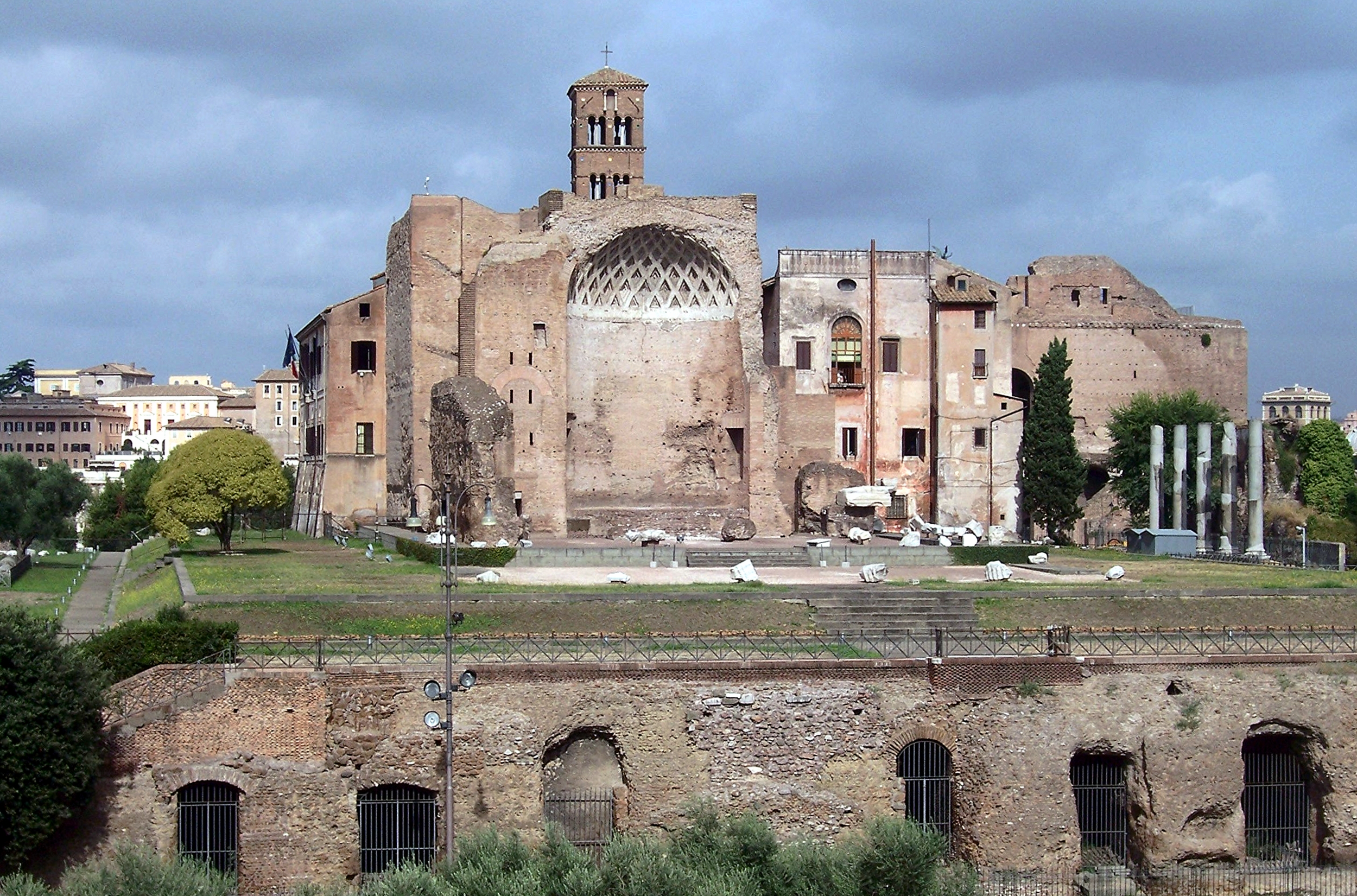
While the Pantheon used concrete to create a brand-new, inward-looking world, the Temple of Venus and Roma (begun around 121 CE) was Hadrian’s grand tribute to his deep love for classical Greek architecture. Situated on the Velian Hill overlooking the Colosseum, it was legally the largest temple in the ancient city of Rome.
The Hellenistic Footprint
Unlike traditional Roman temples, which were elevated on high stone podiums with a single frontal staircase (such as the Temple of Portunus), Hadrian designed this temple in the strict Greek Peripteral style.
The building sat on a low, multi-stepped platform (stylobate) that could be entered from any side, and it was entirely surrounded by a sweeping forest of Corinthian columns. It looked less like a traditional Roman civic building and more like an elevated Parthenon transplanted straight from Athens into the heart of the Roman Forum.
The Back-to-Back Cellae
The interior featured a highly unique, mirrored floor plan. It housed two distinct sacred chambers (cellae) placed completely back-to-back:
One chamber faced west toward the Forum Romanum, housing the statue of Dea Roma (the divine personification of the state).
The opposing chamber faced east toward the Colosseum, housing the statue of Venus Felix (the goddess of love and the ancestral matriarch of the Roman people).
Hadrian was playing a brilliant linguistic and architectural riddle with this dual layout. In Latin, the name of the goddess of love is AMOR. When spelled backward, it forms the name of the city: ROMA.
By placing the statues of Amor and Roma back-to-back in a shared temple, Hadrian visually anchored the cosmic harmony of the empire: Rome was sustained by the power of Love, and Love was protected by the power of Rome.
   [ TEMPLE ENTRANCE: FORUM ] ───► CELLA OF ROMA (The Imperial State)
                                          ▲
                                          │  (Placed Back-to-Back)
                                          ▼
   [ TEMPLE ENTRANCE: COLOSSEUM ] ──► CELLA OF AMOR (The Goddess Venus)
3. The Clash with Apollodorus: Architecture as Imperial Ego
Hadrian’s deep, hands-on obsession with architectural design eventually led to a legendary, fatal clash of egos. The premier architect of the era was Apollodorus of Damascus, the mastermind who had designed Trajan’s Forum, Trajan’s Column, and massive military bridges across the Danube.
According to the Roman historian Cassius Dio, when Hadrian proudly sent his self-designed architectural blueprints for the Temple of Venus and Roma to Apollodorus for a critique, the veteran architect was unimpressed. Apollodorus bluntly criticized the emperor's design, arguing that the statues of Venus and Roma were far too large for their low-ceilinged niches:
"They are drawn much too large for the height of the chambers. For if the goddesses should wish to stand up and leave their temple, they would be unable to do so, bumping their heads on the ceiling!"
Furthermore, Apollodorus argued that the temple should have been elevated higher on a traditional Roman podium to create a grander subterranean storage area for the stage machinery of the nearby Colosseum.
Hadrian, deeply stung by the critique and unable to tolerate insults to his artistic genius, reportedly had the legendary architect banished and eventually executed. Whether fact or historical gossip, the tale highlights just how seriously Hadrian viewed his identity as a master builder.
4. Summary of Hadrianic Architectural Strategy
Spatial Philosophy: * The Pantheon: Introspective and revolutionary; focuses entirely on the internal volume, using concrete to form a perfect, sky-lit sphere.
Temple of Venus & Roma: Extrospective and traditional; focuses on external symmetry and colonnades, bringing a Hellenistic Greek footprint to Rome.
Engineering Innovations:
The Pantheon: Graduated pumice concrete mixes, structural ceiling coffers, and a weight-locking oculus compression ring.
Temple of Venus & Roma: Mirrored back-to-back cellae structuring an architectural palindrome (ROMA/AMOR).
Political Propaganda:
The Pantheon: A temple to "all the gods," framing the emperor as the earthly pivot around which the entire cosmos rotates.
Temple of Venus & Roma: A monumental celebration of Rome’s divine ancestry and structural harmony, designed to bind Rome's elite to the artistic traditions of Greece.
Hadrian's architectural legacy demonstrates that he was a ruler who understood the profound power of stone, mortar, and space. Through the soaring, light-filled dome of the Pantheon, he proved that Roman concrete could liberate architecture from the limits of heavy interior walls, turning a temple into a microcosm of the universe. Through the sweeping, classical colonnades of the Temple of Venus and Roma, he knit the historical gravitas of Greece to the political destiny of Rome. By acting as both emperor and architect, Hadrian did not merely rule the Roman world—he permanently reshaped the physical horizon of its imagination.