Introduction
Located in southern Illinois near present-day Mill Creek, the Mill Creek Chert Mines formed one of the most important prehistoric quarry complexes in eastern North America. Beginning as early as 700 CE and reaching peak production during the Mississippian Period (1000–1400 CE), Indigenous miners extracted high-quality Mill Creek chert, a durable fine-grained stone prized for manufacturing hoes, axes, knives, spear points, scrapers, and other essential tools. The quarry became a major industrial center supplying stone implements to farming communities throughout the Mississippi Valley.
Mining Operations
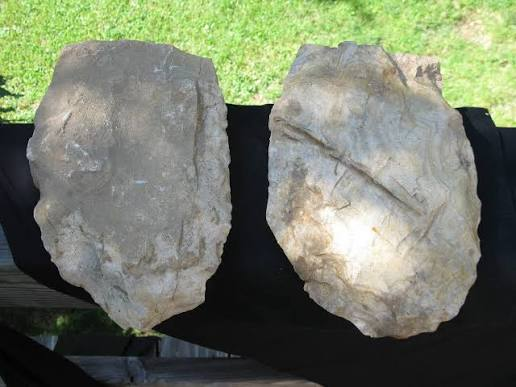
Miners identified exposed chert deposits within limestone bedrock and excavated shallow pits and trenches using stone hammers, antler picks, and wooden digging tools. Large chert nodules were removed, split into workable pieces, and roughly shaped near the quarry before transport.
Specialized craftsmen produced standardized blanks that could later be refined into finished agricultural tools and weapons. This efficient production system allowed large quantities of stone implements to be distributed across extensive trade networks.
Manufacturing and Trade
Mill Creek chert was especially valued for producing hoe blades, which were essential for cultivating large maize fields. Thousands of finished tools traveled hundreds of kilometers through Mississippian exchange networks, reaching communities across Illinois, Missouri, Kentucky, Tennessee, Arkansas, and beyond.
Archaeological evidence shows that Mill Creek chert became one of the most widely distributed stone materials in prehistoric eastern North America, reflecting the economic importance of specialized quarry industries.
Archaeological Importance
Excavations have uncovered quarry pits, manufacturing debris, hammerstones, unfinished tool blanks, and evidence of large-scale stone production. These discoveries reveal one of North America's earliest examples of specialized industrial resource extraction and regional distribution.
The quarry provides crucial evidence for understanding Mississippian technology, labor organization, agricultural expansion, and long-distance trade.
Conclusion
The Mill Creek Chert Mines represent one of the most significant prehistoric quarry and manufacturing complexes in North America. Their large-scale extraction of high-quality chert supplied countless Mississippian communities with essential agricultural and hunting tools, demonstrating the technological innovation, economic specialization, and extensive trade networks that characterized Indigenous civilizations of the Mississippi Valley.