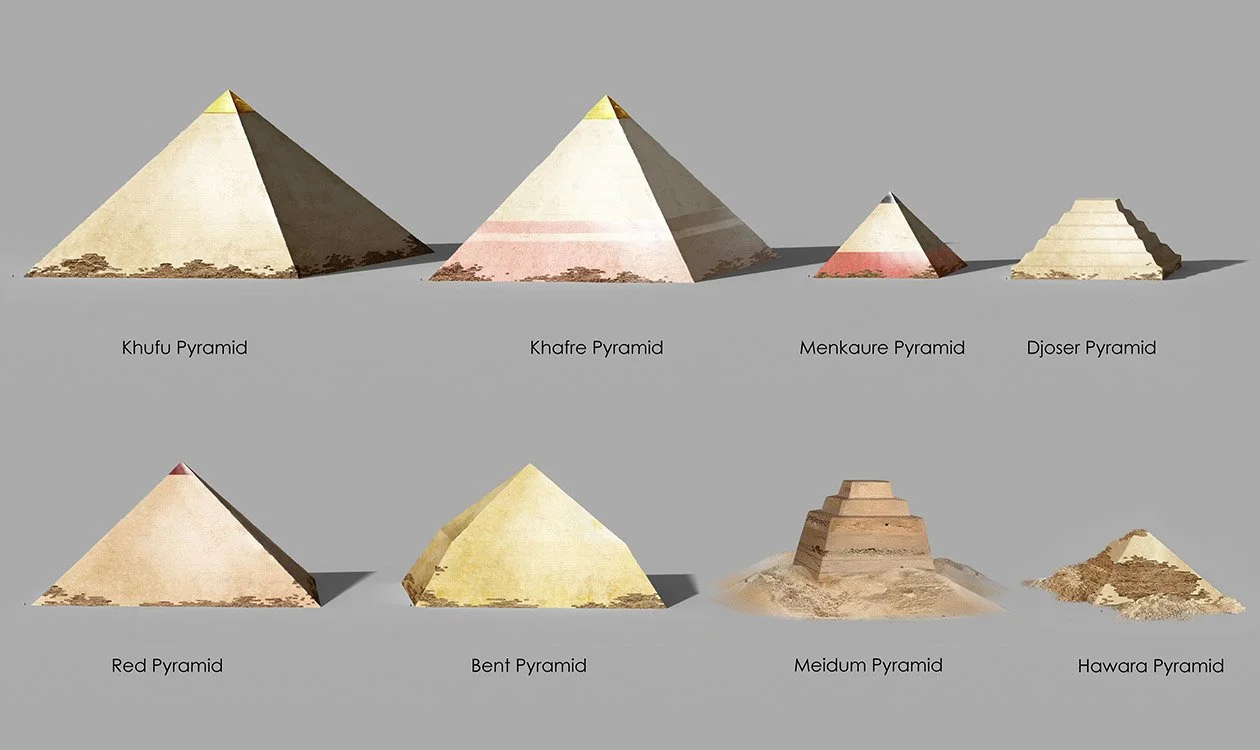
When we look at the gleaming, straight-sided Giza pyramids today, it’s easy to view them as sudden, isolated architectural miracles. But the iconic pyramid silhouette didn’t just appear overnight out of the desert sands. It was the climax of a grueling, multi-generational process of trial, error, and radical theological evolution.
For centuries, Egyptian kings weren't buried under towering mountains of stone. They were buried under flat, mud-brick mounds. The journey from those humble mounds to the world's first soaring stone monument—the Step Pyramid of Djoser—is a masterclass in ancient engineering and political centralisation.
1. The Starting Point: The Mud-Brick Mastaba
During the Early Dynastic Period (Dynasties 1 and 2), royal burials took place at sites like Abydos and Saqqara. The standard tomb architecture of this era was the Mastaba (an Arabic word meaning "bench").
A mastaba was a flat-roofed, rectangular structure with sloped mud-brick walls that sat directly over a deep, underground burial shaft.
Internally, the mastaba served a dual purpose:
The Subterranean Realm: Deep underground lay the actual burial chamber, housing the king's body, sarcophagus, and immediate treasures. Once the burial was complete, this shaft was packed solid with rubble to deter thieves.
The Above-Ground Realm: The mud-brick structure on the surface contained multiple storerooms packed with food offerings, furniture, and wine jars, along with a small offering chapel where priests could leave daily sustenance for the deceased king’s Ka (soul).
2. The Architectural Disruptor: Imhotep's Masterstroke
Around 2670 BCE, Pharaoh Djoser ascended the throne of the Third Dynasty. He wanted a monument that would vastly outshine his ancestors. To design it, he appointed a man named Imhotep—the royal chancellor, high priest of Heliopolis, and the world's first named architect.
Imhotep made two revolutionary decisions that permanently changed human history:
Material Shift: He abandoned perishable, sun-dried mud bricks and opted to build entirely out of quarried limestone. Stone had never been used on this monumental scale before.
Structural Stacking: He realized that if you built a standard mastaba out of stone, you could layer another smaller mastaba directly on top of it.
[ Traditional Mastaba ] ──► Expand Outward ──► Stack Tier 2 ──► Repeat Tiers 3-6 ──► The Step Pyramid
Imhotep didn't set out to build a pyramid on day one. Archaeological excavations reveal that the monument evolved through at least six distinct design phases. He started by building a large, square stone mastaba. He then expanded it horizontally, and finally decided to stack progressively smaller square tiers on top of one another.
3. The Step Pyramid: A Stairway to the Stars
The final result was the Step Pyramid of Djoser at Saqqara—a towering, six-tiered wedding-cake structure rising roughly 60 meters (200 feet) into the sky.
This shift from a flat bench to a soaring staircase was rooted in a profound theological evolution. In the early mastaba era, religion was heavily focused on the subterranean underworld. By the Third Dynasty, the king's afterlife became explicitly stellar and solar.
According to the later Pyramid Texts, the tiers of the step pyramid functioned as a literal cosmic launching pad:
"A stairway to heaven is built for him, that he may ascend on it to the sky."
By climbing these stone steps after death, the Pharaoh's soul could ascend to the northern sky to join the "Imperishable Stars"—the circumpolar stars that never set, guaranteeing the king eternal life at the center of the cosmos.
4. Architectural Comparison: The Evolutionary Leap
The transition from the mastaba to the step pyramid required a total overhaul of Egyptian society, economics, and logistics.
The transition from the Early Dynastic period to the Old Kingdom marked a seismic shift in how Egyptian pharaohs expressed their authority through stone, moving from localized burial mounds to massive, state-orchestrated architectural projects.
The Evolution of Royal Funerary Architecture
The Early Mastaba (Dynasties 1-2)
Primary Material: Sun-dried Nile mud brick and timber, which emphasized the organic, earthen nature of the burial.
Scale of Labor Force: Hundreds of local artisans and mud-molders, representing a smaller, community-based scale of construction.
Subterranean Depth: A single vertical shaft leading to a few chambers, keeping the royal remains relatively private and grounded.
Civic/Political Meaning: Functioned as a localized burial mound for elite tribal kings, emphasizing individual lineage rather than national infrastructure.
Djoser’s Step Pyramid (Dynasty 3)
Primary Material: Local and fine Tura limestone, a shift to permanent, prestigious stone that signaled a new level of architectural permanence.
Scale of Labor Force: Thousands of organized, state-conscripted seasonal workers, marking the birth of the bureaucratic state machine.
Subterranean Depth: A massive 5.7-kilometer labyrinth of tunnels, galleries, and 400 rooms, creating an elaborate underground city for the king's afterlife.
Civic/Political Meaning: A centralized projection of absolute state power and national unity, serving as a monument to the pharaoh's role as the divine anchor of the Egyptian nation.
By successfully marshaling the immense resources, quarrying techniques, and labor forces needed to build the Step Pyramid, Imhotep and Djoser laid the exact institutional and engineering foundations that would allow later Fourth Dynasty pharaohs like Sneferu and Khufu to smooth out the steps entirely and erect the true, straight-sided Great Pyramids at Giza.