When Mount Vesuvius erupted in 79 CE, it didn't just bury cities; it accidentally created a time capsule for a lost world of ancient philosophy.
While the intense volcanic ash and debris destroyed the grand public libraries of nearby Pompeii, the seaside town of Herculaneum met a different fate. It was submerged under a fast-moving, boiling wave of pyrolastic material.
Deep within a sprawling, ultra-luxury estate known today as the Villa of the Papyri, this superheated volcanic mud baked a private library of over 1,800 papyrus scrolls. It effectively carbonized them into fragile chunks of charcoal—preserving the only intact library ever recovered from classical antiquity.
1. The Anatomy of an Elite Think Tank
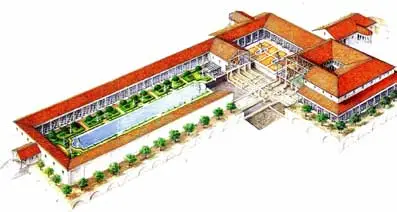
The Villa of the Papyri was an architectural masterpiece stretching along the Mediterranean coastline. Historians strongly believe the estate belonged to Lucius Calpurnius Piso Caesoninus—a wealthy Roman politician, consul, and the father-in-law of Julius Caesar.
Piso wasn't just a politician; he was a massive patron of the arts and philosophy. He gave a permanent residence at the villa to Philodemus of Gadara, a brilliant philosopher and poet who studied under the masters of the Epicurean school in Athens.
Philodemus brought his vast working library with him, setting up an ancient think tank. Unlike typical Roman libraries that balanced Greek and Latin literature equally, this specific collection was overwhelmingly focused on Epicurean philosophy, written in Greek text.
2. The Epicurean Counter-Culture
To understand why this library was so heavily protected and valued by its owners, you have to understand the philosophy it housed. Epicureanism was often viewed with deep suspicion by traditional, conservative Roman elites.
 [ STOICISM (Roman State Default) ]              [ EPICUREANISM (The Villa's Sanctuary) ]
 Duty to the State, Politics, Destiny   vs.      Tranquility (Ataraxia), Friendship, Science
Epicureans believed that the universe was entirely material, composed of microscopic atoms moving through empty space. They taught that the gods existed but had absolutely no interest in human affairs, meaning there was no divine judgment, no afterlife, and no cosmic fate.
The ultimate goal of human life was Ataraxia (unshakable peace of mind) and the elimination of mental anxiety. Philodemus's library contained extensive, previously lost treatises on music, poetry, rhetoric, and death, all aiming to teach humans how to live a life free from the paralyzing fear of the gods and supernatural intervention.
3. The Discovery and the Tragic Early "Unrolling"
In 1752, well-diggers tunneling through the deeply buried ruins of Herculaneum broke through a series of small rooms. They found walls lined with built-in wooden cabinets (armaria) packed with what looked like blackened, charred sticks of firewood or rolls of briquettes.
Many were cast aside or burned for heat before someone noticed the faint outline of Greek letters stamped on the inside layers.
The discovery sparked an immediate crisis: how do you open a scroll that has turned into solid charcoal?
Early attempts were catastrophic. Scholars used knives to slice the rolls in half, or tried using chemical mixtures to soften the layers, which instantly dissolved the ancient ink.
A monk named Camillo Paderni went so far as to peel away the outer layers of text to read them, scraping off and destroying the outer skin of the scrolls just to read a few interior sentences. A more successful mechanical method was designed by Father Antonio Piaggio, who built a delicate frame that used silk threads to slowly peel open scrolls at a painful rate of just a few inches per month. Still, many fractured into thousands of disconnected fragments.
4. 2020s Breakthrough: The Vesuvius Challenge
For over 250 years, hundreds of scrolls remained completely unopenable—too fragile to even touch without turning to black dust. But recently, the field of archaeology witnessed a monumental shift.
Through a global initiative called the Vesuvius Challenge, researchers turned away from trying to physically unravel the carbonized rolls. Instead, they utilized high-resolution X-ray computed tomography (CT scanning) to map the internal layers of the intact scrolls in three dimensions.
The Ink Problem: The major technical hurdle was that the ancient Romans used an ink made of carbon soot and water. Because the papyrus itself was turned into carbon by the volcano, standard X-rays couldn't distinguish between the black ink and the blackened paper.
To solve this, computer scientists trained advanced Machine Learning algorithms to detect the microscopic change in texture left by the ink—essentially teaching the AI to spot the subtle raised patterns where wet ink had dried on the papyrus surface.
In early 2024, the challenge was won when a team of young computer scientists successfully read multiple continuous passages of a completely rolled-up scroll. The revealed text? A completely unknown work by Philodemus himself, musing on the pleasures of life, food, music, and how to enjoy a good meal without ruinous excess. The library of Philodemus is finally speaking again, offering us a direct, unedited portal straight into the intellectual heart of the Roman elite.