When we picture the Viking Age, we usually imagine lightning raids on isolated monasteries or dragon-headed longships braving the open Atlantic. Yet, the true engine of the Viking expansion wasn’t just conquest—it was commerce.
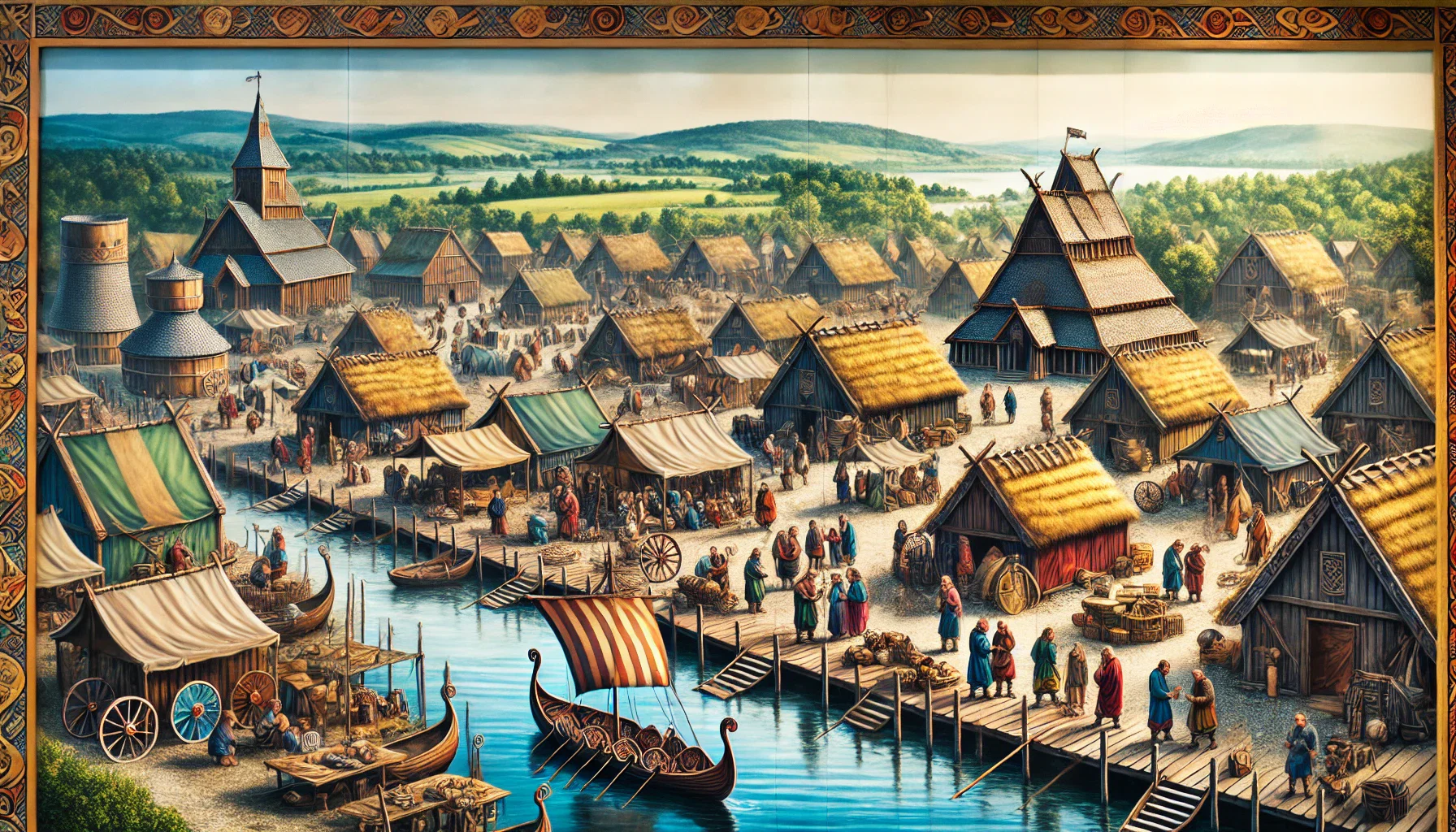
Nowhere was this more evident than in Hedeby (Old Norse: Heiðabýr). Situated at the narrow neck of the Jutland Peninsula in modern-day Schleswig-Holstein, Germany, this bustling, mud-soaked settlement grew into the largest Scandinavian trading metropolis of the early Middle Ages.
Hedeby’s success rested on a single, brilliant geographical loophole: it allowed merchants to cross between two seas without ever having to sail around them.
1. The Geographic Loophole
During the 8th through 11th centuries, sailing a merchant vessel around the northern tip of Denmark through the Skagerrak straight was a terrifying prospect. The waters were notoriously treacherous, riddled with shifting sandbars, unpredictable storms, and heavily armed pirates.
Hedeby offered an ingenious overland shortcut.
[ BALTIC SEA ] ──► Schlei Fjord ──► HEDEBY ──► 11-Mile Portage ──► Treene/Eider Rivers ──► [ NORTH SEA ]
A merchant coming from the Baltic Sea could sail deep inland along the sheltered, 25-mile-long Schlei Fjord right up to Hedeby’s docks. From there, goods were unloaded and transported just 11 miles overland via carts or physical portage (dragging the ships across log rollers) to the Treene River. The Treene connected directly to the Eider River, which emptied straight out into the North Sea.
This narrow land bridge transformed Hedeby into the ultimate choke point and customs gateway connecting Western Europe, Scandinavia, the Baltic states, and the lucrative trade networks of the Islamic Caliphates.
2. A Multicultural Melting Pot
Because Hedeby sat at the volatile intersection of the Danish Viking Kingdom, the Slavic tribes to the east, and the expanding Carolingian (Frankish) Empire to the south, it became a radically diverse urban experiment.
At its peak in the 10th century, roughly 1,500 to 2,000 permanent residents packed into its dense grid of timber-framed houses. This was an immense population for contemporary Scandinavia.
An Arabic diplomat and traveler from Moorish Spain named Al-Turtushi visited Hedeby around 965 CE, leaving behind a vivid, if somewhat horrified, account of its bustling culture:
"Hedeby is a very large city at the absolute edge of the world ocean... The inhabitants worship Sirius, except for a small number of Christians who have their own church. They celebrate a feast where everyone comes to eat and drink. Anyone who slaughters an animal hangs it on poles outside his door so people know he made a sacrifice."
Al-Turtushi also dryly noted that he had never heard "singing more horrible than the howling of these people, which sounds like dogs barking, only more beastly."
3. Industrial-Scale Craftsmanship
Archaeological excavations at Hedeby have revealed that it wasn’t just a market square; it was a massive, smoke-choked industrial manufacturing hub. The waterlogged soil of the site preserved an incredible array of organic materials, allowing researchers to piece together exactly what was being fabricated along its wooden boardwalks.
Craft DistrictRaw Materials UsedFinished Products ExportedThe FoundryRhineland basalt, local bog iron, imported silver.Custom Viking swords, axes, scales, and weights.The GlassworksImported Roman and Frankish scrap glass, beads.Intricate, colorful glass beads highly prized by Viking elites.The Comb-MakersRed deer antlers, whale bone, walrus ivory.Precision-carved hair combs (cleanliness was highly valued in Norse culture).The Textile QuartersLocal wool, imported Byzantine silks.Heavy cloaks, sails, and dyed luxury garments.
Hedeby also housed its own royal mint. Starting around 825 CE, local authorities struck coins mimicking the silver pennies of Charlemagne’s empire, but stamped them with distinct Nordic symbols like longships, deer, and protective masks.
4. The Semicircular Wall and the Violent End
Being the richest trade hub in the North made Hedeby a massive, permanent target. To protect this immense concentration of wealth, the Danish kings integrated Hedeby into the Danewerk—a sprawling, multi-mile system of defensive earthen ramparts protecting their southern border.
During the 10th century, the town was enclosed within a colossal semicircular earthwork wall standing nearly 30 feet high, topped by a wooden palisade. Wooden jetties stretching into the harbor were reinforced with underwater palisades of driven stakes to prevent enemy longships from launching surprise amphibious assaults.
Despite these monumental defenses, Hedeby’s wealth ultimately sealed its doom. The settlement was repeatedly battered by shifting political alliances:
974 CE: Emperor Otto II of the Holy Roman Empire successfully stormed the Danewerk and briefly occupied the trade center.
1050 CE: The Norwegian King Harald Hardrada (The Ruthless) attacked Hedeby during a bitter civil war. He sent fire-ships drifting into the crowded harbor, setting the entire timber city ablaze.
1066 CE: Just sixteen years after Hardrada's raid, a West Slavic army swept through and pillaged what remained.
The survivors abandoned the blackened ruins of Hedeby entirely. They moved across the Schlei Fjord to found the city of Schleswig, leaving the old Viking market to be swallowed up by the rising waters and silt—perfectly preserving its rich archaeological treasures for centuries to come.