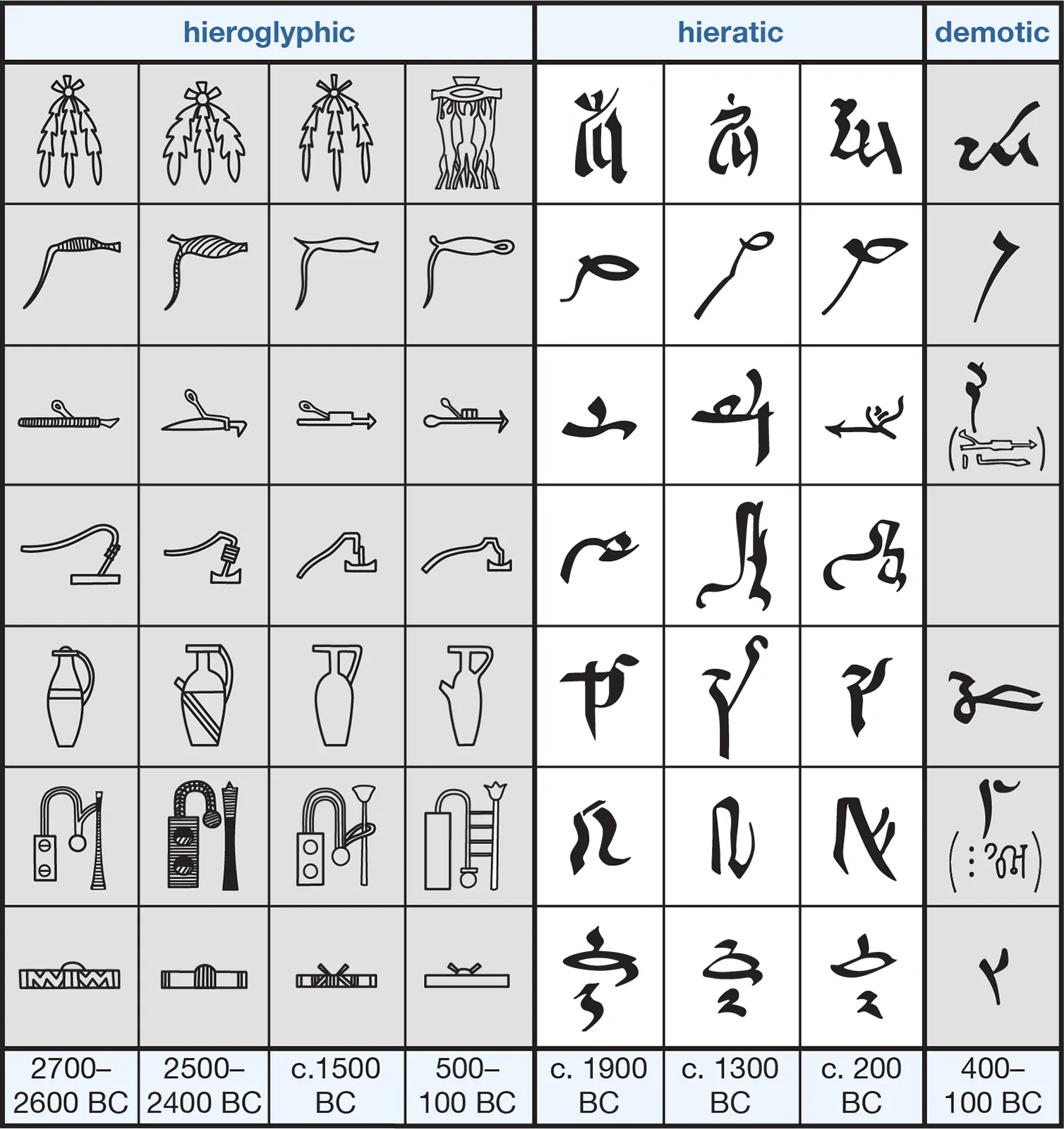
Ancient Egyptian writing was not a single, static system, but a sophisticated, multi-layered tool that evolved over 3,000 years to meet the needs of a bureaucracy, a priesthood, and a complex literary tradition. The Egyptian language utilized three primary scripts, each serving a distinct purpose.
I. The "Sacred Carvings": Hieroglyphs
Hieroglyphs (medu netjer—"words of the gods") were the formal, monumental script of ancient Egypt.
Function: Reserved for the most permanent and sacred purposes, such as temple walls, tombs, and royal monuments. Hieroglyphs were meant to last for eternity; their very form was believed to have magical power, allowing the names and deeds depicted to exist forever.
Structure: It is a complex system combining logograms (symbols representing entire words), phonograms (symbols representing sounds), and determinatives (silent symbols added to clarify the meaning of a word).
The Aesthetic: Because they were often carved into stone or painted with extreme precision, hieroglyphs were rarely used for everyday administrative records. They were an art form as much as a writing system, designed to be visually harmonious and aesthetically balanced.
II. The "Priestly" Script: Hieratic
As the Egyptian state expanded, the need for a faster, more practical writing method became apparent. Hieratic (from the Greek hieratikos, meaning "priestly") was the cursive, simplified version of the hieroglyphic script.
Function: Used primarily for administrative documents, legal texts, letters, and religious manuscripts on papyrus. It was the standard script for scribes working in the palaces and temples.
Technique: Scribes wrote hieratic using a reed brush and black ink. Because it was handwritten, the detailed shapes of hieroglyphs were reduced to streamlined, flowing lines.
Continuity: Hieratic and hieroglyphs functioned side-by-side. Even at the height of the New Kingdom, a scribe would use hieratic for a ledger or a contract but switch to formal hieroglyphs if that same text needed to be inscribed on the walls of a tomb.
III. The "Popular" Script: Demotic
Emerging in the 7th century BCE (during the Late Period), Demotic (sekh shat—"document writing") was the most abbreviated and cursive form of Egyptian script.
Function: By this time, the Egyptian language had evolved significantly, and the script was simplified further to facilitate its use in law, commerce, and daily correspondence. It became the dominant script for the general public, hence the Greek name demotikos ("of the people").
Stylistic Evolution: Demotic is often difficult for modern scholars to read because it is so highly stylized and abbreviated; individual signs were often linked together, making it look almost like shorthand.
The Rosetta Stone: Demotic played a crucial, and often overlooked, role in the decipherment of Egyptian writing. The Rosetta Stone contains the same decree in three scripts: Hieroglyphic (for the priests), Demotic (for the local administration), and Ancient Greek (for the ruling Ptolemaic elite). Because scholars could read Ancient Greek, they were able to use the Demotic and Hieroglyphic versions to "unlock" the meaning of the ancient signs.