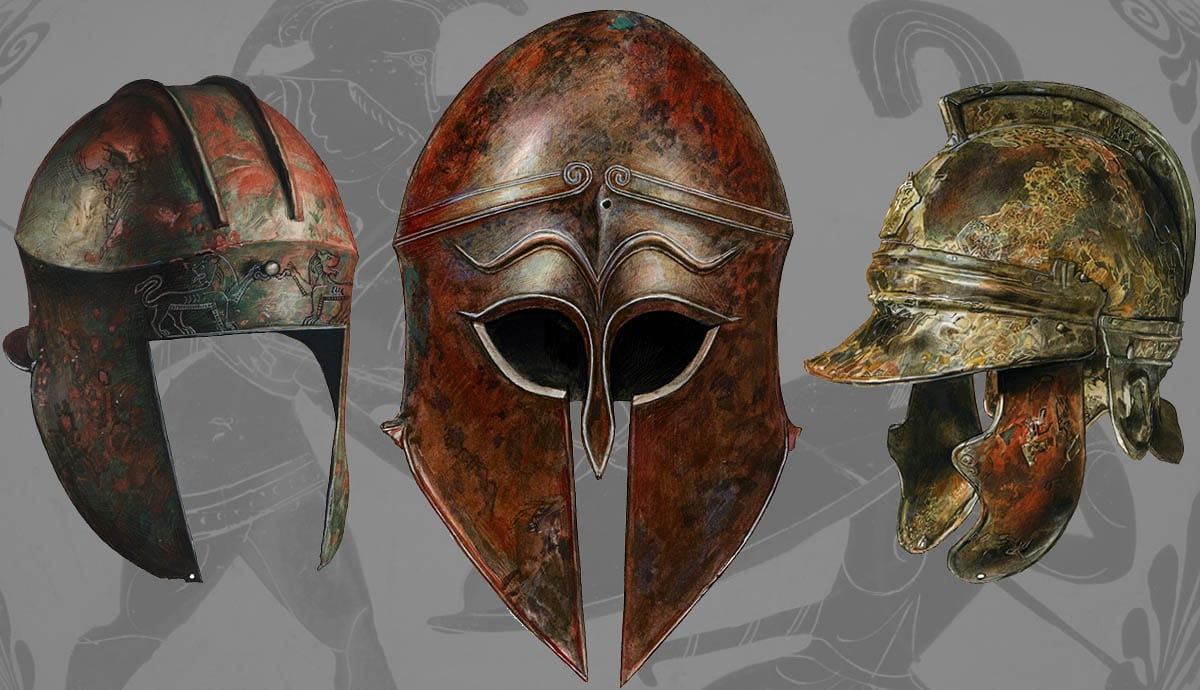
When we envision an ancient Greek warrior, the image that almost instantly comes to mind is a gleaming bronze helmet with a high horsehair crest, slitted eyeholes, and a long nose guard. This iconic silhouette has become a global shorthand for classical martial power.
However, Greek armor was never static. The design of the helmet underwent a dramatic, centuries-long evolutionary shift. It moved away from maximum physical protection toward a greater emphasis on sensory awareness, visibility, and tactical utility on the changing battlefield.
1. The Corinthian Style: The Heavy Iron Curtain (c. 8th – 5th Century BCE)
Emerging in the Archaic period, the Corinthian helmet is the undisputed icon of the Greek hoplite (heavy infantryman).
Smiths hammered each helmet from a single sheet of bronze—an extraordinary feat of metallurgy. It was designed to function like a protective shell for the entire skull:
The Pros: It offered unmatched physical defense. With long cheekpieces and a robust nose guard, it left virtually no part of the face exposed to incoming spears, arrows, or sword slashes.
The Cons: It operated like a sensory deprivation chamber. The small eye slits severely restricted peripheral vision, and the lack of ear holes made hearing commands almost impossible. It was also notoriously hot and suffocating.
When not actively engaged in hand-to-hand combat, hoplites routinely tipped the Corinthian helmet backward to rest on the crown of their heads, exposing their faces so they could breathe and speak—a posture frequently captured in classical Greek art and pottery.
2. The Chalcidian and Phrygian Adaptations: The Middle Ground (c. 5th – 4th Century BCE)
As the nature of Greek warfare shifted toward more complex, coordinated phalanx maneuvers during the Persian and Peloponnesian Wars, the crippling sensory limitations of the Corinthian style became a major tactical liability. Armorers responded by introducing more open designs.
The Chalcidian helmet modified the traditional form by cutting away substantial portions of bronze around the ears and eyes.
Many Chalcidian variations featured hinged cheekpieces that could be flipped up out of the way when the soldier was off-duty. Concurrently, the Phrygian (or Thracian) helmet grew in popularity, recognizable by its tall, forward-curving apex that mimicked the traditional fabric caps of the northern tribes. These styles kept the face relatively open, offering an elegant compromise between visibility and facial protection.
3. The Boeotian Style: The Cavalryman's Visor (c. 4th Century BCE)
By the time Philip II of Macedon and his son Alexander the Great revolutionized ancient warfare in the 4th century BCE, heavy infantry phalanxes were no longer fighting in isolation. Shock cavalry had become a decisive factor on the battlefield.
Cavalrymen required a completely different kind of protection. A horseman traveling at high speeds needed wide, unrestricted peripheral vision to spot flanking maneuvers and open ears to hear shifting acoustic signals across massive battle lines.
The answer was the Boeotian helmet.
Modelled originally after a folded felt Boeotian sun hat (petasos), this design completely abandoned face masks, nose guards, and closed cheekpieces:
The Flared Brim: The wide, undulating brim sloped downward to shield the neck, brow, and upper face from descending sword slashes—the most common threat faced by a mounted rider.
Unimpeded Senses: The face was entirely exposed, granting the wearer a full 180-degree field of view and crystal-clear hearing.
The ancient soldier and historian Xenophon explicitly recommended this style in his treatise On Horsemanship:
"The Boeotian helmet is generally approved of for cavalry, because it protects all the parts above the shoulders, and at the same time allows free sight."
Alexander the Great famously equipped his elite Companion Cavalry (Hetairoi) with Boeotian helmets, and they wore them as they swept across Asia to dismantle the Persian Empire.
The Evolutionary Arc at a Glance
The transition across these designs highlights a fundamental military realization: physical invulnerability is useless if you cannot see or hear the changing tactical landscape around you.