When we think of the Late Bronze Age in Greece (roughly 1600–1100 BCE), we tend to picture the epic world of Homer's Iliad: golden masks, towering citadel walls, and heroic warriors dueling on chariots.
But when archaeologists dug up the actual written documents of the Mycenaean civilization at sites like Pylos, Knossos, Mycenae, and Thebes, they didn't find poetry, law codes, or historical chronicles. They found accounting spreadsheets.
These documents are the Linear B tablets. They reveal that beneath the legendary veneer of heroic kings lay a highly bureaucratic, hyper-centralized, and meticulously managed "command economy."
1. The Accidental Archives
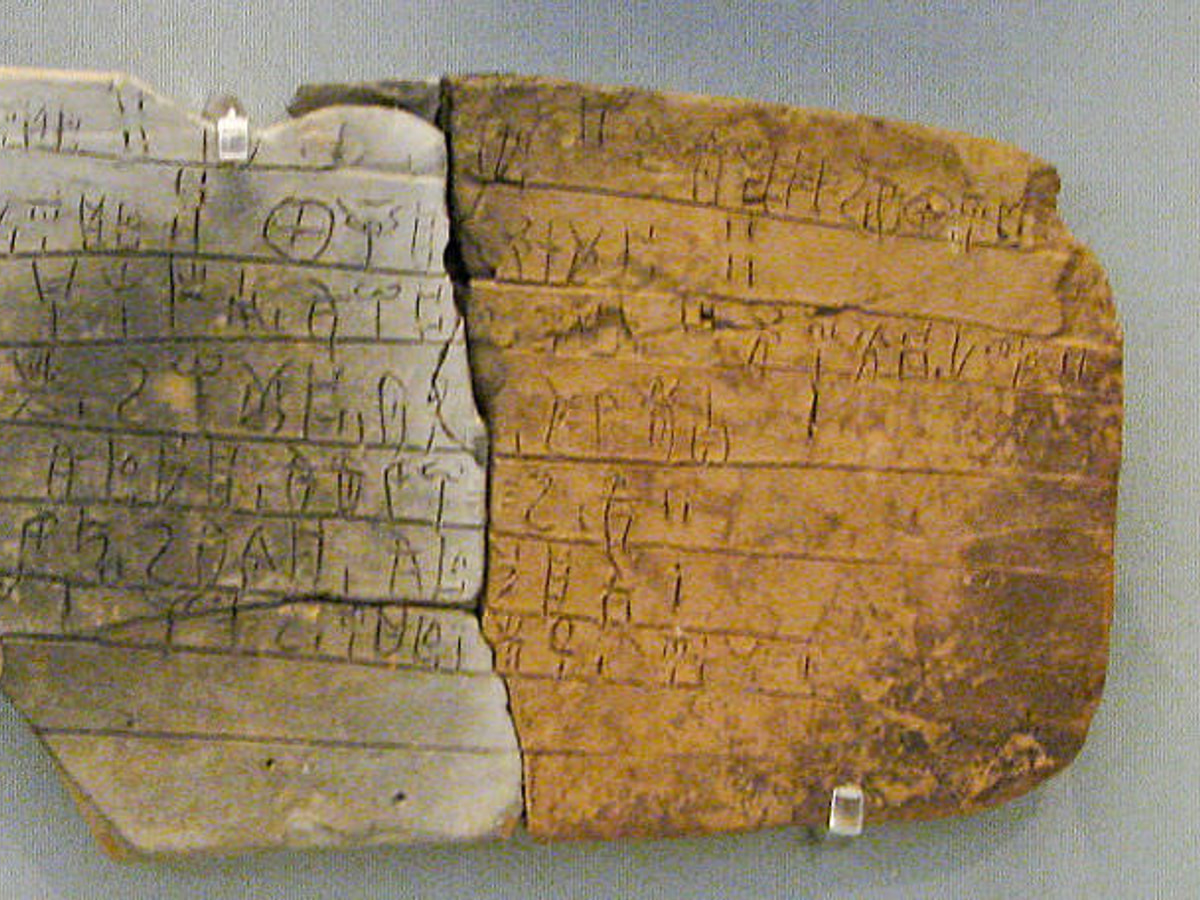
Linear B is the oldest surviving script used to write the Greek language. It is a syllabic script—meaning each symbol represents a syllable (like da, me, zo) rather than a single letter—interspersed with ideograms (pictorial symbols representing objects like "man," "chariot," "wheat," or "wine").
What makes the survival of these tablets fascinating is that they were never meant to be preserved.
 [ SCRIBES SCRACH NOTES ] ──► Temporary sun-dried clay ──► Intended discard (within a year)
 [ PALACE DESTROYED ]     ──► Conflagration / Intense Fire ──► Accidentally baked hard ──► PERMANENT RECORD
Mycenaean scribes used cheap, unbaked clay tablets to record temporary, short-term data—vouchers, tax assessments, and inventories for the current fiscal year. At the end of the year, these tablets were intended to be smashed and recycled back into wet clay.
However, around 1200–1100 BCE, the cataclysmic "Bronze Age Collapse" swept across the Mediterranean. The great Mycenaean palaces were violently burned by attackers or internal rebellions. The roaring fires destroyed the civilizations, but the intense heat acted as a kiln, accidentally baking the temporary clay inventory sheets into hard, permanent ceramic. What we read today are the literal receipts from the final weeks and days before the palaces fell.
2. Anatomy of a Tablet: The Visual Ledger
The scribes utilized a highly organized layout. A typical text, like the "palm-leaf" style or page-style tablet, features clear horizontal lines separating entries, beginning with a keyword, followed by a list of names or places, and ending with an unmistakable ideogram alongside numerical tallies.
The numerical system was beautifully simple and base-10:
Vertical strokes ( | ) counted single units (1 to 9).
Horizontal dashes ( — ) or dots stood for tens.
Circles ( ○ ) stood for hundreds.
Circles with spikes stood for thousands.
3. The Palatial Command Economy
The tablets paint a picture of a Palace Economy. The king, known as the Wanax, sat at the apex of a massive administrative pyramid. The palace acted as a giant vacuum: it assessed taxes on surrounding villages, collected agricultural surpluses, redistributed rations to specialized workforces, and monopolized luxury manufacturing.
The level of granular control recorded by the palace scribes is astonishing:
A. The Wool and Textile Industry
The palace at Knossos on Crete was a textile superpower. Tablets record the management of up to 100,000 sheep across the island. Scribes recorded the precise shearing targets for individual flocks, noted down deficits when a shepherd missed his quota, and tracked groups of dependent women workers—often identified as foreign captives or slaves—who spun and wove the wool into specialized, heavily dyed fabrics.
B. Military Industrial Logistics
The tablets destroy the myth of the independent Homeric hero. Chariots and weapons were not personal heirlooms; they were state property issued by palace bureaucrats. Scribes tracked:
The delivery of raw bronze to blacksmiths (ka-ke-we).
The exact number of chariot wheels in storage, categorized by whether they were "serviceable," "damaged," or made of elm or willow.
The distribution of bronze armor plates to specific coastguard units watching the seas.
C. The Perfumed Oil Trade
One of the main cash crops of the Mycenaean elite was scented olive oil, exported across the Mediterranean. Tablets detail the exact ingredients allocated to royal perfumers (a-re-pa-zo-o), including coriander, sage, cyperus, and honey used as fixatives.
4. Deciphering the Social Pyramid
When British architect Michael Ventris miraculously cracked the code of Linear B in 1952—proving against all prevailing academic consensus that the language was an archaic dialect of Greek—he unlocked the official titles of Bronze Age society.
5. The Last Receipts: Signs of a Looming Crisis?
Because the tablets date to the absolute final moments of these palaces, historians have scanned them for signs of panic or economic collapse.
On the famous Ta tablets from the Palace of Pylos, scribes recorded an incredibly lavish inventory of ornate furniture inlaid with ivory, gold, and ebony, along with sacrificial vessels. This inventory was drawn up on a very specific occasion: "When the King appointed Augetas to the office of Governor." It captures a state trying to maintain a veneer of absolute, opulent normality.
However, other tablets from Pylos hint at a dark, creeping emergency:
The An series tracks the mobilization of over 600 men assigned to "watch the coastal sectors," detailing exactly where soldiers were deployed along the shores.
The Jn series records the palace desperately requisitioning bronze from temples—including bronze strips from holy sanctuaries—likely to melt down into spearheads and arrows.
Shortly after these scribes checked off their lists, the palaces were burned to the ground. The centralized bureaucratic system vanished completely. Greece plunged into a "Dark Age," forgetting how to write entirely until they adopted the Phoenician alphabet centuries later. The Linear B tablets remain a unique, frozen window into a highly organized, bronze-driven world that vanished overnight.