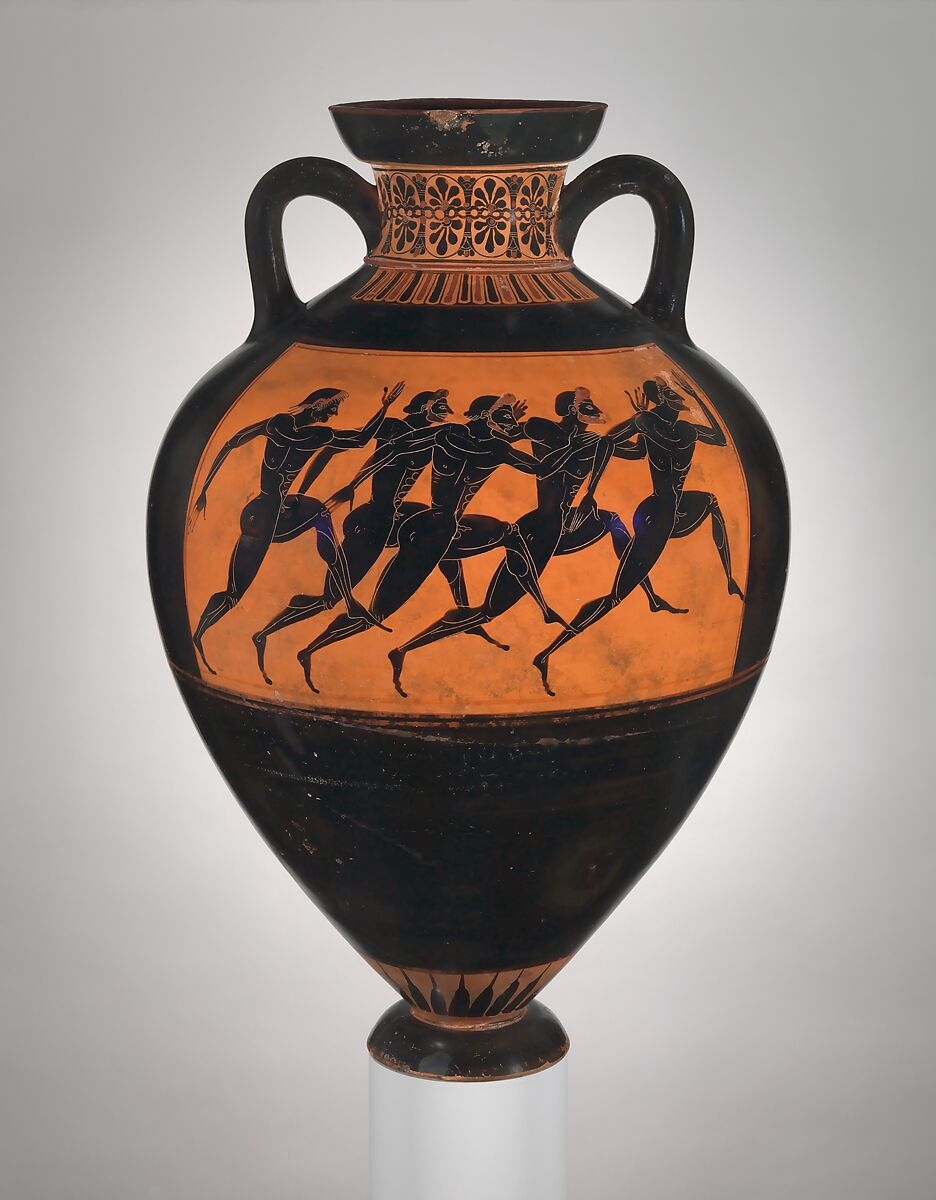
Every four years, the ancient Athenians held the Great Panathenaea—a massive, empire-wide festival of religious processions, athletic events, and cultural competitions designed to honor the city’s patron goddess, Athena.
While the ancient Olympic Games awarded their victors a simple crown of olive leaves, Athens took a wildly different approach. They rewarded their champions with immense material wealth wrapped in high art. The ultimate prize was the Panathenaic Amphora: a massive, beautifully decorated ceramic vessel filled with luxury oil.
Winning a handful of these vases wasn't just a matter of athletic pride; it was the ancient equivalent of winning a multi-million-dollar lottery.
1. Anatomy of an Imperial Trophy
A Panathenaic prize amphora was built to an exacting, monumental standard. Standing roughly 2 feet to 2.5 feet tall, these heavy clay vessels featured a distinct silhouette: a narrow neck, a swelling ovoid body that tapered down sharply to a small base, and two sturdy handles.
By strict religious decree, these jars were always painted using the traditional black-figure technique, even centuries after the more advanced red-figure style became the mainstream fashion. This deliberate archaism gave the trophies a timeless, sacred prestige.
Every official prize vase featured a rigorous, two-sided decorative template:
The Front: Divine Authority
The obverse side always depicted Athena Promachos ("Athena who fights on the front lines"). She is shown stride-forward, clad in a towering helmet and her snake-fringed aegis cloak. In one hand, she brandishes a raised spear; in the other, a large shield.
Flanking the goddess were two slender columns topped by roosters (symbols of competitive spirit). Most importantly, written vertically alongside the left column was the official state inscription certifying its authenticity:
$$\text{ΤΩΝ ΑΘΗΝΗΘΕΝ ΑΘΛΩΝ} \quad (\text{"[I am one] of the prizes from Athens"})$$
The Back: The Event
The reverse side functioned as the custom event receipt. It explicitly illustrated the specific athletic or equestrian discipline that the victor had mastered—whether it was the stadion sprint (as seen above), wrestling, chariot racing, or the brutal, no-holds-barred combat sport known as pankration.
2. The Real Prize: Liquid Gold
While the ceramic craftsmanship was beautiful, the real fortune lay inside the vessel. Each amphora was packed with roughly 38 liters (around 10 gallons) of premium, top-tier olive oil.
This wasn’t standard cooking oil. The prize oil was harvested exclusively from the Moriai—the sacred, state-protected olive groves of Athena scattered across Attica. Cutting down one of these trees was a crime punishable by death or permanent exile.
To understand the immense financial scope of these prizes, we can look at surviving historical inscriptions detailing the payouts for different events:
In the competitive landscape of the Ancient Greek games, prize allocation was carefully calibrated to reflect both the physical difficulty of the event and the socio-economic status of the competitors. The value of these rewards, often measured in high-quality olive oil stored in Panathenaic amphoras, functioned as a substantial economic injection for the winner.
The Economic Tiers of Victory
Stadion (Short Footrace)
Category: Boys
Prize: 30 Amphoras
Economic Weight: In contemporary terms, this haul would be roughly equivalent to the value of a comfortable, well-built house, providing a significant head start for a young athlete just beginning his career.
Pankration (All-Out Combat)
Category: Men
Prize: 40 Amphoras
Economic Weight: Requiring grueling physical endurance and high personal risk, this victory was worth approximately two years of a highly skilled laborer's total wages, marking the athlete as a wealthy figure in his home city-state.
Chariot Race (The Elite Event)
Category: Men
Prize: 140 Amphoras
Economic Weight: Because this event required the owner to breed, train, and maintain a team of horses—an enterprise reserved for the wealthiest aristocrats—the prize was an absolute dynastic fortune, intended to cement the prestige of a family's legacy for generations.
A premier athlete who dominated the track could easily walk away with 60 to 100 amphoras. This massive cargo required a merchant ship just to transport it back to their home city-state.
3. The Ancient Secondary Market
What did an athlete do with thousands of gallons of sacred oil? They capitalized on it immediately.
Because olive oil was the lifeblood of the Mediterranean economy—used for cooking, lighting, cleansing at the gym (palaestra), and base ingredients for perfumes—it was a highly liquid currency. Victors regularly sold the oil directly to international merchants right at the Athenian docks.
[ Athlete Wins Race ] ──► Olive Oil Sold to Traders ──► Shipped to Italy/Black Sea ──► Pots Kept as Luxury Decor
The empty, beautiful prize jars became elite status symbols scattered across the ancient world. They have been unearthed by archaeologists in wealthy Etruscan tombs in Italy, remote military outposts along the Black Sea, and aristocratic villas in North Africa. Owning a genuine Panathenaic amphora in Spain or Crimea was the ultimate way to signal your deep connection to Hellenic high culture.
4. The Bureaucracy of the Games: State-Run Operations
Producing these trophies was a massive logistical undertaking managed by the Athenian state. Every four years, the city appointed ten citizens known as Athlothetai to oversee the festival's finances and infrastructure.
One of their main jobs was commissioning local potters and master painters to produce anywhere from 1,500 to 2,000 amphoras for a single iteration of the Great Panathenaea. This massive state contract kept the pottery quarter of Athens (the Kerameikos) buzzing with industrial-scale production for months.
Through these vases, Athens brilliantly fused religious devotion, economic power, and athletic celebrity. The Panathenaic amphora didn’t just celebrate human physical perfection; it served as a highly effective vessel for projecting Athenian cultural supremacy into every corner of the Mediterranean basin.